

Target 245–250°F to Make Soft English Toffee at Home
Yes, you can make English toffee soft: cook it to the soft-crack stage, roughly 245°F to 250°F, rather than pushing to hard-crack. A slightly higher butter ratio, careful cooling, and a reliable candy thermometer are what separate a chewy, melt-in-your-mouth batch from one that shatters like glass. Pull it a few degrees early, and you’re rewarded with the texture Dudley’s Toffee has built its whole reputation on.
TL;DR:
- Achieving soft toffee requires cooking to the soft-crack stage at 245°F to 250°F, with careful temperature monitoring and moisture control.
- Using a higher butter ratio, adding cream or corn syrup, and managing humidity during cooling help create and preserve the chewiness.
- Overcooking beyond 250°F risks producing brittle, hard-crack toffee, while undercooking results in sticky or unset candy.
- Proper storage in dry, airtight conditions is essential to prevent soft toffee from becoming sticky or rancid from moisture absorption.
- Small-batch, handcrafted production allows tighter control over texture consistency, which large-scale manufacturing may fail to replicate.
Table of Contents
- Why Temperature and Ingredients Decide Soft vs. Hard Toffee
- How Do You Make Soft English Toffee at Home?
- What Causes Toffee to Turn Out Wrong (And How to Fix It)
- What Equipment and Ingredients Do You Actually Need?
- Why Dudley’s Toffee Trusts Small Batches for Soft Texture
- The Conventional Wisdom on Toffee Gets Texture Backward
- Prefer to Skip the Stovetop? Shop Soft Toffee Instead
- Sources
- FAQ
Why Temperature and Ingredients Decide Soft vs. Hard Toffee
The difference between soft and hard toffee comes down to one number on a thermometer and how much water that number leaves behind. Traditional English toffee is cooked to the hard-crack stage, around 300°F to 310°F, which drives out nearly all the moisture and locks the sugar into a brittle, glass-like structure. Soft toffee stops well short of that, landing in the soft-crack range instead, which keeps just enough water trapped in the sugar matrix to stay pliable.
That retained moisture is why soft toffee needs more careful handling. Research on sugar confections and shelf life shows that water activity, not just sugar content, governs whether a candy stays chewy or turns sticky and unstable over time. A few other factors push texture one way or the other:
- Butter ratio. More butter relative to sugar softens the final bite and adds richness.
- Cream or light corn syrup. A small addition helps create a chewier, softer texture compared to a straight hard-crack recipe.
- Humidity during cooling. Damp kitchen air pulls moisture back into the surface, which can make correctly cooked toffee feel tackier than intended.
- Chocolate coating. A chocolate shell melts at body temperature and lubricates each bite, which is part of why coated toffee often feels softer than the bare candy core actually is.
Understanding those levers matters more than memorizing a single recipe, because they’re what let you adjust a batch that’s running a little too firm or too tacky. For a deeper look at how toffee texture differences show up across brands, it helps to taste a few side by side before you start experimenting at home.
How Do You Make Soft English Toffee at Home?
This recipe makes about 1 pound of toffee, enough to cover a standard rimmed baking sheet.
Ingredients:
- 1 cup unsalted butter (2 sticks), so you control the salt level yourself
- 1 cup granulated sugar
- 2 tablespoons light corn syrup or heavy cream (this is the key move for chew)
- 1 tablespoon water
- 1/2 teaspoon salt
- 1 teaspoon vanilla extract
- 1 cup semi-sweet or milk chocolate chips
- 1/2 cup chopped toasted almonds or pecans (optional)
Steps:
- Line a rimmed baking sheet with parchment paper or a silicone mat. Have your candy thermometer clipped to the side of a heavy-bottomed saucepan before you start.
- Combine the butter, sugar, corn syrup or cream, water, and salt in the saucepan over medium heat — for inspiration on alternative recipe styling, see these island baking recipes and stories that showcase complementary ingredient ideas. Stir gently just until the butter melts and the sugar dissolves.
- Once the mixture reaches a boil, stop stirring except for the occasional gentle swirl of the pan. Constant stirring after boiling begins is one of the fastest ways to trigger sugar crystallization and end up with grainy toffee instead of a smooth one.
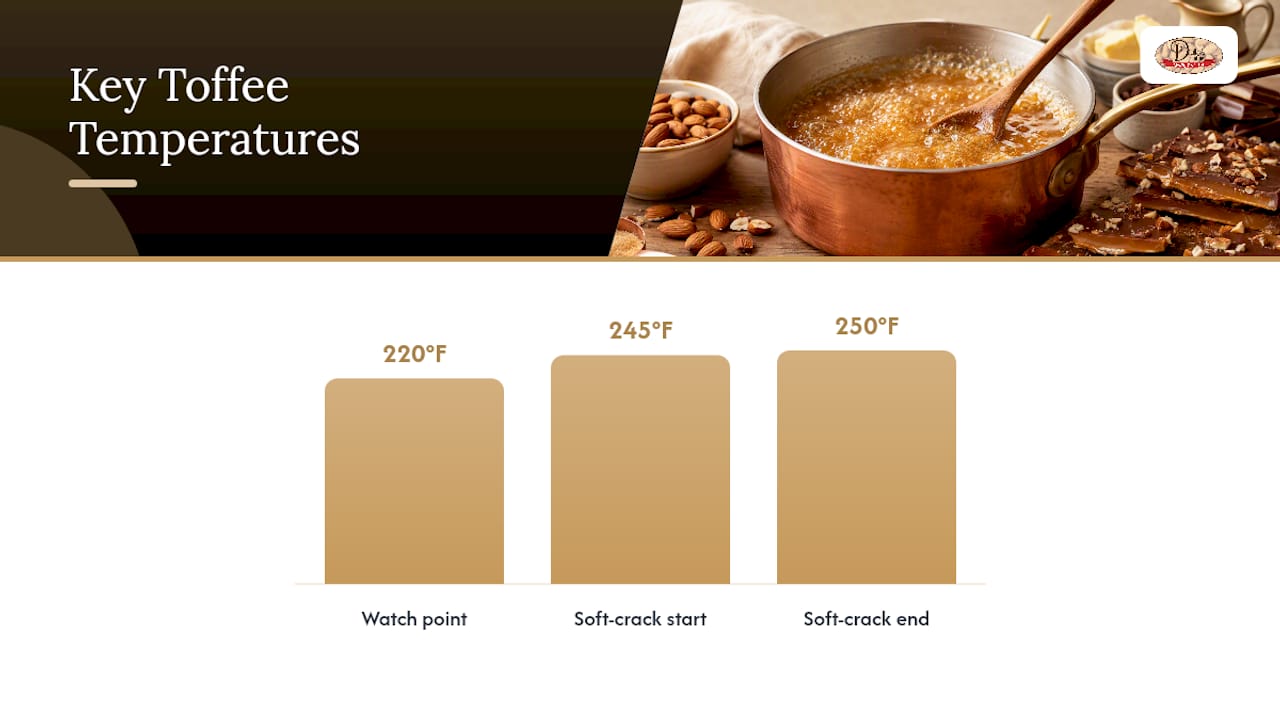
- Watch the thermometer closely once you pass 220°F. The temperature climbs slowly at first, then jumps fast near the finish line.
- Pull the pan off the heat the moment it hits 245°F to 250°F, the soft-crack stage. No thermometer? Drop a small spoonful into a cup of cold water. Reliable soft-toffee recipes confirm that at this stage it should form a pliable, slightly sticky ball rather than a hard, brittle thread.
- Stir in the vanilla, then pour the toffee immediately onto your prepared baking sheet. Work fast. It sets quickly once off the heat.
- Scatter the chocolate chips evenly over the hot toffee and let them sit undisturbed for about two minutes so residual heat melts them, then spread the melted chocolate smooth with an offset spatula. This is the same timing trick behind several well-tested toffee recipes that consistently turn out even, glossy coatings.
- Sprinkle chopped nuts over the chocolate while it’s still soft, then let the whole pan cool undisturbed at room temperature for at least two hours before breaking it into pieces.
A pan with straight sides and even thickness helps the toffee cook evenly, so avoid thin, warped baking sheets that develop hot spots. Spread the poured toffee to about a quarter inch thick. Thinner sets faster but risks scorching at the edges; thicker takes longer to firm up but gives you a chewier bite.
What Causes Toffee to Turn Out Wrong (And How to Fix It)
Most toffee failures trace back to one of four culprits, and each has a specific fix.
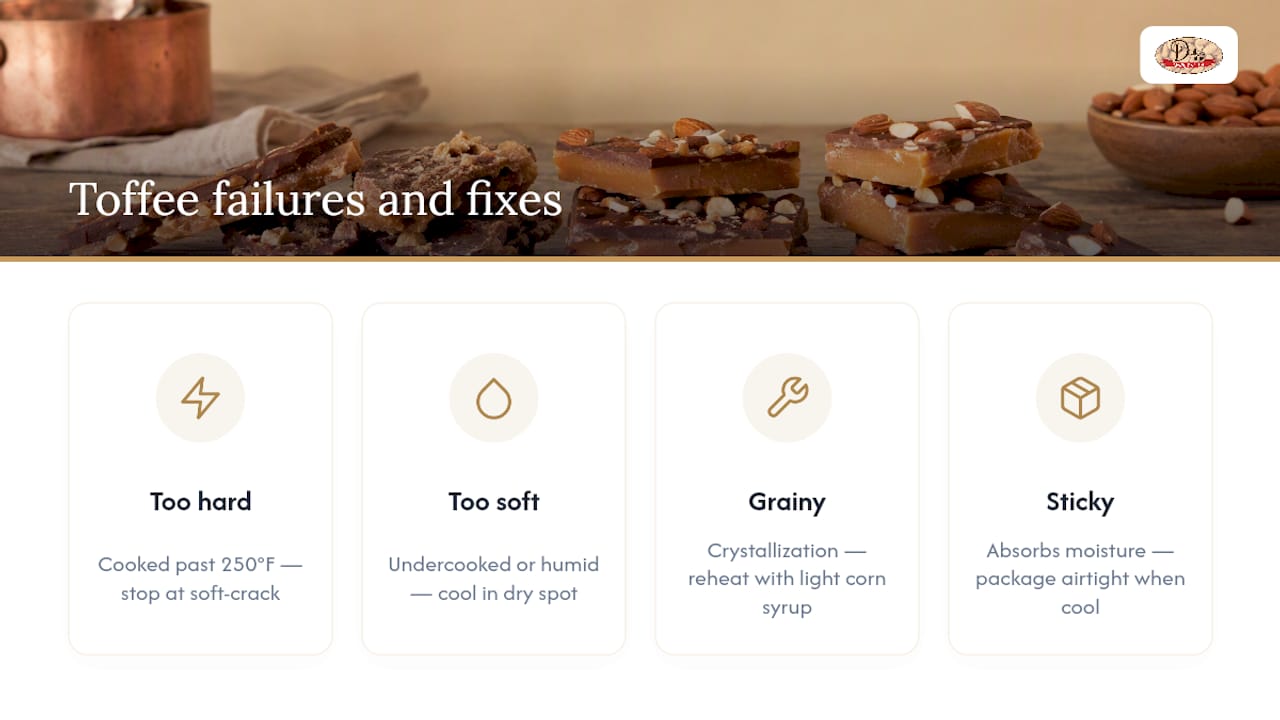
Too hard or brittle: The batch was cooked past 250°F, closer to hard-crack territory. Prevention beats correction here. Pull the pan the instant your thermometer hits the soft-crack range, since toffee keeps climbing a few degrees from residual heat even off the burner. If you already have a hard batch, it’s still delicious, just crunchy rather than chewy. Compare notes on this exact issue in our guide to non-sticky, hard-crack toffee for home cooks who want that style intentionally.
Too soft or won’t set: Usually undercooking, or high humidity pulling moisture back in during cooling. Keep the pan uncovered in a cool, dry spot rather than the refrigerator, which can introduce condensation as it warms back up.
Grainy texture: Crystallization from stirring during the boil, or from sugar crystals clinging to the side of the pan. A tablespoon of light corn syrup or a few drops of water, reheated gently and cooked back up without stirring, can sometimes redissolve stray crystals, though repeated reboiling darkens flavor and risks separating the butter.
Sticky after storage: Ambient moisture is the enemy of soft toffee. Package it airtight the moment it’s fully cooled, and store it somewhere cool and dry rather than a humid pantry.
Pro Tip: If you’re shipping soft toffee anywhere warm, pack it the same way small candy shops do: insulated boxes with gel packs keep chocolate and soft centers stable in transit instead of arriving as a melted mess.
For more on keeping finished batches fresh, see our full breakdown on how to store toffee properly.
What Equipment and Ingredients Do You Actually Need?
A short shopping list keeps this recipe foolproof:
- Candy thermometer. A clip-on digital thermometer or thermocouple gives the most accurate reading. Calibrate it fast by checking that boiling water reads 212°F at sea level before you start cooking.
- Heavy-bottomed saucepan. Thin pans create hot spots that scorch sugar unevenly.
- Silicone spatula and parchment or silicone mat. Nonstick surfaces make pouring and spreading far less stressful.
- Unsalted butter. Lets you set the salt level yourself instead of guessing how much a salted butter brand already added.
- Light corn syrup or heavy cream. Either works for the softer, chewier finish this recipe targets.
- Real chocolate chips or bar chocolate. Better melt and snap than chocolate-flavored coatings.
Why Dudley’s Toffee Trusts Small Batches for Soft Texture
Getting soft English toffee right at home takes attention to temperature and timing, and that’s exactly the discipline behind every batch Dudley’s Toffee makes in Indiana. Small-batch production means tighter control over heat, pan size, and pour timing than any large commercial line allows, which is a big part of how a softer, buttery texture that melts instead of sticking to your teeth stays consistent from batch to batch.
A few things worth knowing about our approach:
- Every batch is handcrafted in small quantities, not mass-produced on an industrial line.
- All of it is gluten-free and made without high fructose corn syrup.
- Both milk and dark chocolate varieties follow the same soft-texture standard.
Curious how our approach differs from traditional English toffee? Our explainer on English toffee for home cooks covers the texture, ingredient, and buying questions we hear most.
The Conventional Wisdom on Toffee Gets Texture Backward
Most recipe sites treat hard-crack as the gold standard for English toffee, with soft toffee framed as a variation or a mistake to avoid. That framing has it backward. A softer toffee isn’t undercooked hard toffee. It’s a deliberate product of a lower target temperature and a different butter-to-sugar balance, and it demands more precision, not less, because the margin between soft-crack and hard-crack is only about 50 degrees.
The biggest thing home cooks underestimate is how much cooling technique matters after the pour. Plenty of recipes nail the temperature and still end up with uneven texture because the batch sat somewhere humid, or the chocolate went on too soon and never set properly. If you’re troubleshooting a batch that didn’t turn out right, check your thermometer’s calibration before you blame the recipe. A thermometer running even five degrees hot will push a soft-crack batch straight into brittle territory without you ever knowing why.
Prioritize the thermometer first, ingredient ratios second, and cooling conditions third. Get those three in order and soft, melt-in-your-mouth toffee stops being a lucky outcome and starts being a repeatable one.
— Dudley’s Toffee
Prefer to Skip the Stovetop? Shop Soft Toffee Instead
Making soft toffee at home rewards patience and a good thermometer, but if a batch just failed on you or you’d rather skip the sugar-crystal drama entirely, Dudley’s Toffee bottles that same soft, melt-in-your-mouth result in every bag we ship from Indiana.
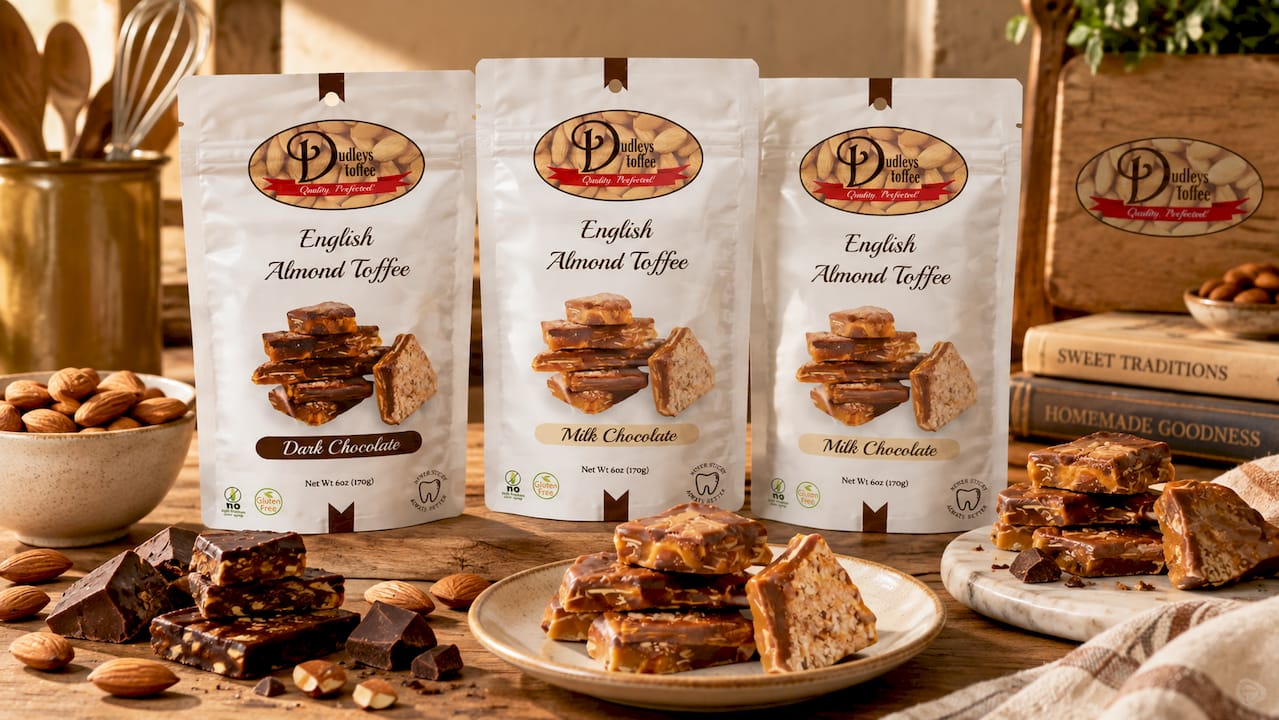
Our Dark Chocolate English Toffee comes in 6 ounce bags for readers who prefer a richer, slightly bitter contrast against the buttery toffee core. The Milk Chocolate English Almond Toffee, also 6 ounces, pairs classic milk chocolate with toasted almonds for a gift-ready option that first-time buyers tend to reach for. If you’re buying for a school group, team, or nonprofit, the Milk Chocolate English Toffee Fundraiser pack is built specifically for bulk fundraising orders.
Every order ships gluten-free with no high fructose corn syrup, handcrafted in small batches the same way this recipe is meant to be made. If you’re ordering during warmer months, add the optional cold pack for $2.99 to keep the chocolate and soft centers stable in transit. Browse the full English Almond Toffee lineup, priced at $11.99, and shop Dudley’s Toffee today.
Sources
- English toffee temperatures for flavor and texture — Thermoworks blog
- Moisture and sugar in shelf life (Talcott Lab, Texas A&M)
- How to make soft toffee recipe — Meemaw’s Recipes
FAQ
What’s the Difference Between Toffee and English Toffee?
Toffee is a broad category of butter and sugar candy cooked to varying temperatures. English toffee specifically refers to a buttery, often nut-topped version traditionally cooked to hard-crack, though soft variations like Dudley’s Toffee cook lower for a chewier result.
What Is the Best English Toffee?
The best English toffee depends on the texture you want. If you prefer melt-in-your-mouth chew over a hard snap, look for toffee made with a higher butter ratio and cooked to the soft-crack stage, the same approach Dudley’s Toffee uses in every small batch.
What Exactly Is English Toffee?
English toffee is a butter-based candy made by cooking sugar, butter, and sometimes cream or corn syrup to a specific temperature, then typically coating it in chocolate and topping it with nuts. The cooking temperature, either soft-crack near 245°F to 250°F or hard-crack near 300°F to 310°F, determines whether the final texture is chewy or brittle.
What Are the Different Types of English Toffee?
English toffee mainly splits into two textures: soft, chewy toffee cooked to soft-crack, and hard, brittle toffee cooked to hard-crack. Both types are then commonly finished with milk or dark chocolate and topped with almonds, pecans, or left plain.
Recommended
Share