
1820s Origins of English Toffee and Its American Makeover
English toffee is a butter and sugar confection cooked to the hard-crack stage, often studded with almonds and finished in chocolate. The American “English toffee” label came later and describes a chocolate-coated, almond-enriched evolution of that original British sweet.
TL;DR:
- The hard-crack stage, around 149 to 154 degrees Celsius, is crucial for making authentic toffee with a brittle, snap-ready texture.
- American “English toffee” typically features a hard, almond-studded, chocolate-coated form, unlike the firmer, chewier British version.
- The word “toffee” likely entered English in the 1820s and evolved from regional dialects linked to “taffy,” with origins rooted in England.
- Mass production in the 19th century was driven by the wider availability of sugar and butter, transforming toffee from a home treat into a widespread confection.
- Small-batch makers like Dudley’s preserve traditional techniques by carefully monitoring temperatures and using high-quality ingredients for a softer, more buttery snap.
Table of Contents
- What Is Toffee, Exactly? Ingredients and the Hard-Crack Stage
- Where Does the Word “Toffee” Actually Come From?
- How Toffee Went from Home Kitchens to Commercial Candy
- What Makes American “English Toffee” Different from British Toffee?
- How Traditional Toffee Gets Made: Ingredients, Temperature, and Finishing
- Why Toffee Still Shows Up in Gift Boxes Every Winter
- Dudley’s Toffee: Keeping a 200-Year-Old Craft Alive in Indiana
- Our Take: Why the “English” in English Toffee Matters More Than the Recipe
- Taste the Tradition: How to Bring Home Dudley’s Handcrafted Toffee
- Sources
- FAQ
What Is Toffee, Exactly? Ingredients and the Hard-Crack Stage
Toffee starts simple: sugar, butter, and heat. That combination, cooked patiently over a stove, is what separates toffee from caramel or fudge, and it’s the reason toffee has survived a long history of candy trends without losing its identity.
The defining moment in toffee making happens at the hard-crack stage, a specific temperature range typically between 149 and 154 degrees Celsius (300 to 310 degrees Fahrenheit). At that point, nearly all the water has cooked out of the sugar syrup, and the mixture will set into a brittle, glass-like sheet rather than a chewy or sticky one. Cross that threshold too far and the sugar scorches. Stop short and the toffee stays tacky, clinging to teeth instead of snapping cleanly. Confectionery references trace toffee’s defining process directly to this narrow temperature window, which is why traditional toffee makers watch a candy thermometer the way a baker watches an oven.
Beyond the base of sugar and butter, most traditional and modern recipes build in a few common additions:
- Salt, to balance the sweetness and sharpen flavor
- Vanilla, added after cooking to preserve its aroma
- Almonds, either folded in or pressed into the surface
- Chocolate, poured or enrobed over the cooled toffee base
Nuts and chocolate don’t just add flavor. They change the mouthfeel entirely, turning a hard, glassy candy into something with contrasting textures, which is part of why almond and chocolate versions became so popular commercially.
Where Does the Word “Toffee” Actually Come From?
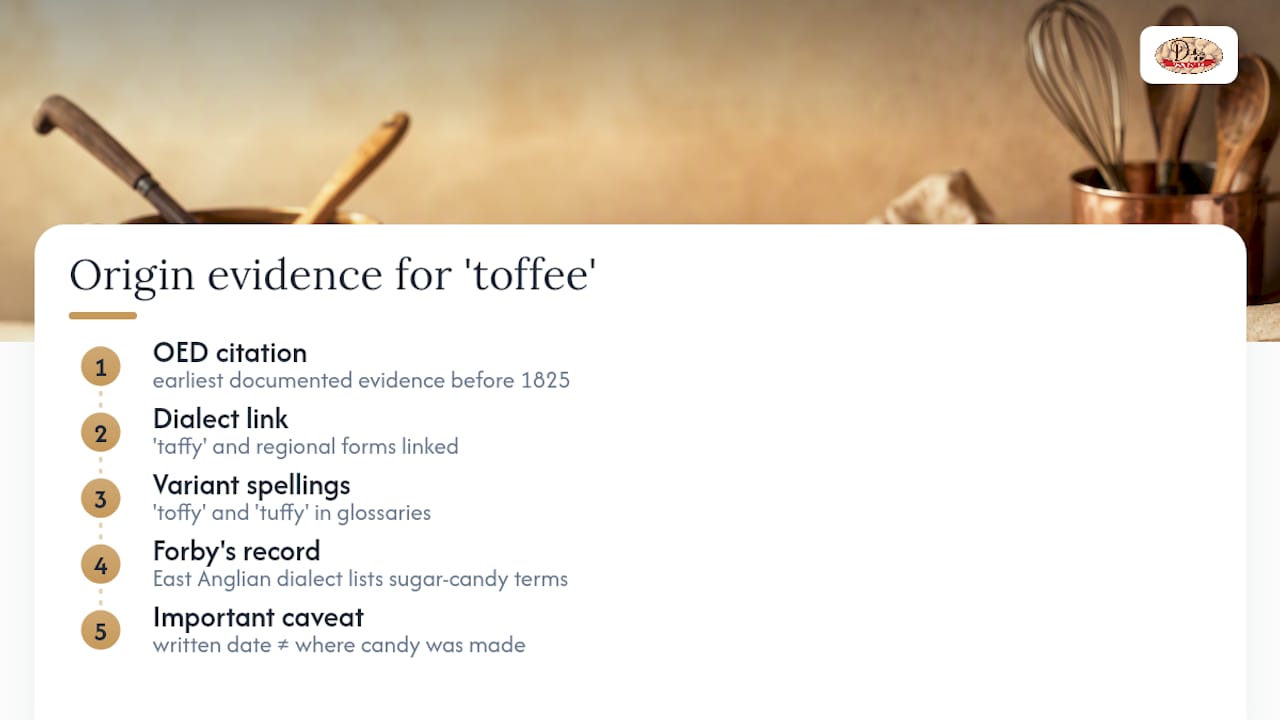
The Oxford English Dictionary places the earliest documented evidence for “toffee” before 1825, making it one of the more recent entries in the broader family of British sugar-confection words. That timing matters, because it tells us the word itself is a 19th-century invention, not a medieval or Tudor-era term as some candy folklore suggests.
The OED’s etymology entry links “toffee” to dialectal forms connected to “taffy,” a related northern and regional English word for a similar pulled or boiled sugar candy. Early spellings varied, including “toffy” and “tuffy,” which shows up in period glossaries and regional literature from the early to mid-1800s. Historical dictionaries documenting these dialectal forms note that “toffee” and “taffy” likely emerged from overlapping regional speech rather than one word cleanly splitting into the other. One frequently cited data point traces back to Robert Forby’s work cataloging East Anglian dialect, which recorded regional sugar-candy vocabulary consistent with this period.
Here’s the important caveat: etymology tells us when a word entered written English, not where the candy itself was first made or by whom. A dialect word can circulate in speech for years, even decades, before anyone bothers to write it down. So while the 1820s citation is solid evidence for when “toffee” became a fixed term, it’s not proof of an exact birthplace or a single inventor. What the record does support is a strong association with England, and specifically with the regional, home-kitchen sugar candy traditions of the early 1800s.
How Toffee Went from Home Kitchens to Commercial Candy
Toffee’s rise as a widespread confection tracks closely with two ingredients becoming dramatically more accessible in 19th-century Britain: sugar and butter. Food historians generally point to the early 19th century in England as the period when toffee moved from an occasional home treat to something closer to a household staple.
Sugar had been a luxury good for much of British history, heavily taxed and tied to colonial trade routes. As import volumes grew and prices dropped through the 1800s, sugar became affordable enough for ordinary households to cook with regularly, not just for special occasions. Dairy farming across England also expanded during this period, which meant a steadier, cheaper supply of butter for baking and candy making alike. Put those two trends together, and you get the exact conditions that let a simple butter and sugar candy go from a rare kitchen experiment to a common domestic sweet.
By the mid to late 1800s, toffee had moved beyond the home kitchen entirely. Confectionery shops began producing it commercially, wrapping and selling it much like other boiled sugar candies of the era. That commercial footing set the stage for toffee’s next big leap: crossing the Atlantic. American candy makers picked up the basic technique, adapted it with local tastes and ingredients, particularly almonds and chocolate, and began marketing their version under a name that nodded to its origins: English toffee.
What Makes American “English Toffee” Different from British Toffee?
Ask someone in England for toffee, and you’ll likely get something closer to a firm, chewy candy, sometimes closer to what Americans would call caramel. Ask someone in the United States for English toffee, and you’ll almost certainly get a hard, buttery candy layered with almonds and coated in milk or dark chocolate. Both are legitimately “toffee.” They’re just not the same candy.
A few practical distinctions help sort out the confusion:
- British toffee tends to be firmer and chewier, closer to what American candy labels call caramel, and rarely includes almonds or a chocolate shell as a default.
- American English toffee is almost always hard-crack, almond-studded, and chocolate-coated, more closely resembling what some American recipes separately label “buttercrunch.”
- Buttercrunch is essentially the domestic American term for the same basic candy, used somewhat interchangeably with “English toffee” depending on the maker and region.
- The word “English” in the American name functions more as a nod to heritage and craftsmanship than a strict claim about geographic manufacturing origin.
Commentary on the candy’s naming conventions notes that American markets use “English toffee” as a marketing and nostalgic descriptor rather than a formally protected recipe name, which explains why you’ll find real variation from maker to maker while the label stays consistent. If you want to taste the difference for yourself, look at the texture on the first bite: a true hard-crack English toffee should snap cleanly, not stretch or stick.
How Traditional Toffee Gets Made: Ingredients, Temperature, and Finishing
Making toffee well comes down to three things: ingredient quality, temperature control, and finishing technique. Skip attention to any one of them and the candy suffers, no matter how good the recipe looks on paper.
The process generally follows this sequence:
- Melt and combine sugar, butter, and often a touch of water or corn syrup over controlled heat.
- Cook to hard crack, monitoring closely as the mixture climbs toward 300 to 310 degrees Fahrenheit, since the last few degrees happen fast.
- Pour and cool the base onto a flat surface, letting it set into a solid sheet.
- Enrobe in chocolate, applying melted milk or dark chocolate over the cooled toffee.
- Finish with almonds, pressed into the chocolate before it sets, or folded into the base itself.
Butter quality has an outsized effect on the final flavor. Higher fat content produces a richer, more rounded taste, while lower-quality butter substitutes can leave a flat or waxy aftertaste that lingers. Small-batch producers tend to cook slower and finish faster, moving from hard-crack straight into enrobing before the base has a chance to absorb ambient moisture, a common cause of graininess or stickiness in mass-produced toffee. Learning more about why some toffee turns sticky while other batches snap cleanly usually comes down to exactly this kind of temperature discipline.
Pro Tip: If your toffee turns out sticky instead of snappy, the culprit is almost always undercooking. Even five degrees below the hard-crack range can leave enough residual moisture to soften the final texture.
Why Toffee Still Shows Up in Gift Boxes Every Winter
Toffee’s association with the winter holidays isn’t an accident of marketing. It’s a candy built for gifting: it travels well, keeps for weeks without refrigeration, and its rich, buttery flavor feels indulgent in a way that fits cold-weather celebrations. National Toffee Day, observed every January 8, has become a small but genuine marker of the candy’s cultural staying power.
Toffee also earned its place as a candy-bar ingredient, showing up as a core or coating in several well-known American confections, which kept the flavor familiar to generations who never bought a standalone bag of it. Modern small-batch makers have adapted the tradition further, producing gluten-free versions with no high-fructose corn syrup and premium chocolate coatings, meeting today’s ingredient expectations without abandoning the candy’s original buttery character.
Dudley’s Toffee: Keeping a 200-Year-Old Craft Alive in Indiana
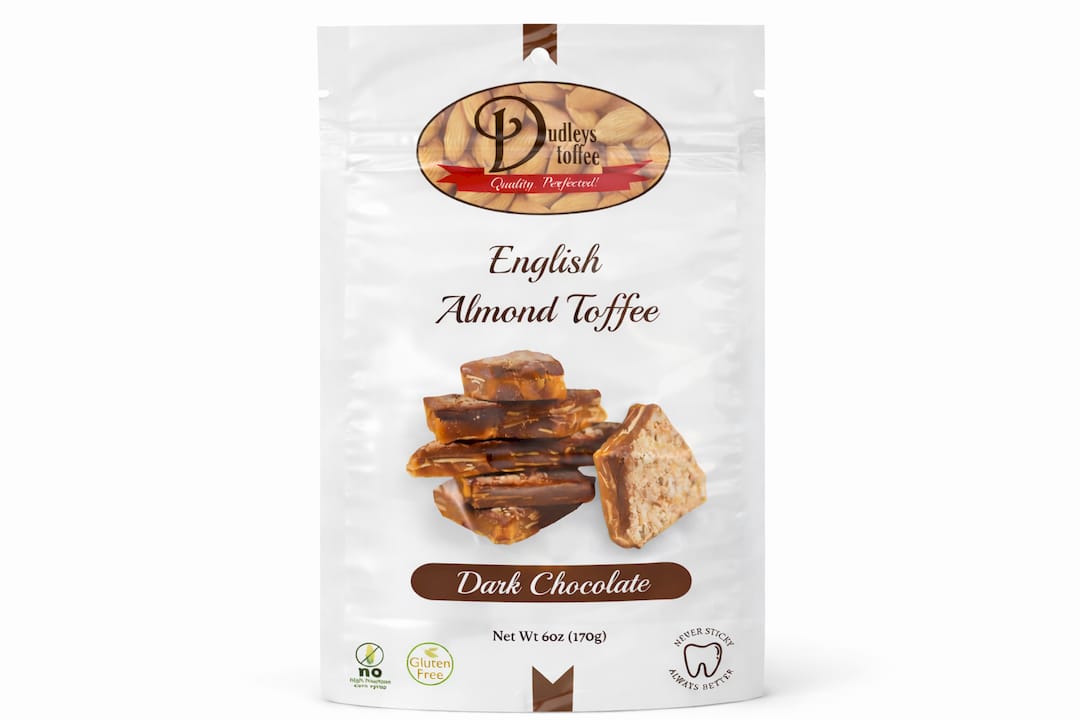
Dudley’s Toffee makes handcrafted English almond toffee in small batches in Indiana, using the same fundamental technique that defined the candy two centuries ago: butter, sugar, careful heat, and patience. Every batch is gluten free and made with no high fructose corn syrup, offered in both milk chocolate and dark chocolate varieties.
Small-batch production matters here in a very specific way: slower cooking and closer attention to the hard-crack stage protect the soft, buttery snap that defines a well-made toffee, rather than the brittle, overcooked texture common in mass production. That’s the throughline connecting a 19th-century English kitchen to a modern Indiana candy shop.
Our Take: Why the “English” in English Toffee Matters More Than the Recipe
Here’s where most explanations of English toffee history get lazy: they treat “English toffee” as if it were a single, fixed recipe handed down unchanged since the 1820s. It wasn’t, and pretending otherwise does the candy a disservice. The OED evidence tells us when the word entered written English. It doesn’t hand us a recipe card, and it definitely doesn’t explain why American candy makers started coating almond toffee in chocolate and calling it English.
What the evidence actually supports is a more interesting story: a British dialect word for a butter-sugar candy crossed the Atlantic, got reshaped by American tastes and ingredients, and kept its heritage name as a mark of craftsmanship rather than geography. That’s not a weakness in the history. It’s the whole point. A candy worth naming after a place is a candy worth making carefully, wherever it’s actually cooked.
Readers chasing “authentic” English toffee should stop looking for the one true original recipe and start paying attention to technique instead: real butter, patient cooking to hard crack, and finishing that respects the base rather than burying it. That’s the tradition actually worth preserving.
— Dudley’s Toffee
Taste the Tradition: How to Bring Home Dudley’s Handcrafted Toffee
Dudley’s Toffee gives you a direct line to the same butter-and-sugar craft behind two centuries of English toffee history, made fresh in small batches rather than mass-produced on an industrial line. That difference shows up in every bite: a softer, buttery snap instead of the overcooked crunch you’ll find in most grocery-aisle toffee.
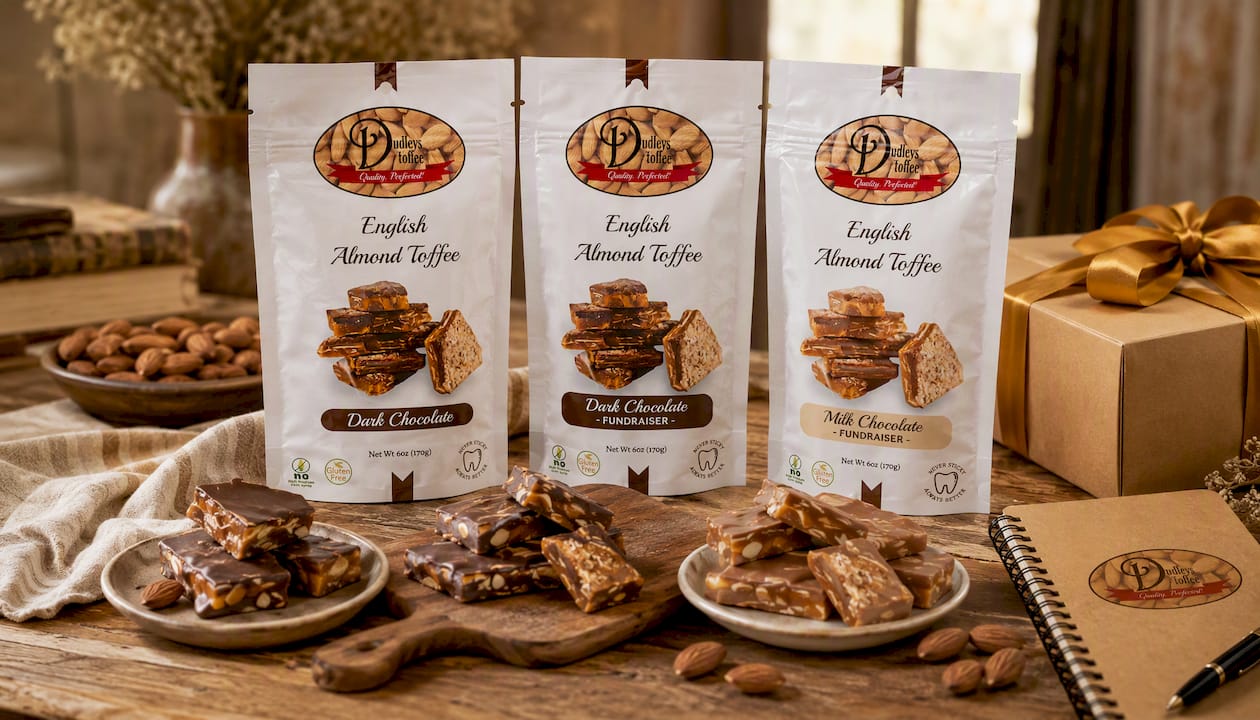
Every batch is handcrafted in Indiana, gluten free, and made without high fructose corn syrup, available in both milk chocolate and dark chocolate. Buying for a holiday gift list, a corporate order, or a fundraiser? Dudley’s Toffee offers a milk chocolate fundraiser bag, a handcrafted almond toffee option in milk or dark chocolate, and mixed cases with both milk and dark chocolate bags for groups who can’t pick just one. Retailers and specialty shops looking to carry the brand can check wholesale options directly. Ready to taste the difference small-batch technique makes? Order a bag today and see why this centuries-old candy still earns its place on the gift table.
Sources
For readers who want to dig deeper into the sourcing behind this history, start with the Oxford English Dictionary’s toffee entry, the Wikipedia overview of toffee covering the hard-crack process and American variants, and TheNibble’s toffee history page for production and regional context.
FAQ
What Makes English Toffee Different From Regular Toffee?
American English toffee is typically a hard-crack candy enriched with almonds and coated in milk or dark chocolate, while British toffee tends to be firmer and chewier without those additions, according to confectionery references documenting both styles.
What Do Americans Call Toffee?
Americans commonly use “English toffee” or “buttercrunch” interchangeably for the almond, chocolate-coated toffee style, a naming pattern that candy historians describe as more nostalgic marketing than a strict recipe standard.
Which Country Invented Toffee?
The word “toffee” has its earliest documented use in England in the 1820s, and food historians generally trace the candy’s rise to early 19th-century England, based on Oxford English Dictionary etymology records.
Which Is the Most Famous Toffee in the World?
There’s no single globally agreed-upon “most famous” toffee, but American English toffee, made with almonds and chocolate coating, remains one of the most widely recognized and commercially popular versions, showing up in candy bars and gourmet gift assortments across the United States.
Recommended
Share