
Toffee vs Brittle: How to Tell and Which to Choose
Toffee is a butter-forward, emulsion-style candy; brittle is a mostly sugar-based, glassy crunch. That single ingredient difference explains nearly everything else: why toffee feels richer and slightly softer, why brittle shatters so cleanly, and why the two can look similar in a gift box yet taste completely different. According to The Spruce Eats, toffee’s rich profile comes from the emulsion of butter and sugar, while brittle’s simplicity is defined by its sugar base.
Here’s how to tell them apart at a glance:
- Toffee: butter and sugar cooked together (often with brown sugar or cream), finished with chocolate and chopped nuts, softer snap
- Brittle: granulated sugar and water (sometimes corn syrup) with nuts stirred in, thin and glassy, shatters on first bite
- Common add-ins: toffee gets chocolate and nut toppings; brittle carries the nuts inside the candy itself
Read on for cooking temperatures, home-cook tips, and a real-world artisan example that shows how ingredient choices shape the final bite.
Key Takeaways
Toffee and brittle both reach the hard-crack sugar stage, but butter content and cooking method determine whether you get a rich, softer snap or a thin, glassy shatter.
| Point | Details |
|---|---|
| Butter is the dividing line | Toffee is built on a butter-sugar emulsion; brittle uses little to no butter. |
| Texture follows fat content | More butter means a softer snap; a pure sugar base produces a glassy, clean shatter. |
| Sugar type shapes flavor | Brown sugar gives toffee caramel depth; granulated sugar keeps brittle’s sweetness clean. |
| Toppings vs. mix-ins | Toffee gets chocolate and nuts on top; brittle carries nuts inside the candy itself. |
| Dudley’s Toffee example | Small-batch Indiana toffee shows how butter content and precise temps create a softer, buttery bite. |
Table of Contents
- What is toffee, and how does it differ from brittle?
- What is brittle, and what makes it unique?
- How ingredients separate toffee from brittle
- How sugar stages and technique create different textures
- Common variations and where they land on the spectrum
- Why toffee and brittle get confused in stores and recipes
- Dudley’s Toffee as a real-world English toffee example
- Which one should you choose?
- Handcrafted English almond toffee, ready to ship
- Sources
- FAQ
What is toffee, and how does it differ from brittle?
Toffee starts with butter, and a lot of it. The basic formula combines butter and sugar, cooked together until the fat and sugar form a stable emulsion. Many recipes add brown sugar for deeper color and caramel-like flavor, and some include a splash of cream or milk, which makes the finished piece slightly chewier. Vanilla is a common finishing note.
The method matters as much as the ingredients. Butter and sugar go into the pan together and cook as a unit, which is what separates toffee from brittle at a technical level. That fat content prevents the candy from reaching the glass-like hardness of a pure sugar confection. The result is a candy with real body: a snap that gives a little, a buttery depth that lingers, and a richness that plain sugar syrup cannot replicate.
Temperature target: most toffee recipes aim for the hard-crack stage, roughly 300°F–310°F (149°C–154°C). English toffee and butter crunch both land in this range, though the presence of butter and brown sugar means the finished texture feels softer than the temperature alone would suggest.
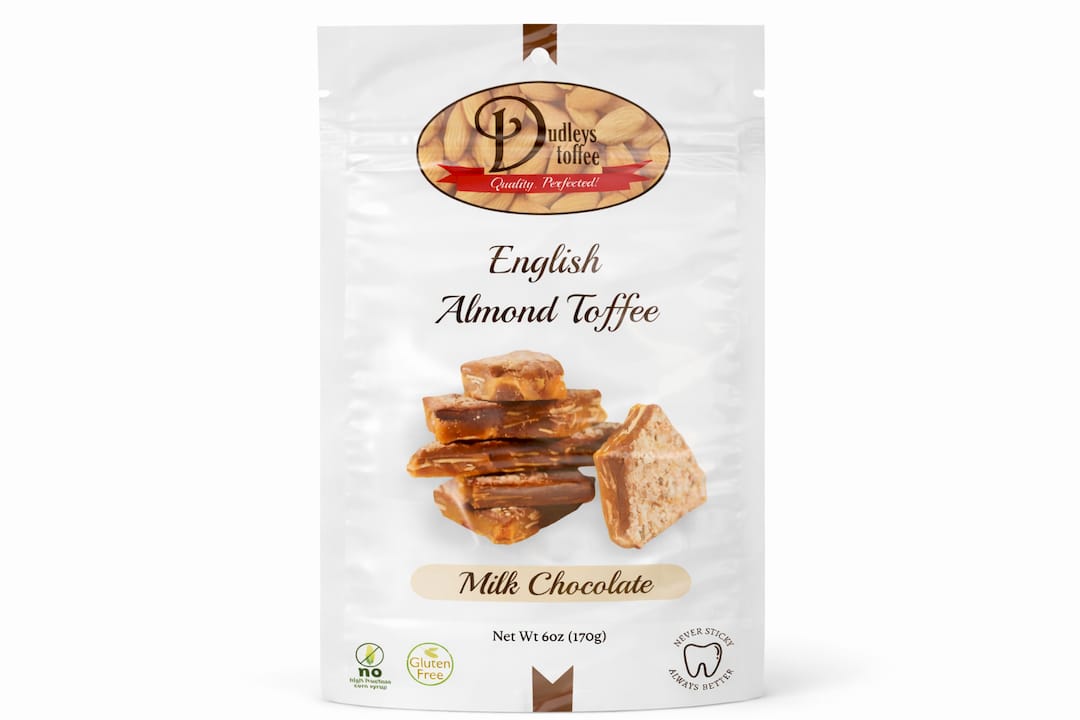
English toffee, the American interpretation, typically gets a coat of melted chocolate and a layer of chopped almonds or other nuts pressed in while the chocolate is still warm. Butter crunch is a close cousin, sometimes made with a higher butter ratio for an even more tender bite. Both are chocolate-covered toffee styles that showcase what butter does for texture and flavor.
Storage and allergens to note:
- Store toffee in an airtight container at room temperature, away from humidity, for up to two weeks
- Refrigerate or freeze for longer shelf life, separating layers with parchment
- Common allergens: dairy (butter, sometimes cream or milk chocolate), tree nuts (almonds, pecans, walnuts)
What is brittle, and what makes it unique?
Brittle is, at its core, a sugar candy with nuts suspended inside. The ingredient list is short: granulated sugar, sometimes water or light corn syrup, and nuts, most often peanuts, though cashews and almonds appear in many recipes. Butter, if it appears at all, is added in a small amount near the end, primarily to help the candy release from the pan rather than to build flavor.
A classic peanut brittle comes together in four basic steps:
- Cook sugar and corn syrup to the hard-crack stage (300°F–310°F / 149°C–154°C)
- Stir in peanuts and a small pat of butter
- Add baking soda, which aerates the mixture and creates a slightly lighter texture
- Pour onto a greased surface, stretch thin if desired, and cool completely before breaking
That pull-and-stretch step is what Tasting Table describes as the key to brittle’s signature shatter: stretching the hot candy while warm produces an extra-thin, glass-like sheet that breaks cleanly on first bite. No chocolate coating, no layering, just the candy itself.
The flavor profile is cleaner and simpler than toffee. You get sweetness, toasted nut notes, and sometimes a pinch of salt or a hint of spice. There is no buttery depth because there is no meaningful butter content.
Storage and allergens:
- Store brittle in an airtight container at room temperature; humidity is its enemy and will make it sticky
- Shelf life is typically two to three weeks when stored properly
- Common allergens: peanuts or tree nuts (always), sometimes soy (from corn syrup)
How ingredients separate toffee from brittle
The clearest way to read a candy label or recipe is to look for butter and brown sugar. Their presence almost always signals toffee; their absence points to brittle. The Spruce Eats notes that brown sugar and dairy increase color and depth in toffee, while brittle sticks to granulated sugar and is usually thinner.
| Feature | Toffee | Brittle |
|---|---|---|
| Primary ingredients | Butter, brown sugar, sometimes cream | Granulated sugar, water or corn syrup |
| Fat content | High (butter is structural) | Low (butter optional, finishing only) |
| Sugar type | Brown sugar (adds molasses depth) | Granulated sugar (cleaner sweetness) |
| Typical texture | Softer snap, slightly chewy | Thin, glassy, shatters cleanly |
| Flavor profile | Buttery, caramelized, rich | Sweet, toasted nut, clean |
| Common add-ins | Chocolate coating, chopped nuts on top | Nuts stirred inside, finishing salt |
| Typical uses | Gifting, holiday boxes, snacking | Snacking, crumbling over desserts, baking |
What to look for on packaging:
- “Butter toffee” or “English toffee” on a label almost always means a dairy-rich, chocolate-finished candy
- “Brittle” labels rarely list chocolate as an ingredient; look for nuts listed early in the ingredient deck
- A gluten-free claim is more common on toffee made by specialty producers; brittle is naturally gluten-free in most recipes
How sugar stages and technique create different textures
Both candies reach the hard-crack sugar stage, which is why they can look similar on a thermometer. What separates them is what happens to the sugar once it gets there.
| Sugar stage | Temperature | Typical result |
|---|---|---|
| Soft-crack | 270°F–290°F (132°C–143°C) | Chewy, pliable candy (caramel territory) |
| Hard-crack | 300°F–310°F (149°C–154°C) | Firm snap; toffee and brittle both land here |
| Overcooked | Above 320°F (160°C) | Burnt flavor, dark color |
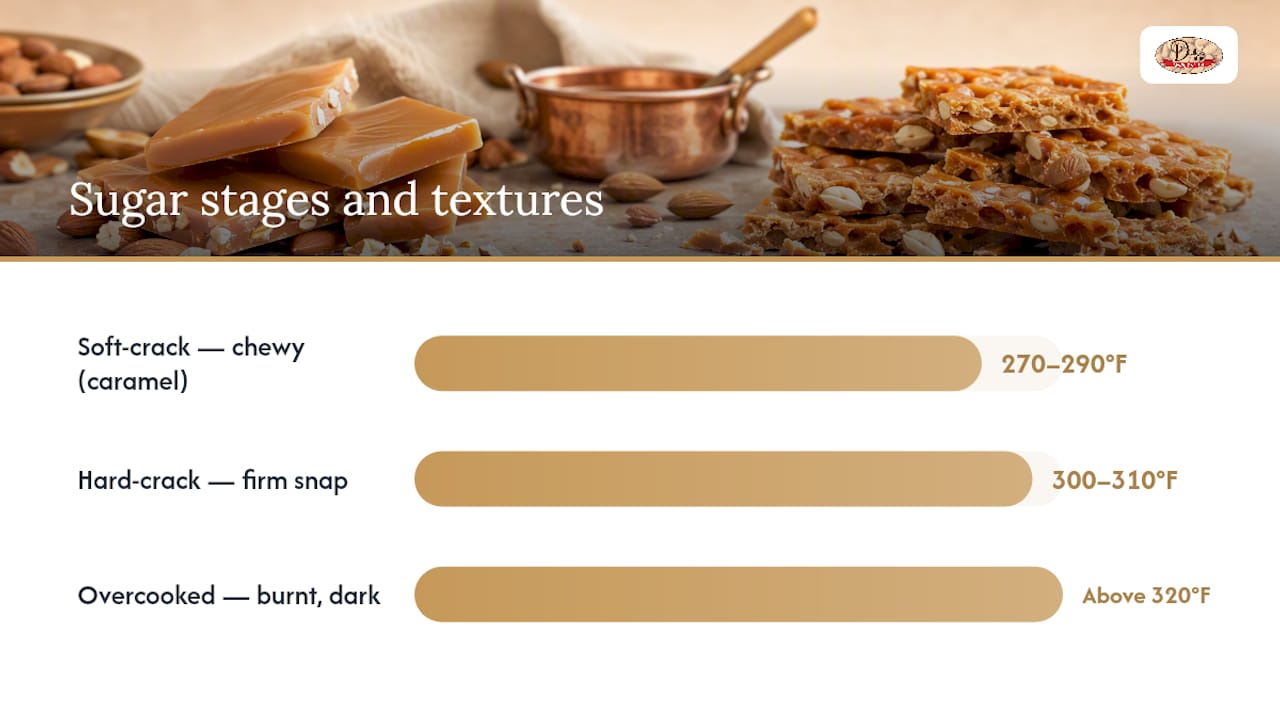
Toffee cooked with butter reaches 300°F–310°F but the fat in the emulsion softens the perceived hardness. The candy firms up but retains a slight give. Brittle cooked to the same temperature, with almost no fat, sets into a true glass. Thickness amplifies the difference: toffee is typically poured thicker, while brittle is stretched thin, which makes the shatter even more pronounced.
Troubleshooting common problems:
- Sticky toffee or brittle: undercooked; the sugar did not reach hard-crack. Use a thermometer, not a visual guess
- Grainy texture: sugar crystallized during cooking; avoid stirring once the sugar dissolves, and use corn syrup in brittle to inhibit crystallization
- Overly hard toffee: cooked past 310°F or butter broke from the emulsion; lower the heat and stir steadily
Pro Tip: A reliable candy thermometer is the single most important tool for either candy. Tasting Table confirms that precise temperature control and small-batch attention prevent the two most common failures: burnt flavor from overheating and sticky results from undercooking. Clip the thermometer to the side of the pan so the tip sits in the candy but does not touch the bottom.
Common variations and where they land on the spectrum
Not every candy fits neatly into one category. Here is where the most familiar names fall:
- English toffee (American style): butter-rich, chocolate-coated, often topped with almonds; the softest and richest of the toffee family. For a deeper look at how almond toffee is made and paired, the flavor combinations go well beyond the basics
- Butter crunch: nearly identical to English toffee, sometimes with a higher butter ratio; the name is used interchangeably in many American kitchens
- Peanut brittle: the most recognized brittle; thin, glassy, peanut-studded, no chocolate coating
- Cashew or almond brittle: same technique as peanut brittle, with a milder nut flavor and a slightly more upscale presentation
- Honeycomb / cinder toffee: a sugar-and-syrup candy aerated with baking soda; closer to brittle in texture but often called “toffee” in British English, which adds to the naming confusion
- Nut-forward brittles with salt: a finishing pinch of flaky sea salt has become standard in artisan versions; the salt amplifies the toasted nut flavor without changing the candy’s structure
Regional naming is genuinely confusing. In the United Kingdom, “toffee” can refer to a soft, chewy candy that Americans would call caramel. In the United States, “English toffee” almost always means the butter-rich, chocolate-coated style. SauceAndBites notes that American “English toffee” sits between classic toffee and brittle in texture, which is part of why the two categories blur at the edges.
Why toffee and brittle get confused in stores and recipes
Small differences in fat content, thickness, and toppings can push a candy toward either label, and manufacturers do not always use terms consistently.
- A thin toffee with no chocolate coating can look and snap like brittle
- A thick brittle with a chocolate drizzle can be mistaken for toffee
- “Butter crunch” and “toffee” are used interchangeably by many brands
Quick clarifications:
- Is toffee the same as brittle? No. Toffee is an emulsion of butter and sugar; brittle is a sugar syrup with nuts. The fat content and method are fundamentally different, even when both reach the same cooking temperature
- Is toffee basically caramel? Not quite. Tasting Table explains that toffee is cooked to the hard-crack stage (300°F+), while caramel stops at a lower temperature for a soft, chewy result. Toffee is firmer; caramel is pliable
- Is peanut brittle like toffee? They share a cooking temperature but differ in fat content and technique. Brittle is thinner, crisper, and built around a sugar syrup rather than a butter emulsion
Dudley’s Toffee as a real-world English toffee example
Seeing the technical differences in a real product makes them easier to remember. Dudley’s Toffee, handcrafted in small batches in Indiana, is a clear illustration of what butter content and small-batch control actually produce in the finished candy.
Three products show the range:
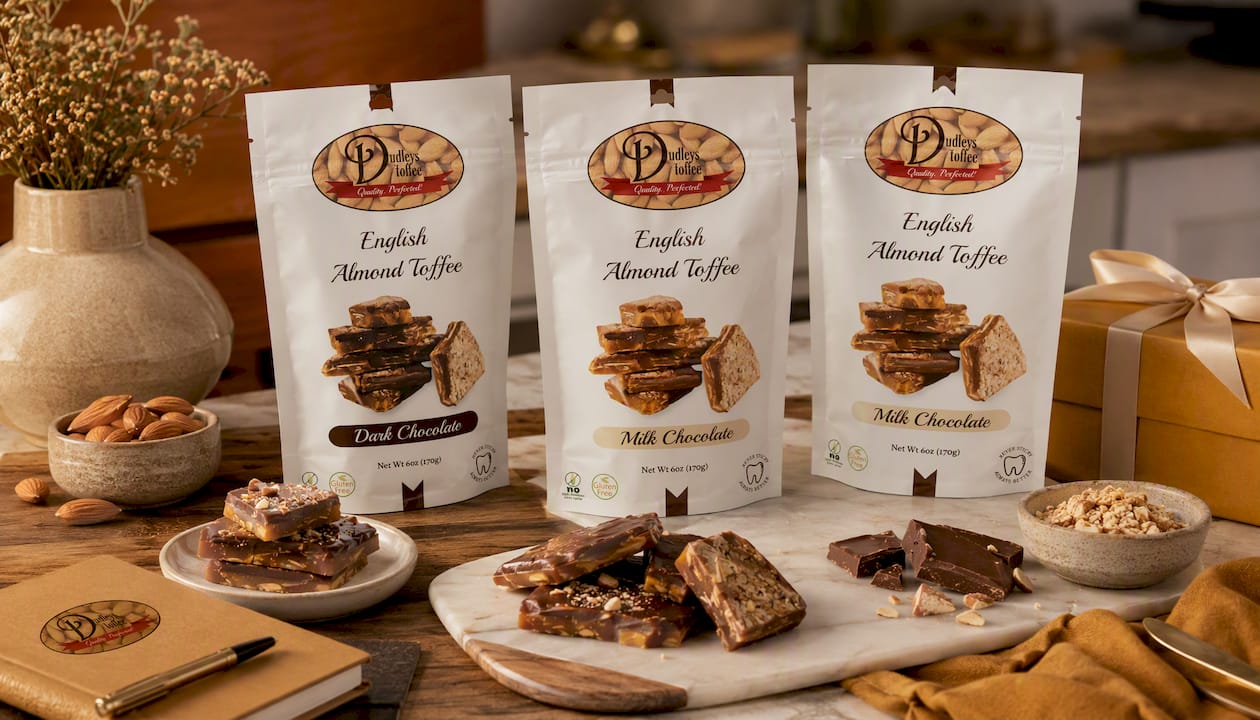
- Dark Chocolate English Toffee (6oz): the butter-forward base coated in dark chocolate, demonstrating how a rich cocoa finish complements the caramelized toffee layer
- Dudley’s English Almond Toffee (6oz, Milk or Dark Chocolate): the signature product, with almonds pressed into the chocolate coating, showing the classic English toffee construction
- Milk Chocolate English Almond Toffee (6oz): the milk chocolate version, which adds a creamier, sweeter finish that contrasts with the deeper notes of the dark chocolate variety
What the production approach illustrates about the technical points:
- Small-batch cooking allows tighter temperature control, which is what keeps the toffee in the softer end of the hard-crack range
- High butter content produces the melt-in-your-mouth quality rather than a tooth-sticking chew
- Gluten-free formulation and no high fructose corn syrup mean the ingredient list stays clean and readable
- Milk and dark chocolate options show how the same toffee base reads differently depending on the coating
For readers curious about how toffee texture varies by technique and batch size, that detail is worth exploring before attempting a home recipe.
Which one should you choose?
From Dudley’s Toffee’s perspective as a maker, the choice usually comes down to occasion and what you want the candy to do.
- Choose toffee when you want something gift-worthy, chocolate-paired, and rich enough to feel like a genuine treat. Toffee travels well in a gift box, pairs naturally with a spring floral arrangement for a layered gift, and holds its own as a standalone confection for holidays or corporate gifting
- Choose brittle when you want a crunchy, nut-forward snack or a topping to crumble over ice cream, yogurt, or baked goods. Its simplicity is its strength, and it is easy to make at home with four ingredients
- Try both if you are baking or building a candy assortment. Toffee bits add buttery richness to cookies and brownies; brittle crumbles add crunch and a toasted nut note. They serve different purposes in the same kitchen
Handcrafted English almond toffee, ready to ship
If the butter-forward, chocolate-coated style is what you are after, Dudley’s Toffee makes it straightforward to order. The English almond toffee is handcrafted in small batches in Indiana, gluten-free, and made without high fructose corn syrup, available in milk and dark chocolate to suit any preference.
For gifting, a soft toffee gift guide on the Dudley’s site walks through options for holidays, corporate orders, and fundraising. Shop directly at Dudleystoffee to find the right size and chocolate variety for your occasion.
Sources
- What’s the Difference Between Toffee and Brittle? — The Spruce Eats
- The Actual Difference Between Toffee And Brittle — Tasting Table
FAQ
Is toffee the same as brittle?
No. Toffee is an emulsion of butter and sugar that produces a richer, softer snap; brittle is a sugar syrup with nuts and little to no butter, resulting in a thin, glassy shatter.
What do Americans call toffee?
In the United States, “toffee” most often refers to English toffee: a butter-rich, hard candy coated in chocolate and topped with nuts, distinct from the softer, chewier candy the British sometimes call toffee.
Is toffee basically caramel?
They share ingredients but not cooking temperature. Caramel is cooked to a lower sugar stage for a soft, chewy result, while toffee reaches the hard-crack stage (300°F–310°F) for a firmer candy with a snap.
Is peanut brittle like toffee?
Peanut brittle and toffee reach similar cooking temperatures, but brittle uses a sugar syrup base with minimal butter, producing a thinner, crisper candy. Toffee’s butter emulsion gives it a softer, richer character that brittle does not share.
Recommended
Share