

Keep Shipped Chocolate 55–68°F: Shop Tested Pack Out for Small Shops
The best way to ship chocolate without melting combines four things working together: insulated packaging, properly placed cold packs, one to two day expedited shipping, and quick recipient pickup. Keep the package’s internal temperature between 55°F and 68°F throughout transit. If daytime highs at the destination top 90°F, delay the shipment or add a cold pack rather than risk a melted gift.
TL;DR:
- Shipping chocolate between 55°F and 68°F prevents melting and bloom, especially for milk and white varieties that are more temperature-sensitive.
- Proper packing includes pre-cooling all materials, sealing chocolates airtight, using desiccants, and placing refrigerants around the product without direct contact.
- Fast, one to two-day shipping early in the week reduces transit time and exposure to heat, significantly lowering the risk of melting or bloom.
- Using insulated liners combined with correctly placed gel packs or PCM panels can extend the safe window for transit up to 48 hours.
- For warm climates or summer shipping, adding an optional cold pack boosts protection but should complement, not replace, smart timing and insulation.
Table of Contents
- What Temperature Makes Chocolate Melt or Bloom?
- What Packaging Materials Keep Chocolate From Melting?
- Which Insulation and Cold Packs Work Best?
- When Should You Ship Chocolate to Avoid Heat Exposure?
- How Do You Prevent Porch Melt After Delivery?
- How Do You Ship Filled Chocolates or International Orders Safely?
- How Dudley’s Toffee Tests Its Own Warm-Weather Pack-Out
- Why Most Chocolate Shipping Advice Misses the Point
- Shipping Chocolate in Summer? Here’s What Actually Helps
- Sources
- FAQ
What Temperature Makes Chocolate Melt or Bloom?
Chocolate typically begins to soften near 72°F and can melt at higher temperatures, depending on the cocoa butter content and formulation. That’s a narrower margin than most people assume, especially if your package sits on a delivery truck that’s been idling in a parking lot all afternoon. The sweet spot for shipping is 55–68°F, a range that keeps the texture firm and the shine intact without tipping into the danger zone.
But melting isn’t the only risk. Even chocolate that never gets warm enough to liquefy can come out of a box looking chalky, streaked, or dull. That’s bloom, and it’s arguably more common in shipped chocolate than outright melting.
Fat bloom happens when cocoa butter separates and rises to the surface, usually triggered by temperature swings. Sugar bloom happens when moisture condenses on the chocolate’s surface, dissolves a bit of sugar, then evaporates and leaves behind a gritty white residue. Neither ruins the flavor, but both ruin the presentation, and presentation is exactly what someone’s paying for when they order a gift box.
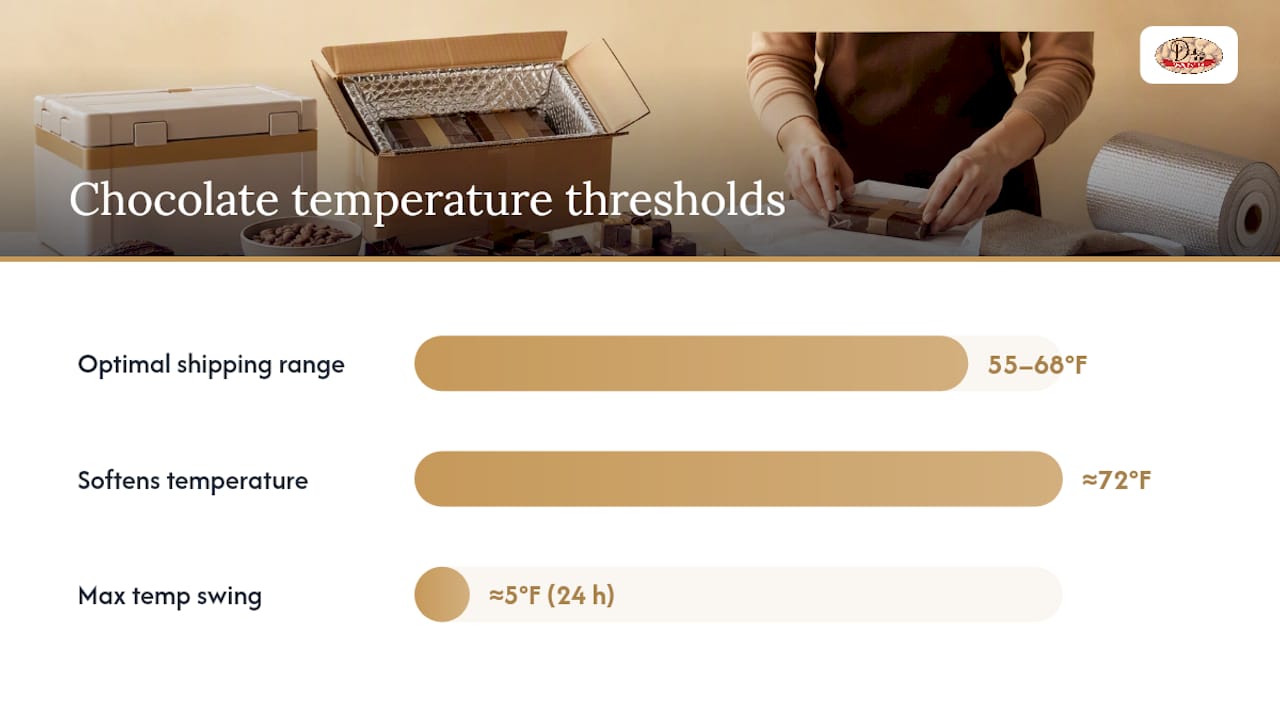
Temperature swings greater than about 5°F within a 24 hour window meaningfully raise the odds of bloom, according to temperature control research from SUAID Global. That’s why a package that goes from an air-conditioned warehouse to a hot delivery van and back to a cool porch can arrive visually damaged even if it technically never melted.
Chocolate type matters more than most shippers realize:
- Dark chocolate has a higher melting point and handles moderate heat better than milk or white varieties, thanks to its lower milk fat content.
- Milk chocolate is more heat-sensitive because of its milk solids and generally softer set.
- White chocolate is the most vulnerable of the three since it’s almost entirely cocoa butter and sugar with no cocoa solids to help it hold structure.
- Filled chocolates and pralines carry an extra risk layer. Ganache, caramel, and fruit fillings can leak or separate at temperatures that solid chocolate would tolerate just fine.
- Toffee, by contrast, holds up noticeably better in transit. Some types of toffee coated in milk or dark chocolate can be less temperature-reactive than soft-centered pralines, which is part of why they may travel better as a warm-weather gift when packed correctly.
Quick reference: Optimal shipping range is 55–68°F. Chocolate softens around 72°F. Keep humidity under 65%. Avoid swings greater than 5°F in a 24 hour period.
Understanding these thresholds is what separates a lucky shipment from a reliable one. Once you know what you’re protecting against, the packing choices in the next section start to make a lot more sense.
What Packaging Materials Keep Chocolate From Melting?
Good packing starts on the inside, not with the box you drop off at the carrier counter. The inner assembly is what actually touches your product, and it’s where most amateur shipments go wrong.
Start with an inner box or tray sized to fit your chocolate snugly. Loose product shifts during transit, and shifting product means broken pieces and scuffed chocolate no matter how cold the box stays. If you’re shipping delicate or filled pieces, use dividers or molded inserts to keep each piece isolated. This is also where thoughtful presentation pays off twice: it protects the product and it makes for a better unboxing moment, something worth considering alongside general gift packaging ideas if you’re building out a gift line.
Here’s the sequence that works, in order:
- Pre-cool everything to 60–65°F before you start packing, including the chocolate, the inner box, and any liners or inserts. Pre-cooling both the product and packaging meaningfully extends how long your coolant stays effective, because you’re not asking a gel pack to fight against a batch of chocolate that started at room temperature.
- Seal the chocolate airtight. Use a heat-sealed bag or a sealed sleeve around each piece or the whole tray. This does double duty: it blocks moisture from reaching the product and it keeps any condensation that does form away from direct contact with the chocolate.
- Add a desiccant packet. A small silica gel packet inside the sealed product compartment absorbs stray humidity that sneaks in during assembly, which matters more than people expect given how sensitive chocolate is to sugar bloom.
- Fill every void with cushioning that doesn’t compress. Crumpled paper or air pillows work; anything that flattens under weight loses its insulating value exactly when you need it most.
- Close the inner box before it warms back up. Don’t leave your pre-cooled materials sitting out on a warm kitchen counter while you hunt for tape. Every extra minute at room temperature erodes the head start you built.
Pro Tip: Keep your packing materials, including the outer box, gel packs, and liners, in a cool room or a spare refrigerator the day before you ship. A pre-chilled box takes far less time to bring back down to temperature than one that started at 78°F, which means your cold packs spend their energy protecting the chocolate instead of cooling your cardboard.
If you’re storing finished product before a shipping run, the same cool, stable environment that keeps toffee fresh on the shelf is the one you want for pre-cooling shipments. Our guide on how to store toffee covers the basics if you’re new to managing shelf conditions for chocolate-coated candy.
Which Insulation and Cold Packs Work Best?
Insulation and refrigerants do two different jobs, and confusing them is where a lot of home shippers waste money. Insulation slows heat transfer. Refrigerants absorb heat. You need both, sized correctly for your box and your transit time.

Metalized reflective bubble liners are the workhorse choice for most small shipments. They’re lightweight, reflect radiant heat, and cost far less than rigid foam coolers. Foam liners and pre-built insulated box liners offer stronger, more consistent insulation for longer routes but add bulk and weight, which matters if you’re paying by dimensional weight. Thermal blankets work as a budget middle ground when wrapped directly around the inner product box. Phase change material (PCM) panels hold a steady temperature far longer than standard gel packs because they’re engineered to melt and refreeze at a specific target temperature instead of just absorbing ambient heat until they’re spent, making them the strongest option for multi-day transit.
There’s no universal formula for how many gel packs a box needs, since it depends on box volume, insulation quality, and expected transit hours, but a useful principle from insulation research at Temperpack treats the whole system as energy management: liners slow the heat coming in, and refrigerants act as a heat sink that has to be sized to match how long the trip will take and how hot conditions will get.
Placement matters as much as quantity. Position cold packs around the product, above and below, rather than jamming one directly underneath where its weight can crush delicate pieces. Never let a gel pack touch the chocolate or its packaging directly.
- Wrap every gel pack in a layer of paper or thin bubble wrap before placing it in the box.
- Leave a small air buffer between the wrapped pack and the sealed chocolate compartment.
- This buffer is what actually prevents condensation from forming on the product itself, which otherwise triggers exactly the sugar bloom you’re trying to avoid.
It’s worth resisting the urge to over-chill. A pack that’s colder than necessary for a short, one-day trip generates more condensation as it warms back to ambient temperature, which raises bloom risk rather than lowering it. Match your coolant choice to your actual transit window: standard gel packs for overnight or two-day trips, PCM panels calibrated closer to the 64–68°F range for anything longer.
One combination worth remembering: insulated liners paired with correctly placed gel packs can extend a package’s safe window by up to 48 hours when the pre-cooling and placement steps are done right. That’s the difference between a shipment that survives a carrier delay and one that doesn’t.
When Should You Ship Chocolate to Avoid Heat Exposure?
Packing gets your chocolate through the box safely. Timing determines how long it has to survive once it leaves your hands.
- Choose expedited shipping with the shortest possible transit time whenever the forecast calls for warm weather. Faster transit is the single biggest lever you control once the package leaves your building, and it matters more than almost any packing upgrade. A five day ground shipment gives heat five days to find a way in; a one day shipment gives it one.
- Ship early in the week, preferably Monday through Wednesday, to avoid weekend delays. A package that enters the carrier network late in the week risks sitting in a non-climate-controlled sorting facility over the weekend while regular staffing winds down, and that dead time is where most warm-weather shipping failures happen. A Monday shipment that takes two days lands Wednesday. A Friday shipment that takes two days can sit until the following Monday.
- Add signature-required delivery for hot climates or high-value orders. This prevents a package from being left on a porch in direct sun for hours while the recipient is at work.
- Use hold-for-pickup at a local carrier facility when the destination is expecting extreme heat. Air-conditioned pickup counters are a safer holding environment than an uninsulated porch or mailroom.
- Reserve temperature-controlled or special-handling carrier services for high-value, long-distance, or corporate orders. These services cost more, but for a large corporate gifting order or a cross-country shipment during a heat wave, the added cost is far cheaper than replacing a melted batch and managing an unhappy client relationship.
If you’re shipping somewhere with a genuinely brutal climate, treat it as its own planning problem rather than a standard shipment with an extra ice pack thrown in. We’ve walked through exactly that scenario in our guide to shipping chocolate to Miami, where summer humidity and heat combine to shrink your safe window considerably.
How Do You Prevent Porch Melt After Delivery?
A package can survive a flawless pack-out and a perfectly timed shipment, then melt anyway because it sat on a sun-baked porch for six hours before anyone brought it inside. Delivery handling and recipient coordination close that last gap.
Label the outside of the box clearly: “Perishable,” “Keep Cool,” and “Do Not Leave in Direct Sun” are simple instructions, but they change how a delivery driver treats the package and how quickly a recipient reacts when they see the truck pull away. If your carrier supports fragile or temperature-sensitive markings, use them.
- Send tracking information and delivery alerts as soon as the label prints, so the recipient knows roughly when to expect the truck.
- For gifts going to an office, a hot climate, or an address you know will be empty during the day, offer hold-for-pickup or coordinate a specific delivery window.
- Communication like this meaningfully reduces the time a package spends exposed after it’s technically “delivered,” which is often the least controlled part of the entire shipping chain.
- Skip boxes with clear plastic windows for warm-weather shipments. A window that looks nice on a store shelf becomes a magnifying lens for sunlight sitting on a porch.
- If you know the recipient will be out, suggest they ask a neighbor to bring the package inside, or have it shipped to a workplace instead of a home address.
None of this requires special equipment. It just requires treating the delivery moment as part of the shipping plan instead of the finish line.
How Do You Ship Filled Chocolates or International Orders Safely?
Some situations call for more caution than a standard pack-out, and knowing when to deviate from the usual plan is as important as the plan itself.
Filled chocolates, ganaches, ice cream inspired truffles, and chocolate-covered fruit are the most fragile category by far. Fillings can separate, leak, or spoil at temperatures solid chocolate tolerates without issue. For these, local delivery or hand-delivery by courier is often the safer route than a standard shipping carrier, and some small shops choose to limit these items to local pickup entirely during peak summer months.
Multi-day or international shipments raise the stakes further because you lose control over customs delays, transfer points, and unpredictable holding conditions.
- Use a temperature-controlled carrier service or a PCM-based cooling system calibrated to the 64–68°F range for anything crossing multiple time zones or requiring several days in transit.
- Dry ice is sometimes used for extreme long-haul shipments, but it comes with strict carrier restrictions and documentation requirements. It also runs far colder than chocolate needs, which introduces its own condensation and bloom risk if it’s not managed carefully.
- International orders often require customs paperwork specifying contents and perishability, so confirm requirements with your carrier before committing to a ship date.
There are times when the right call is simply not to ship. If the forecast shows extreme heat at either end of the route, or a multi-day delay is likely, offer the customer local pickup or a delayed ship date instead. A short delay costs far less than a melted, refunded order, and most customers appreciate the honesty over a gamble that doesn’t pay off.
How Dudley’s Toffee Tests Its Own Warm-Weather Pack-Out
Every batch that leaves the kitchen goes through the same warm-weather pack-out, refined by shipping small-batch candy to customers across the country, including destinations with hot summers. Here’s the sequence, step by step:
- Pre-chill toffee and packing materials to roughly 60–65°F before assembly begins. No one starts packing with warm cardboard or room-temperature toffee.
- Assemble the inner box with a silica gel packet included to manage humidity inside the sealed compartment.
- Line the outer box with a reflective or insulated liner sized to the box, not just tossed in loosely.
- Place a wrapped cold pack above and below the product, never touching it directly, to buffer temperature from both directions.
- Fill remaining voids with cushioning that holds its shape under pressure.
- Seal and ship using one or two day service, avoiding late week dispatch whenever the calendar allows it.
We also hold to a few standing rules behind the scenes: packing materials stay in a cool storage area at 60–65°F rather than a warm back room, and we avoid dispatching warm-weather orders late in the week for the same reason outlined earlier. Customers receive tracking and delivery alerts so they know when to expect the shipment.
If you want the deeper mechanics behind this process, including exact liner choices and packing sequences, we’ve documented it further in our tested pack-out guide and in our seasonal summer shipping notes. Being a family-owned, small-batch operation means we ship what we’d want to receive ourselves, and that standard doesn’t change just because the forecast says 95°F.
Why Most Chocolate Shipping Advice Misses the Point
Most guidance on this topic treats melting as a packaging problem, and packaging is only part of the equation. The research is consistent on this: temperature swings and humidity cause bloom even when chocolate never technically liquefies, which means a box can arrive “unmelted” and still look like a disappointment. That distinction gets lost in advice that only talks about gel packs and ice.
The overrated fix is throwing more cold at the problem. Piling in extra gel packs or over-chilling a box actually raises condensation risk, which is the opposite of what a nervous shipper is trying to accomplish. What’s underrated is timing and coordination: shipping early in the week, choosing one or two day service, and simply telling the recipient a package is coming. Those steps cost nothing extra and prevent more failures than a second ice pack ever will.
If you take one thing from all of this, prioritize the sequence over any single material. Pre-cool everything, insulate properly, ship fast, and communicate with whoever’s receiving the box. Skip any one of those, and the others have to work twice as hard to compensate.
— Dudley’s Toffee
Shipping Chocolate in Summer? Here’s What Actually Helps
Even a well-packed box benefits from an extra buffer when the weather works against you, which is exactly why we offer an Optional Cold Pack for Warm Weather Shipping as a simple add-on at checkout.
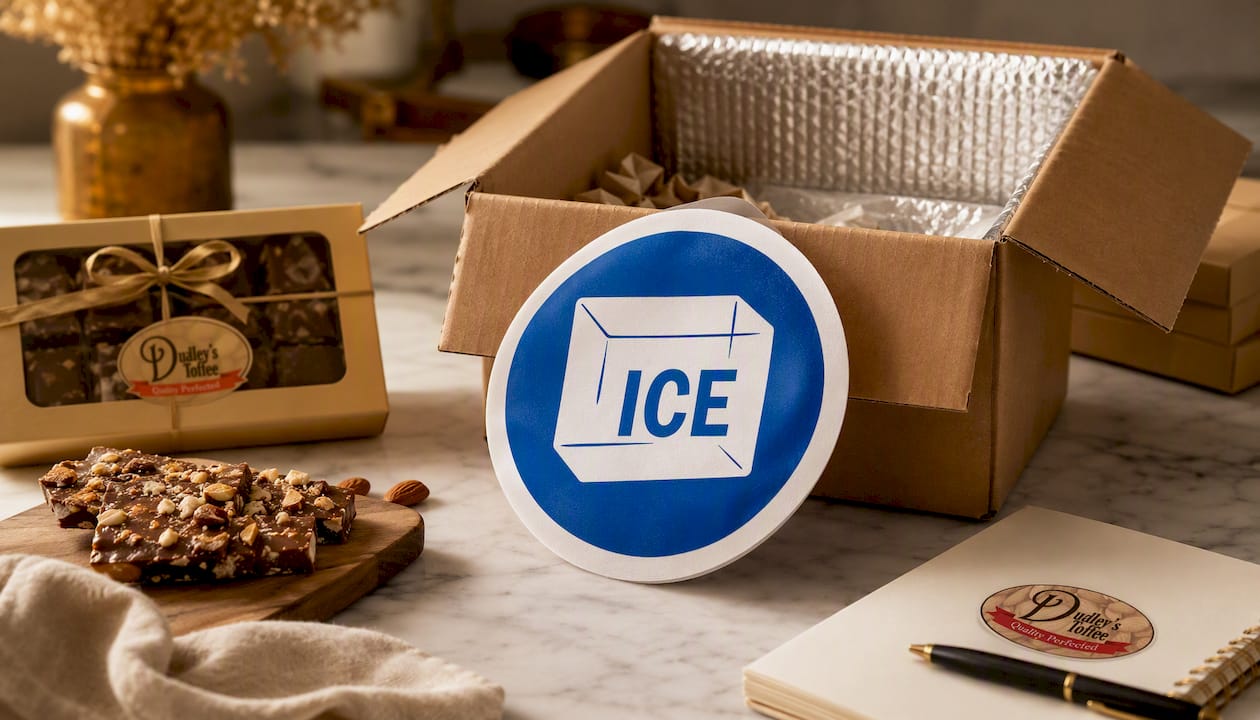
It’s built to work inside the same pack-out described above: pre-chilled, wrapped, and positioned around your toffee rather than pressed against it. It’s most useful for destinations with high summer temperatures, orders headed to the South or Southwest between June and September, or any gift where a delayed delivery is a real possibility. It’s a supplement, not a substitute. Good insulation, fast shipping, and smart timing still do most of the work; the cold pack just gives you extra margin when the forecast isn’t cooperating.
Adding it takes one click during checkout. If you’re sending toffee as a corporate gift, a fundraising thank you, or a holiday order during a warm stretch, it’s a small cost against the alternative of a disappointing unboxing. Browse our gift and gluten-free toffee options and add the cold pack at checkout the next time you’re shipping somewhere warm.
Sources
- How to ship chocolate (ParcelPath)
- Chocolate Shipping Guide: 6 Simple Steps - EasyPost
- Shipping chocolate: temperature control guide (SUAID Global)
- How to Ship Chocolate (WebstaurantStore)
FAQ
Can You Send Chocolate in the Mail Without It Melting?
Yes, if you pre-cool the product, insulate the box properly, place wrapped cold packs around the chocolate, and ship with a one or two day service. The safest internal temperature range to maintain is 55–68°F throughout transit.
How Do You Transport Chocolate So It Doesn’t Melt?
Use a snug inner box, seal the product to control moisture, add a desiccant packet, and surround it with insulation and properly wrapped refrigerants. Ship early in the week and choose expedited delivery to minimize the time chocolate spends in transit.
What Is the Best Way to Ship Chocolate?
The most reliable method combines pre-cooled packing materials, insulated liners like reflective bubble wrap, correctly placed gel packs or PCM panels, and one to two day carrier service. Avoid shipping Thursday through Sunday since weekend transit raises the odds of exposure in non-climate-controlled facilities.
What Kind of Candy Can I Send in the Mail That Won’t Melt?
Denser, lower-fat candies travel better in warm weather than soft-centered chocolates. Dudley’s Toffee, coated in milk or dark chocolate but built around a firmer toffee center, tends to hold up well in transit when packed with the same insulation and timing principles used for any chocolate-covered gift.
Should You Freeze Chocolate Before Shipping It?
No. Freezing chocolate before packing creates condensation problems as it warms back up, which increases the risk of sugar bloom. Instead, chill it to a moderate 60–65°F range before you begin assembling the shipment.