

Shipping Chocolate to Miami: Keep It From Melting
Shipping chocolate to Miami without melting comes down to four things: a rigid corrugated box, an insulated thermal liner, gel or phase-change material (PCM) packs, and an expedited 1–2 day transit service. Ship between Monday and Wednesday, and your package avoids sitting in a hot warehouse or delivery truck over the weekend.
Before you pack a single piece, gather these must-haves:
- Rigid corrugated cardboard box (appropriately sized)
- Insulated foil thermal liner or insulated mailer
- Gel packs or PCM packs (pre-conditioned per product instructions)
- Bubble wrap or kraft paper for cushioning
- Desiccant packets to control moisture
- Strong packing tape and a “Perishable” label
Pro Tip: Choose PCM packs over standard frozen gel packs when possible. PCM packs hold a target temperature longer and produce less condensation, which protects chocolate’s finish during transit.
Key Takeaways
Shipping chocolate to Miami safely requires insulation, cold packs, expedited transit, and a recipient who is ready to receive the package promptly.
| Point | Details |
|---|---|
| Ship early in the week | Send Monday through Wednesday to avoid packages sitting in heat over the weekend. |
| Choose 1–2 day service | Overnight or 2-day transit (UPS, FedEx, or USPS Express) limits heat exposure significantly. |
| Use rigid box plus insulation | A corrugated box lined with a foil thermal liner protects chocolate on all six sides. |
| Add PCM or gel packs | Position cold packs on top and sides; include a desiccant to control condensation. |
| Avoid dry ice unless trained | Dry ice requires carrier approval, special labeling, and hazmat compliance for air transport. |
| Dudley’s Toffee cold-pack option | Add the optional cold-pack upgrade at checkout for warm-weather or multi-day shipments to Florida. |
Table of Contents
- When to ship to Miami to avoid heat exposure
- Step-by-step packing checklist for safe chocolate shipments
- Which insulation and cold pack types actually work
- Which carrier and service to pick for Miami shipments
- How hot is “too hot” for chocolate in transit
- Carrier policies, labeling, and hazardous materials rules
- Recipient instructions that prevent heat damage after delivery
- How Dudley’s Toffee ships to hot destinations
- A small-batch producer’s honest take on shipping to Miami
- Dudley’s Toffee: handcrafted toffee shipped with care
- Sources
- FAQ
When to ship to Miami to avoid heat exposure
Timing is one of the most underrated variables in chocolate gift shipping to Miami. A perfectly packed box can still arrive as a puddle if it spends a weekend sitting in a non-climate-controlled facility.
- Ship Monday through Wednesday. This keeps your package moving through the carrier network during business days and avoids the Friday-to-Monday gap where parcels sit idle in warm sorting facilities.
- Avoid Friday shipments for any service longer than overnight. A 2-day shipment sent Friday often arrives Monday, adding two extra days of potential heat exposure.
- Drop off early in the day. Most carriers have same-day processing cutoffs in the early afternoon. Missing that window adds a full day to transit.
- Consider local same-day delivery for Miami addresses. Some Miami chocolatiers deliver locally if orders are placed before noon for same-day service, which eliminates transit risk entirely.
Pro Tip: If the recipient is in Miami-Dade or Broward County, check whether a local artisan chocolatier offers same-day delivery. It sidesteps the entire shipping-in-heat problem.
Step-by-step packing checklist for safe chocolate shipments
Good packing is a sequence, not just a collection of materials. Follow this order and you protect the chocolate at every layer.
Materials to gather first:
- Rigid corrugated box (snug but with room for insulation on all six sides)
- Foil-lined thermal liner or insulated box insert
- PCM or gel packs (frozen or pre-conditioned per instructions)
- Bubble wrap or kraft paper void fill
- Small desiccant packet (silica gel works well)
- Strong packing tape
- “Perishable” and “Keep from Heat” labels
Numbered packing steps:
- Pre-condition cold packs. Freeze gel packs solid or condition PCM packs according to the manufacturer’s instructions. Never place a warm pack in the box.
- Wrap each chocolate piece or box. Use bubble wrap or tissue paper to protect the finish and prevent pieces from shifting.
- Place the thermal liner inside the corrugated box. Press it firmly against all six interior faces so there are no gaps.
- Position cold packs on top and along the sides, not directly against the chocolate. Direct contact can cause condensation marks on the coating.
- Place the wrapped chocolate in the center of the box, surrounded by cushioning material.
- Add a desiccant packet to absorb any moisture that builds up inside.
- Seal the thermal liner, then close and tape the outer box securely on all seams.
- Label the outside with “Perishable,” “Keep from Heat,” and your recipient’s full address and phone number.
Box sizing matters. Leave roughly one inch of space on each side for insulation, but avoid excessive empty volume. Too much air space means the cold packs have more warm air to fight. For gift packaging ideas that balance presentation and protection, a snug fit with good cushioning is the goal.
Pro Tip: Pre-condition PCM packs exactly as the product instructions specify. Over-freezing a PCM pack can actually reduce its effectiveness at holding the target temperature.
Which insulation and cold pack types actually work
Not all thermal materials perform equally, and the difference matters when your package is crossing Florida in summer.
Insulation options:
- Foil thermal liners (bubble-lined foil bags or sheets): lightweight, affordable, and widely available. Best for overnight shipments.
- Insulated mailers: pre-formed pouches with built-in foam or foil lining. Convenient for smaller orders.
- Corrugated insulated box inserts: thicker foam panels cut to fit inside a standard box. Better thermal performance for 2-day shipments.
- Rigid cooler-style inserts: the strongest option for extended transit, though heavier and more expensive.
Cold pack types:
- Frozen gel packs: common and inexpensive. They work for overnight shipments but can produce condensation as they thaw, which may affect chocolate’s appearance.
- Phase-change material (PCM) packs: engineered to hold a specific temperature (often around 59°F or 68°F) as they transition from solid to liquid. PCM packs reduce condensation risk and maintain a stable temperature longer than standard gel packs, making them the better choice for 2-day transit to a hot destination like Miami.
Placement guidance: Position cold packs on top and along the sides of the chocolate, never underneath. Heat rises, so top placement slows the most significant heat flow. Always include a desiccant packet to manage the moisture that forms as packs thaw.
Dry ice caution: Dry ice is classified as a hazardous material by carriers. Shipping it requires special packaging, carrier approval, quantity limits, and an air-transport declaration for certain services. For domestic overnight or 2-day shipments, dry ice is generally unnecessary and adds regulatory complexity. Stick with PCM or gel packs for most chocolate shipments.
Pro Tip: Source insulated liners and PCM packs from restaurant supply stores, shipping supply retailers like Uline, or online marketplaces. Many are available in standard box sizes, which simplifies the fit.
Which carrier and service to pick for Miami shipments
Speed is your primary defense against Miami’s heat. The longer a package is in transit, the more thermal protection it needs.
Relevant services to consider:
- USPS Priority Mail: typically 1–3 days, lower cost, but no guaranteed delivery date. Riskier for chocolate in summer.
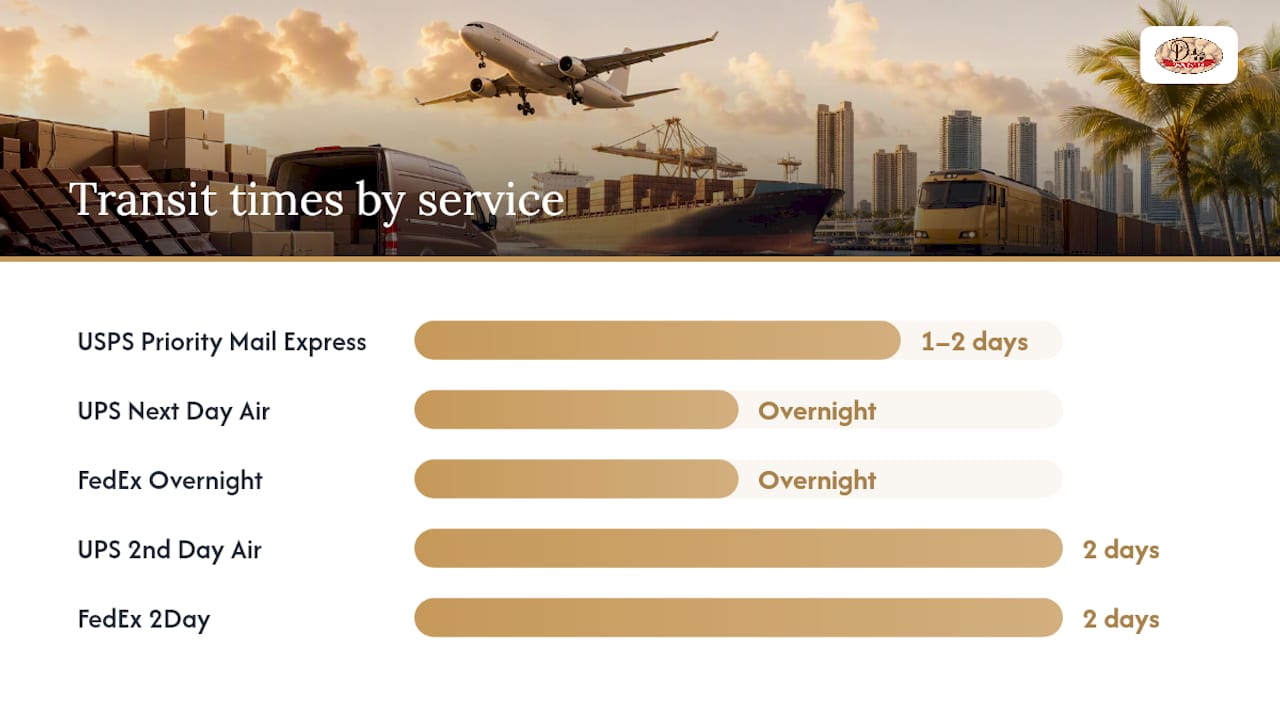
- USPS Priority Mail Express: overnight to 2-day with a money-back guarantee. More reliable for heat-sensitive shipments.
- UPS 2nd Day Air: guaranteed 2-day delivery, widely used for temperature-controlled chocolate shipments nationwide.
- UPS Next Day Air: overnight guaranteed. The most reliable option when temperatures are extreme.
- FedEx 2Day: guaranteed 2-day service with strong network coverage.
- FedEx Overnight (FedEx Express): next-business-day delivery, the premium choice for high-value or heat-vulnerable shipments.
Speed vs. cost tradeoffs:
| Service | Transit Time | Cost Shape | Heat Exposure Risk |
|---|---|---|---|
| USPS Priority Mail | 1–3 days | Lowest | Higher (no guarantee) |
| USPS Priority Mail Express | 1–2 days | Moderate | Lower |
| UPS 2nd Day Air | 2 days guaranteed | Moderate-high | Moderate with PCM packs |
| UPS Next Day Air | Overnight guaranteed | Highest | Lowest |
| FedEx 2Day | 2 days guaranteed | Moderate-high | Moderate with PCM packs |
| FedEx Overnight | Overnight guaranteed | Highest | Lowest |
For budget-conscious shippers, UPS 2nd Day Air or FedEx 2Day shipped Monday through Wednesday with PCM packs is a solid middle ground. When outdoor temperatures in Miami are sustained above 85°F, or when the shipment is high-value, overnight is worth the premium. Carrier pickup from your location is preferable to dropping off at a third-party retail location, since it reduces the time the package sits in a warm lobby.
How hot is “too hot” for chocolate in transit
Chocolate begins to soften noticeably around 75°F–80°F and can melt completely above 90°F. Miami’s average summer highs regularly exceed 90°F, and package surface temperatures in direct sun can run significantly higher than the ambient air temperature.
Practical thresholds to keep in mind:
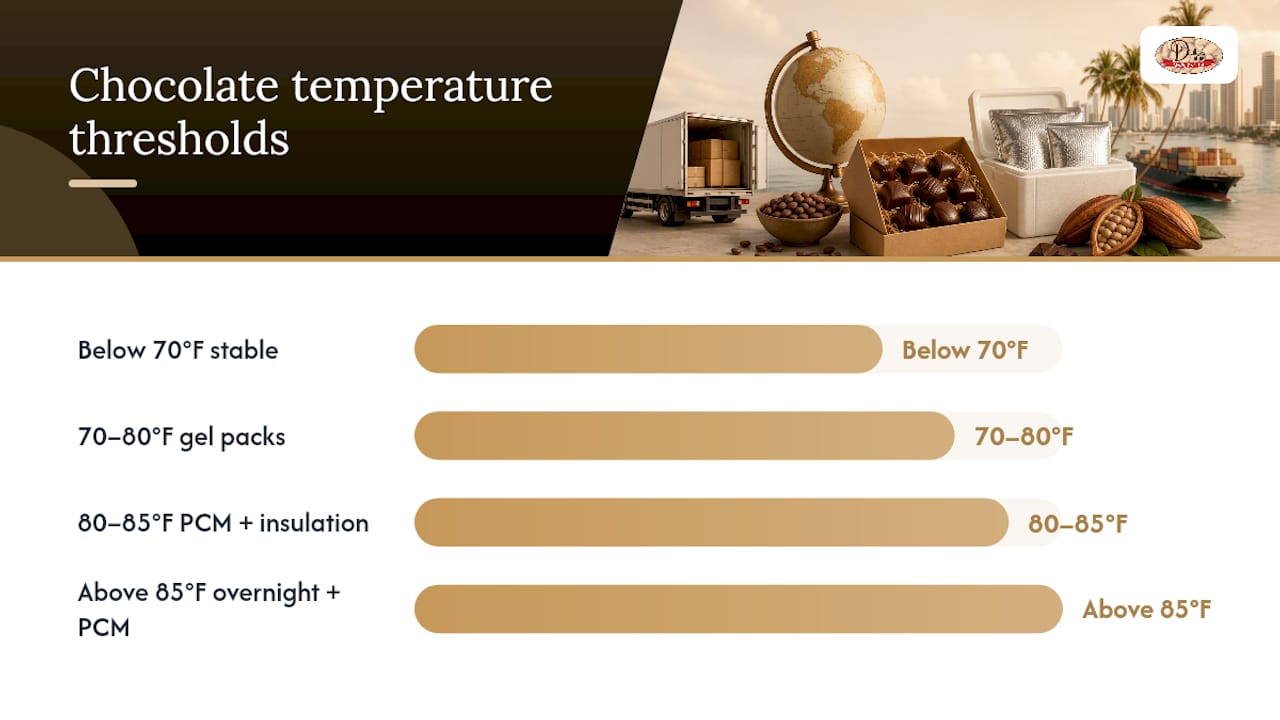
- Below 70°F (21°C): chocolate is generally stable without cold packs for short overnight transits.
- 70°F–80°F: use insulation and gel packs; overnight or 2-day service recommended.
- Above 80°F–85°F: PCM packs plus insulation are necessary; prefer overnight service.
- Sustained daytime highs above 85°F at the destination: choose overnight and add PCM packs regardless of transit time.
Transit-time tolerance matters too. A well-packed overnight shipment with PCM packs can handle Miami summer conditions reliably. A 2-day shipment with the same packing is workable if shipped early in the week. Ground shipping of 3 or more days to Miami in warm months carries a high risk of heat damage, even with insulation.
One more factor: condensation. When a cold package arrives in Miami’s warm, humid air, moisture can form on the chocolate’s surface as it warms. A desiccant packet inside the box absorbs that moisture before it affects the coating or bloom.
Carrier policies, labeling, and hazardous materials rules
Before you hand a package to any carrier, check their current terms for perishable and temperature-sensitive shipments. Policies do change, and a labeling error can delay your package or result in a refused shipment.
- Dry ice rules: USPS, UPS, and FedEx all permit dry ice shipments but require specific labeling (including the net weight of dry ice), quantity limits, and in some cases an air-transport declaration. Check each carrier’s current hazmat guidelines before using dry ice.
- “Perishable” markings: write or label “Perishable” and “Keep from Heat” on at least two sides of the outer box. This signals handlers to prioritize the package, though it does not guarantee special treatment.
- Signature required: for high-value chocolate gifts, request a signature on delivery. This prevents the package from sitting on a Miami doorstep in afternoon heat.
- Special handling options: UPS and FedEx offer temperature-controlled shipping programs for commercial shippers. These add cost but provide a more controlled environment throughout transit.
Carrier guidance pages to consult:
- USPS perishable shipping guidelines
- UPS hazardous materials and perishables
- FedEx perishable shipping requirements
Pro Tip: Always verify dry ice rules directly on the carrier’s website before your ship date. Regulations for air transport of dry ice are updated periodically, and retail staff at drop-off locations may not have the latest guidance.
Recipient instructions that prevent heat damage after delivery
Packing and carrier choice protect the chocolate during transit. What happens after delivery is the recipient’s responsibility, and a quick heads-up can save a gift from melting on a Miami doorstep.
- Share the tracking number as soon as the label is created so the recipient can monitor the delivery window.
- Ask the recipient to retrieve the package promptly, especially during Miami’s peak afternoon heat (typically 1–5 PM).
- Request a signature on delivery to prevent the carrier from leaving the package unattended.
- Suggest a delivery hold or redirect if the recipient will be away. UPS My Choice and FedEx Delivery Manager both allow recipients to redirect packages to a pickup location.
- Provide the recipient’s phone number on the label so the carrier can call if there is a delivery issue.
- For local Miami addresses, consider using a same-day local delivery service with a specific delivery window. Local delivery with a noon order cutoff eliminates transit risk entirely and gives the recipient a predictable arrival time.
How Dudley’s Toffee ships to hot destinations
Dudley’s Toffee ships its handcrafted English almond toffee nationwide, and warm-weather destinations like Florida get special attention. The optional cold-pack upgrade is available at checkout and is recommended for any order shipping to Florida during warm months or traveling via a 2-day or longer service.
Here is how Dudley’s approaches warm-weather packing:
- Insulated liners are used inside the shipping box to slow heat transfer on all sides.
- PCM or gel packs are positioned on top and along the sides of the toffee, never in direct contact with the product.
- Shipping schedules avoid weekends. Orders are processed and shipped Monday through Wednesday to prevent packages from sitting over a weekend, consistent with best practices for chocolate shipping schedules.
- Signature release options are available for customers who want to confirm the package is received promptly.
To add the cold-pack upgrade, simply select it at checkout alongside your toffee order. For bulk orders, corporate gifting, or fundraising shipments to Miami, contact Dudley’s customer service directly to discuss packing options and lead times.
Pro Tip: If you are sending Dudley’s toffee as a gift to Miami in summer, add the cold-pack upgrade and choose expedited shipping at checkout. The combination gives your gift the best chance of arriving in perfect condition.
A small-batch producer’s honest take on shipping to Miami
Shipping handcrafted toffee to a hot climate is a genuine tradeoff between cost and risk. Overnight shipping with PCM packs is the safest choice for summer shipments to Miami, and it is what Dudley’s Toffee recommends for orders traveling to Florida between May and October. For early-week shipments in mild weather, 2-day service with a cold-pack upgrade is a reasonable middle ground that most customers find acceptable. Bulk and fundraising orders need extra lead time so packing can be optimized for the quantity and the destination’s forecast. The honest answer is that no amount of clever packing fully replaces speed. The faster the package moves, the less work the insulation has to do.
Dudley’s Toffee: handcrafted toffee shipped with care
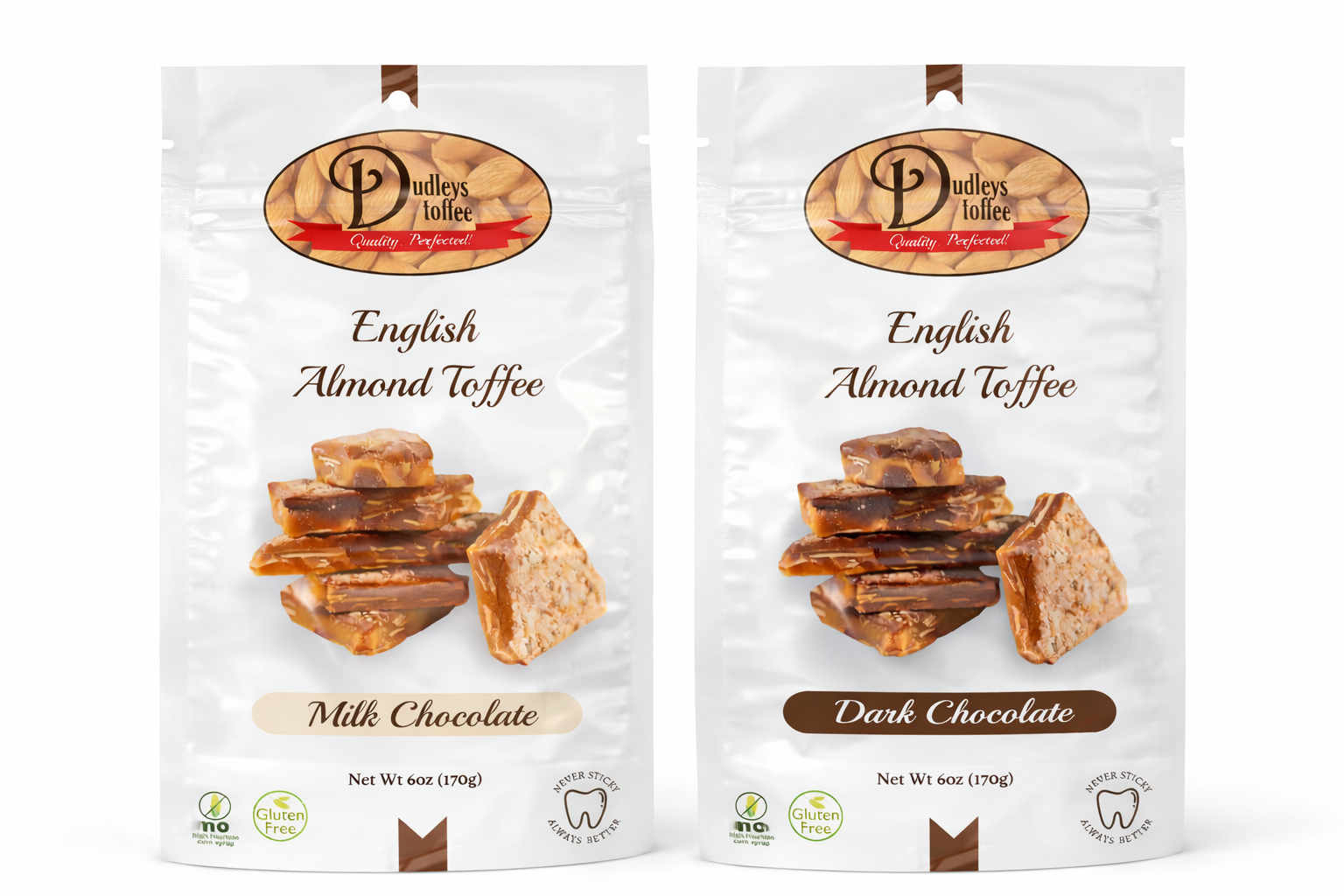
Dudley’s Toffee is handcrafted in small batches in Indiana using premium ingredients, with no high fructose corn syrup and a gluten-free recipe that produces a softer, buttery toffee in both milk and dark chocolate. When you send it to Miami, you want it to arrive exactly as it left the kitchen.
That is why Dudley’s offers a cold-pack shipping upgrade at checkout, ships Monday through Wednesday to avoid weekend transit, and uses insulated packaging designed for warm-weather destinations. Choose from individual 6 oz bags of milk or dark chocolate toffee, or order a 12-pack for gifting or fundraising. For bulk or corporate orders, the wholesale program accommodates larger quantities with flexible lead times.
Visit Dudleystoffee to place your order and add the cold-pack upgrade at checkout.
Sources
FAQ
Can you mail chocolate through USPS to Miami?
Yes. USPS Priority Mail Express is the most reliable USPS option for shipping chocolate to Miami, offering 1–2 day delivery with a money-back guarantee. Standard Priority Mail is cheaper but lacks a guaranteed delivery date, which increases heat exposure risk in warm weather.
What is the best way to ship chocolate to a hot climate?
Use a rigid corrugated box with a foil thermal liner, PCM or gel packs positioned on top and sides, and an overnight or 2-day expedited service. Ship Monday through Wednesday to avoid weekend transit delays.
How do you mail chocolate without it melting?
Combine insulated packaging, pre-conditioned cold packs, and expedited shipping (overnight or 2-day). Ship early in the week, label the package “Perishable,” and ask the recipient to retrieve it promptly upon delivery.
Are there restrictions on sending chocolate to Florida?
Chocolate is generally permitted for domestic shipping to Florida with no special permits required. Dry ice, if used as a coolant, requires carrier approval, specific labeling, and hazmat compliance. Check your chosen carrier’s current perishable and hazmat policies before shipping.
Does Dudley’s Toffee offer cold-pack shipping for Miami orders?
Yes. Dudley’s Toffee offers an optional cold-pack upgrade at checkout, recommended for orders shipping to Florida during warm months or traveling via 2-day or longer transit. Orders are shipped Monday through Wednesday to avoid weekend heat exposure.