

Keep Chocolate 55–68°F When Shipping: Tested Pack Out for Small Shops
The most reliable way to ship chocolate is an insulated liner packed with sealed, large-format gel packs, a moisture barrier, and overnight or two-day delivery. That combination keeps the inside of the box between roughly 55°F and 68°F, the range that avoids softening and melting. Dudley’s Toffee’s Optional Cold Pack for Warm Weather Shipping gives you that protection in one add-on at checkout.
TL;DR:
- Using large, leakproof gel packs combined with proper insulation typically keeps the internal temperature between 55°F and 68°F for 24 to 48 hours, preventing melting and bloom.
- Pre-cooling all packaging materials and wrapping the chocolate in a sealed moisture barrier reduces thermal load and condensation risks during transit.
- Packing smaller, controlled transit times with overnight or two-day shipping minimizes the chance of temperature breaches, especially in warmer climates or summer months.
- Phase-change materials offer longer temperature stability for shipments exceeding 48 hours or high-value products, while dry ice is generally unnecessary and risky for most chocolate shipments.
- Running test shipments with a thermometer beforehand and refining your pack-out based on actual temperature data increases reliability more than simply adding extra coolant or upgrading materials.
Table of Contents
- What You Need Before You Start Packing
- How Do You Pack Chocolate So It Doesn’t Melt in Transit?
- Which Cold Pack Should You Use, and How Many?
- Why Does Shipping Speed Matter So Much?
- How Should You Test and Refine Your Pack-Out?
- What Packaging Materials Work Best With Cold Packs?
- The Simplest Reliable Way to Ship Chocolate
- What This Article Gets Right That Most Shipping Guides Miss
- Shop Dudley’s Toffee’s Warm-Weather Shipping Solution
- Sources
- FAQ
What You Need Before You Start Packing
A good pack-out starts with the right supplies laid out on the table, not improvised halfway through taping a box shut. Here’s what a small confectionery business or a home shipper needs on hand before assembling a single order.
Insulation:
- An insulated liner or thermal mailer, sized to fit your box snugly. Reflective bubble liners, molded EPS foam liners, and kraft-clad thermal liners are the three common options, each with different price points and different landfill footprints.
Cooling:
- One or more large leakproof gel packs or phase-change material (PCM) panels. Bigger packs beat several small ones of the same total weight because mass holds cold longer than surface area alone.
- Extra zip-top bags to double-bag every gel pack before it goes anywhere near the liner.
- Absorbent pads to place under the liner and catch any stray condensation.
Primary packaging:
- Moisture-resistant inner wrap, either food-safe plastic or foil, sealed tight around the toffee or chocolate itself.
- Bubble wrap or cardboard dividers to buffer the product from direct coolant contact.
- A snug outer corrugated box. Too much empty space works against you here.
Shipping supplies:
- “Perishable, Keep Cool” labels for the outside of the box.
- Strong packing tape for sealing every seam.
- An account set up for expedited shipping, since speed matters more than almost anything else on this list.
If you would rather skip sourcing gel packs yourself, Dudley’s Toffee’s Optional Cold Pack for Warm Weather Shipping is built specifically for this checklist and ships pre-sealed.
How Do You Pack Chocolate So It Doesn’t Melt in Transit?
Order matters as much as materials. Skip a step, and you risk either a soggy box or chocolate that arrives with a dull, waxy bloom on the surface.
- Pre-cool everything 24 hours ahead. Bring your chocolate, your liner, and your packing materials down to roughly 65°F to 68°F before you touch anything. Pre-cooling the liner along with the product reduces the thermal load your gel packs have to fight, which stretches how long they stay effective.
- Lay down an absorbent pad first. This sits at the bottom of your insulated liner, ready to catch any condensation that forms later in transit.
- Wrap the product in a sealed moisture barrier. Foil or food-safe plastic, pressed tight with no gaps, keeps ambient humidity away from the chocolate’s surface.
- Add a buffer layer. Bubble wrap or a cardboard divider goes between the wrapped product and where your coolant will sit. Direct contact between gel pack and chocolate is a common mistake, and it causes localized over-chilling that can trigger its own condensation problems.
- Position your gel packs around, not against, the product. Top and sides work better than underneath, since cold air sinks. Keep that buffer layer between coolant and candy at all times.
- Compress out the dead air. Fill every gap with crumpled paper or extra bubble wrap. Empty space inside a shipping box is exactly where warm air pools and starts working against your coolant.
- Tape every seam on the outer box. A loose flap is a heat leak. Run tape along all seams, not just the top.
- Label it clearly and schedule an early-week pickup. “Perishable, Keep Cool” on the outside, then a text or email to the recipient letting them know when to expect the box.
Pro Tip: Run this exact sequence on a test box with a $10 thermometer taped inside before you commit to it for a real order. Twenty-four hours later, you’ll know whether your gel-pack count actually holds the line, instead of hoping it does.
For readers shipping into particularly warm regions, Dudley’s Toffee has walked through the specifics of shipping chocolate to Miami without losing quality along the way.
Which Cold Pack Should You Use, and How Many?
Gel packs, PCMs, and dry ice each solve a different problem, and picking the wrong one either wastes money or risks the shipment.
Gel packs are the standard choice for most orders. Paired with proper insulation, they typically hold a safe internal temperature for 24 to 48 hours, which covers the vast majority of overnight and two-day shipments. Always choose fewer, larger packs over many small ones. Retail Confectioners International recommends this specifically because mass and surface-area ratios favor the bigger format, and a simple test confirms it.
A quick test worth running: Pack two identical boxes with identical insulation. Give one a single large gel pack, the other four small packs of equal total weight. Ship both the same route and check core temperatures after 24 hours. Many packers who try this find the single large pack pulls ahead, holding cold longer than the split-up equivalent.
PCMs (phase-change materials) hold a calibrated temperature, often around 64°F to 68°F, for longer than a standard gel pack under the same conditions. They cost more, but they’re worth it for high-value orders or any shipment that might run past 48 hours in transit.
Dry ice belongs in a narrower lane. It’s built for frozen goods, not chocolate, and it introduces carrier restrictions plus a real risk of freezing your product if it isn’t buffered correctly. Reserve it for the rare case where extreme heat or a multi-day route leaves no better option, and always follow your carrier’s hazardous-materials labeling rules.
Rules of thumb for quantity:
- Small box, overnight shipping: one large gel pack.
- Medium box, two-day shipping: two medium-to-large gel packs.
- Any shipment expected to run past 48 hours: step up to PCMs, or reconsider whether dry ice is genuinely necessary.
Condensation remains the quiet threat in all three cases. Double-bag every coolant source, tuck a desiccant packet near the product, and keep that absorbent pad under the liner. Melting gel packs are the leading cause of the moisture that produces sugar bloom, the dusty white film that makes perfectly good chocolate look spoiled.
Why Does Shipping Speed Matter So Much?
Insulation only slows heat transfer. It doesn’t generate cold on its own, and every hour a box sits in a warm truck or a hot loading dock eats into the coolant’s remaining life. That’s why the shipping method you choose matters just as much as what’s inside the box.
- Choose overnight or two-day expedited service in warm weather. Ground shipping that stretches past 48 hours puts your chocolate outside the window a standard gel pack can reliably cover.
- Ship Monday through Wednesday when possible. A box that leaves your hands on Thursday or Friday risks sitting in a warehouse over the weekend, and holiday weeks compound that risk further.
- For long-distance or hot-climate destinations, upgrade your insulation and consider a PCM or, in extreme cases, dry ice. Confirm your carrier’s rules before adding dry ice to any shipment, since requirements vary.
- Request a signature or a hold-for-pickup option when you can. A box baking on a sunlit porch for six hours undoes everything you did right inside it.
The Ultimate Guide to Shipping Chocolate Safely makes the same point: keeping total transit time under 48 hours is the single biggest lever most shippers have, bigger than any coolant upgrade. A short instruction card inside the box, asking the recipient to move the package to a cool spot right away, closes the gap on that last unpredictable mile.
How Should You Test and Refine Your Pack-Out?
Pre-cooling and testing are where a shipping process stops being a guess and starts being a system. Chocolate begins to soften around 72°F, and it fully melts between 86°F and 93°F, so the goal is never “cold as possible.” It’s holding a steady range without swinging into condensation territory on the other end.
- Pre-condition your chocolate and packaging to 65°F to 68°F for 24 hours before you pack. Skipping straight to freezer-cold packaging invites condensation once the box warms back up in transit, and that moisture is what triggers bloom.
- Run at least one real test shipment with a cheap thermometer or data logger taped inside. Ship it on the actual route your customers will receive, not just across town.
- Log everything: ambient temperature that day, coolant type and count, total transit time, and the reading when the box arrives. A few logged shipments turn into a reliable standard operating procedure fast.
Pro Tip: Keep a simple spreadsheet with one row per test shipment. After five or six entries, patterns show up that no single shipment ever reveals on its own, like which routes consistently run warmer than expected.
Dudley’s Toffee built its own warm-weather approach around exactly this kind of testing, which is part of why the Optional Cold Pack for Warm Weather Shipping exists as a checkout option rather than an afterthought.
What Packaging Materials Work Best With Cold Packs?
Insulation choice comes down to a trade-off between cost, performance, and what the box looks like when it lands on someone’s doorstep.
- Reflective bubble liners are lightweight and inexpensive, good for most one- or two-day shipments, though they perform slightly below foam on longer routes.
- Molded EPS foam liners insulate the best of the three but add bulk and aren’t curbside recyclable in most areas.
- Kraft-clad thermal liners split the difference, offering solid insulation with a more sustainable, presentable exterior, which matters if the shipment is a gift.
Inside that liner, your primary wrap should always be a sealed foil or plastic barrier, with a desiccant sachet tucked nearby to soak up any stray humidity. For presentation-focused orders, pairing thermal packaging with a proper gift box arrangement keeps the unboxing experience intact even after a cold-chain trip.
Size your outer box as tightly as the contents allow. A box that’s too roomy leaves dead air for coolant to fight against, which means you need more gel packs than a properly sized box would require. Tape every seam, not just the top flaps, since a gap at a side seam lets warm air seep in just as easily as one at the top.
The Simplest Reliable Way to Ship Chocolate
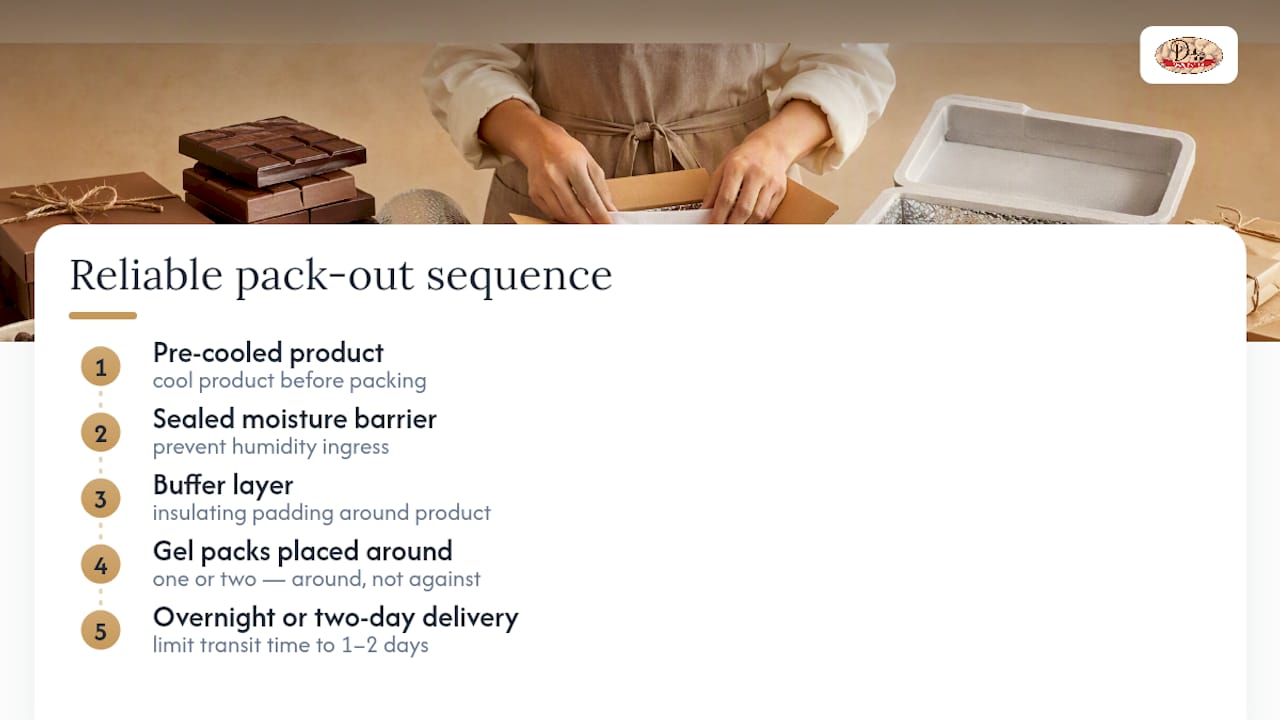
For most individual orders and small-batch business shipments, the standard pack-out holds up: pre-cooled product, sealed moisture barrier, a buffer layer, one or two large gel packs positioned around (not against) the product, and overnight or two-day delivery. That combination handles the vast majority of U.S. routes without needing to escalate further.
Escalate to PCMs when a shipment might exceed 48 hours in transit, when the destination runs consistently hot, or when the order is valuable enough that a melted box would be a real loss. Reserve dry ice for the rare edge case, and only after confirming your carrier’s rules.
Dudley’s Toffee’s Optional Cold Pack for Warm Weather Shipping is designed to slot directly into this pack-out. Consider adding it at checkout when shipping to warmer climates or during summer months to help maintain product quality. It’s a small addition that solves the one variable most likely to ruin an otherwise perfect batch of toffee.
What This Article Gets Right That Most Shipping Guides Miss
Most shipping guides treat cold packs like a checkbox: throw one in, tape the box, done. That advice undersells the two variables that actually determine whether chocolate arrives intact: pre-cooling and moisture control. A gel pack fighting against a room-temperature liner and a warm chocolate bar is working twice as hard as it needs to, and it will lose that fight faster than the label promises.
The conventional wisdom also overrates dry ice as a default upgrade. It’s the wrong tool for most chocolate shipments, since the risk of overchilling and cracking the product is real, and the paperwork burden isn’t worth it for a two-day domestic order that a well-packed gel pack setup would handle just fine.
What we’d tell any small shipper to prioritize first isn’t a fancier coolant. It’s running one honest test shipment with a thermometer taped inside before committing to a process for real customers. That single test tells you more about your actual pack-out than any generic guide, including this one, ever could.
— Dudley’s Toffee
Shop Dudley’s Toffee’s Warm-Weather Shipping Solution
Dudley’s Toffee makes this easier for anyone who would rather not source gel packs, liners, and desiccants separately. Every order ships from Indiana, handcrafted in small batches with our signature soft, buttery English almond toffee recipe in both milk and dark chocolate, and every batch is gluten-free with no high fructose corn syrup.
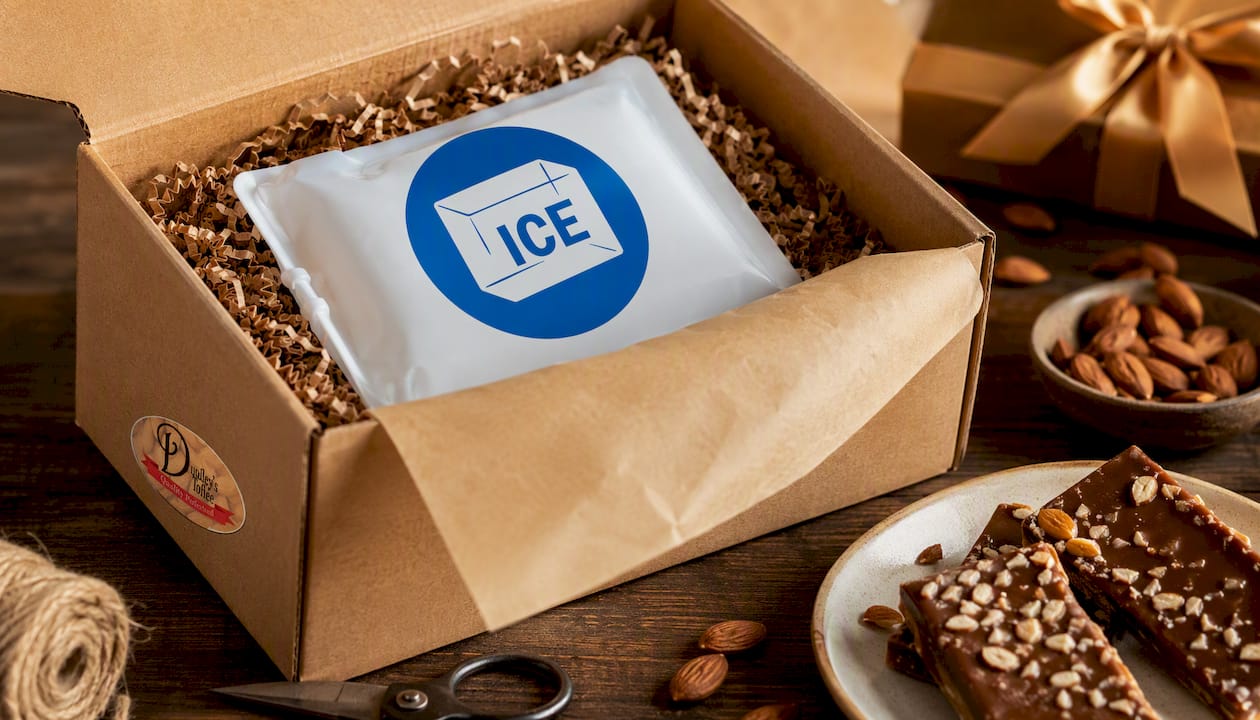
When you’re shipping into warmer months or a hotter climate, add the Optional Cold Pack for Warm Weather Shipping at checkout. It’s built around the exact pack-out this article walks through, so you’re not guessing whether a standard box will hold up on a July delivery route. For readers curious about how we keep toffee fresh between batches and shipments, our notes on storing toffee properly cover the same moisture-control principles that protect it in transit.
Visit the Dudley’s Toffee store, add a box of your favorite variety to your cart, and check the Optional Cold Pack box before checkout if you’re shipping anywhere warm this season.
Sources
- Shipping chocolate guide | IPC Pack
- How to ship chocolate | ShippingLabel
- Tip 296: Shipping Chocolate in the Summer is Possible! Here’s How! | Retail Confectioners International
- Shipping Chocolate: Temperature Control Guide | Suaid Global
FAQ
What kind of cold packs are best for shipping chocolate?
Large, leakproof gel packs are the best all-around choice for most shipments, since bigger packs hold cold longer than several smaller packs of the same total weight. PCMs are worth the upgrade for shipments running past 48 hours or for high-value orders.
What is the best way to mail chocolate without it melting?
Pre-cool the chocolate and packaging to around 65°F to 68°F, wrap it in a sealed moisture barrier, surround it with large gel packs inside an insulated liner, and ship overnight or two-day. Dudley’s Toffee’s Optional Cold Pack for Warm Weather Shipping is built to slot right into that setup.
At what temperature should you not ship chocolate?
Chocolate starts to soften around 72°F and fully melts between 86°F and 93°F, so any shipment likely to sit in temperatures above roughly 70°F for an extended period needs extra cold-pack protection or an upgraded coolant like a PCM.
What are the best insulated boxes for shipping chocolate?
Reflective bubble liners, molded EPS foam liners, and kraft-clad thermal liners are the three common options, each trading off cost, insulation strength, and presentation. Foam insulates best, kraft-clad liners look better for gifts, and reflective bubble liners are the budget-friendly middle ground for most one- to two-day shipments.