

How to Ship Chocolate in Summer Without It Melting
You can ship chocolate in summer successfully if you do three things: pre-chill the product and your packaging materials, use a reflective insulated liner with adequate refrigerant, and choose overnight or 2-day air service with a Monday through Wednesday departure. That combination keeps most chocolate shipments within the safe 50°F–70°F range from pack to doorstep.
Before you pack, run through these three actions:
- Pre-chill your chocolate and your insulated liner in the refrigerator or a wine cooler for at least two hours before packing.
- Freeze or thoroughly chill your gel packs, then wrap them in a sealed plastic bag so they never touch the chocolate directly.
- Book overnight or 2-day air service, schedule a morning pickup, and avoid Thursday or Friday departures.
Quick TL;DR:
- Keep transit as short as possible to reduce heat exposure.
- Chocolate softens near 72°F; ship it cooled rather than at room temperature.
- Avoid Thu/Fri shipments during hot weather to prevent weekend holdovers.
- Label every package “Perishable / Keep Cool.”
- Add an optional cold pack for any 2-day or longer route in warm months.
Table of Contents
- Why summer heat ruins chocolate before it arrives
- When should you ship to avoid summer heat damage?
- How to pack chocolate for a summer shipment, step by step
- Which refrigerant should you use for summer chocolate shipping?
- Which U.S. carriers work best for summer chocolate delivery?
- What to do if a shipment arrives melted
- Common mistakes that cause summer shipments to fail
- Summer chocolate shipping checklist
- Key Takeaways
- Shipping handcrafted toffee in summer: a note from Dudley’s Toffee
- Dudley’s Toffee makes summer gifting easier
- Useful sources and further reading
- FAQ
Why summer heat ruins chocolate before it arrives
Chocolate stays in its best condition between 50°F and 70°F. Softening begins around 72°F, well before a full melt, which means a package sitting on a warm loading dock for two hours can deform the product without ever reaching the temperature most people associate with melting. Milk chocolate is more vulnerable than dark chocolate because of its higher milk-fat content; if you’re shipping milk chocolate toffee, treat every warm-weather route as high risk.
Humidity compounds the problem. When a cold pack warms and moisture condenses inside the box, that moisture can cause sugar bloom, a grayish, grainy surface that forms when sugar crystals migrate to the chocolate’s surface. It doesn’t affect safety, but it does affect the premium appearance your recipient expects. Condensation can also soften the corrugated box itself, weakening the structure mid-transit. Using absorbent pads under the liner and sealed, sweat-proof gel packs reduces both problems.
Temperature fact: Chocolate softens near 72°F and can deform significantly before reaching a full liquid melt — meaning a warm truck, not a hot one, is often the culprit.
Pro Tip: Pre-chill your insulated liner and gel packs before you start packing. A liner that starts cold extends your protection window meaningfully compared to packing into a room-temperature box.
When should you ship to avoid summer heat damage?
Timing is the lowest-cost protection you have. A well-packed box shipped on a Tuesday still has a better chance of arriving intact than a perfectly packed box shipped on a Friday afternoon.
- Ship Monday through Wednesday. This keeps the package moving through the carrier network on business days, avoiding the risk of sitting in a warm regional facility over a weekend.
- Choose overnight or 2-day air as your baseline. Standard ground shipping in summer is high risk for temperature-sensitive chocolate; overnight or 2-day air is the minimum viable service level for most warm-weather shipments.
- Check route weather before you book. Look at forecast highs for your origin city, any known hub cities along the route, and the destination. Routes with sustained daytime highs above 85°F deserve heavier insulation and more refrigerant.
- Schedule morning pickups. Afternoon pickups often mean the package rides in a warm delivery vehicle before reaching a climate-controlled facility. A morning pickup buys hours of cooler handling.
- Build seasonal route profiles if you ship regularly. Tracking which routes cause problems in June through August helps you adjust liner thickness and refrigerant volume before failures happen, not after.
For 3-day transit, only proceed with heavy-duty insulation and extra refrigerant volume. Even then, avoid routes with extreme heat forecasts.
How to pack chocolate for a summer shipment, step by step
Good packing is a sequence, not a collection of tips. Follow this order every time.
Prepare your materials
Chill the chocolate in the refrigerator for at least two hours. Put your insulated liner and gel packs in the freezer or refrigerator at the same time. Assemble your outer box, tape, poly bags, desiccant or absorbent pad, and labels before you open the refrigerator. The goal is to minimize the time any cold item spends at room temperature.
Choose the right box size
A box that’s too large creates excess air volume, which warms faster than a snug fit. Use the smallest box that fits your product with the liner in place and a small air gap between the liner and the chocolate. That gap is intentional: it acts as a thermal buffer and prevents direct contact between refrigerant and product.
Line and load
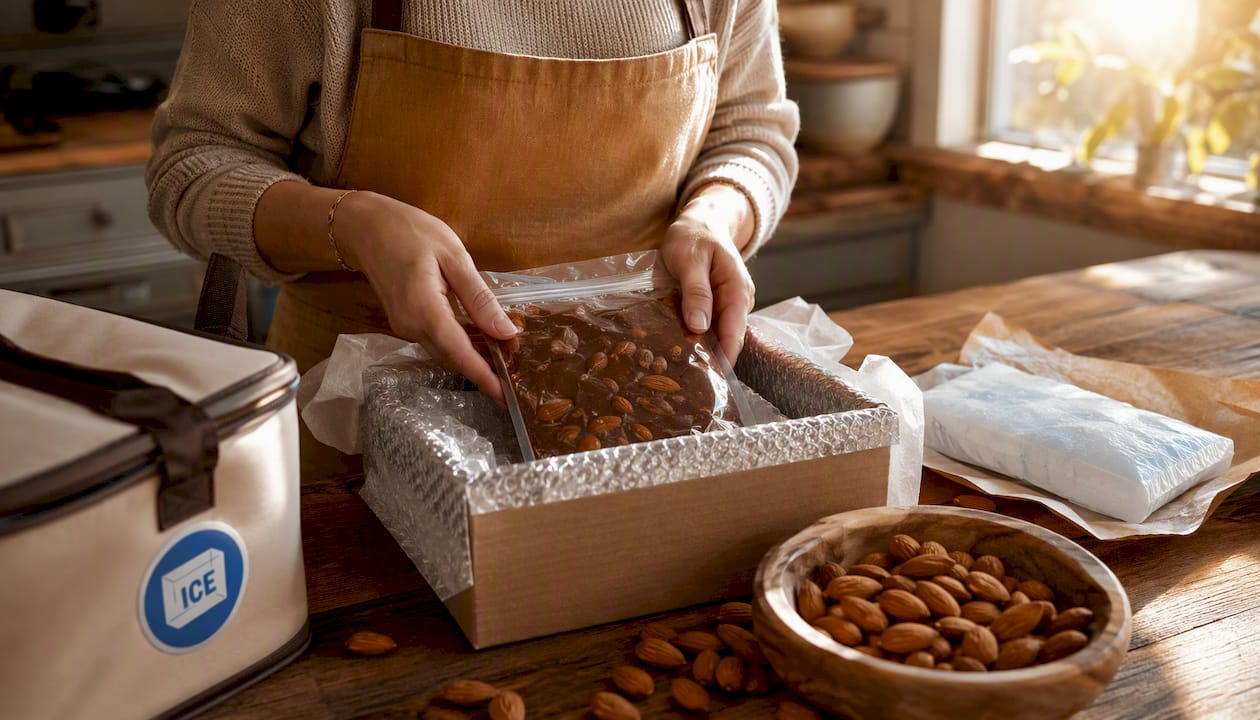
Place an absorbent pad at the bottom of the outer box. Set the insulated liner inside. Add a chilled gel pack at the bottom of the liner, then place the chocolate (sealed in a watertight poly bag) on top. Add a second gel pack on top or along the sides as needed. For reflective bubble liners, expect roughly 24 hours of effective protection; thicker cellulose or textile liners can extend that to 48 hours or more when combined with adequate refrigerant.
Control condensation
Seal the poly bag around the chocolate tightly. Wrap gel packs in a sealed plastic bag if they are not already sweat-proof. Never let a bare gel pack rest directly against chocolate — the temperature differential causes condensation and can cause sugar bloom or soggy wrappers.
Pro Tip: Use one large gel block rather than several small packs. A single large cold mass thaws more slowly than multiple small ones, giving you a longer, more stable protection window.
Seal and label
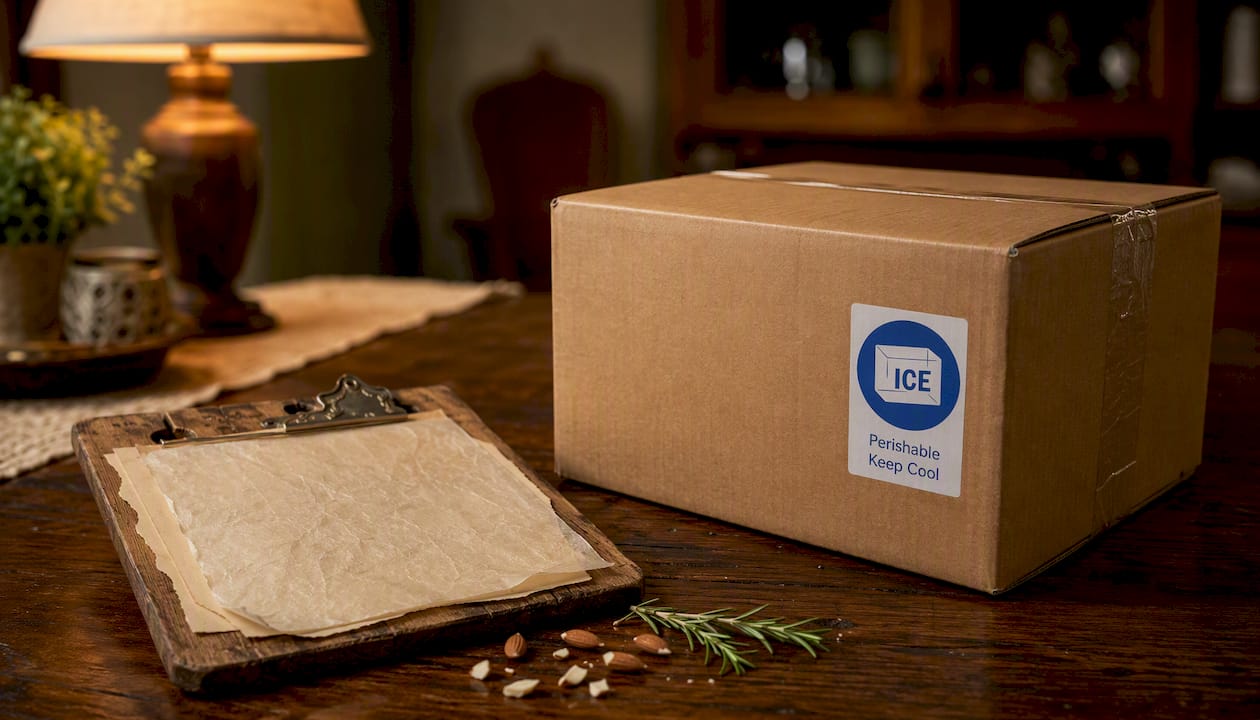
Close the liner, tape all box seams, and label the outside clearly: “Perishable / Keep Cool.” Include a packing slip inside with a brief handling note. Store the sealed box in a cool space until your carrier arrives — don’t leave it in a warm garage or on a sunny porch.
Insulation comparison at a glance:
| Liner type | Effective hold time | Best for |
|---|---|---|
| Reflective bubble liner | ~24 hours | Overnight/next-day shipments |
| Thick cellulose or textile liner | 48+ hours | 2-day air, moderate heat routes |
| Molded foam insert | 48–72 hours with gel packs | High-value or multi-day shipments |
Which refrigerant should you use for summer chocolate shipping?
Matching your cold source to your transit time is one of the most practical chocolate shipping tips you can apply.
Gel packs are the standard choice. Standard gel packs maintain temperatures below about 68°F for roughly 24–36 hours; pairing them with a reflective liner and sufficient volume can extend that to 48–72 hours. They’re non-cryogenic, easy to handle, and widely available. The main risk is condensation if the pack isn’t sealed.
Phase-change material (PCM) packs are formulated to hold a specific temperature range rather than simply staying as cold as possible. A PCM pack rated for 55°F–65°F is well-matched to chocolate’s ideal shipping window and avoids the over-chilling that can cause condensation.
Frozen bottles or large ice blocks offer a lower-cost alternative with significant thermal mass. Wrap them in sealed plastic to prevent leakage and condensation. They work well for short routes when you need bulk cold without the cost of specialty packs.
Dry ice is appropriate for multi-day, high-value, or international shipments. It extends the cooling window substantially, but it comes with real constraints: carriers require hazard labeling, quantity limits apply, and you must not seal all box seams because dry ice off-gasses CO₂ and needs ventilation. Dry ice combined with vacuum-sealed packaging extends cooling for 48-hour-plus shipments, but confirm your carrier’s specific rules before booking. For chocolate specifically, avoid letting dry ice contact the product directly — extreme cold can cause condensation damage and affect texture.
Refrigerant rule of thumb: Match your cold source to your transit time. Gel packs for overnight and 2-day; PCM or dry ice for 3-day or longer.
| Refrigerant | Hold time (summer) | Best transit window | Key consideration |
|---|---|---|---|
| Standard gel pack | 24–36 hours | Overnight/next-day | Seal to prevent condensation |
| Gel pack + reflective liner | Up to 48–72 hours | 2-day air | Volume matters; use enough |
| PCM pack (55°F–65°F) | 36–48 hours | 1–2 day | Precise temp control |
| Frozen bottle/block | 24–36 hours | Overnight/next-day | Wrap to prevent leakage |
| Dry ice | 48–72+ hours | 2–3 day or longer | Carrier rules; ventilation required |
Which U.S. carriers work best for summer chocolate delivery?
For most summer shipments, UPS Next Day Air, FedEx Overnight, and USPS Priority Mail Express are the primary service levels to consider. Two-day options from UPS and FedEx are acceptable for well-insulated packages on moderate-heat routes. Overnight or 2-day air is the minimum viable choice for temperature-sensitive chocolate in warm months; standard ground is not.
A few practical notes on booking:
- Confirm same-day pickup cutoff times with your local carrier facility. These vary by location and can be as early as 2:00 PM.
- For bulk or high-value orders, such as a case of 24 bags, consider a refrigerated 3PL or temperature-controlled freight service. The cost of a reship or refund on a large order often exceeds the premium for cold-chain freight.
- For routes through southern states in peak summer, treat the shipment the way you’d treat a winter shipment in reverse: increase refrigerant volume and liner thickness rather than relying on ambient cool air.
Premium chocolate is worth the overnight rate when you factor in the cost of replacing a melted order and the reputational cost of a disappointed recipient.
What to do if a shipment arrives melted
Act quickly and document everything.
Immediate steps: Photograph the package exterior and interior before disturbing anything. Separate any salvageable product, refrigerate it, and note the time and condition. Keep all original packaging, packing materials, and the packing slip.
Customer communication: Reach out to the buyer before they contact you. Acknowledge the issue, offer a replacement or refund, and reference any heat-advisory language you posted at checkout. Transparent policies reduce disputes and preserve trust. Dudley’s Toffee’s order protection option is worth considering for buyers who want added peace of mind on summer orders.
Carrier claims: Contact your carrier promptly. Each carrier has its own claim window, and waiting too long forfeits your right to file. Gather photos, the tracking timeline, your packing method documentation, and receipts. A well-documented claim is far more likely to be honored.
For premium handcrafted products, reshipping is usually the right call when the product value justifies it. A replacement order sent with better insulation also gives you a chance to recover the customer relationship.
Common mistakes that cause summer shipments to fail
Most summer melt failures trace back to one of these errors:
- Shipping Thursday or Friday. Packages that miss Friday delivery sit in warm facilities over the weekend.
- Using too little refrigerant. One small gel pack in a large box is not enough for a 2-day route in July.
- Placing gel packs directly on chocolate. Direct contact causes condensation and can damage the coating or wrapper.
- Overpacking and removing the air gap. Stuffing the box too tightly eliminates the thermal buffer between refrigerant and product.
- Choosing standard ground in peak heat. Ground transit in summer can mean 4–6 days in warm vehicles and facilities.
- Skipping the route weather check. A route from Indiana to Phoenix in August needs heavier insulation than a route to Chicago.
- Ignoring tracking alerts. A package stalled at a hub during a heat wave is a signal to contact the carrier immediately, not to wait and hope.
On cost: if the forecast for your route shows sustained highs above 85°F, it’s worth pausing shipments for a day or two, adding extra refrigerant, or requiring expedited shipping as the only checkout option. The short-term inconvenience is far less costly than a wave of melted-order complaints.
Summer chocolate shipping checklist
Print this and keep it at your packing station.
- [ ] Pre-chill chocolate in refrigerator (minimum 2 hours)
- [ ] Pre-chill insulated liner and gel packs
- [ ] Assemble all materials before opening refrigerator
- [ ] Select correct box size (snug fit, minimal air volume)
- [ ] Place absorbent pad at box bottom
- [ ] Insert pre-chilled insulated liner
- [ ] Add bottom gel pack (sealed in plastic bag)
- [ ] Place poly-bagged chocolate on top of gel pack
- [ ] Add top or side gel pack as needed
- [ ] Maintain air gap between refrigerant and chocolate
- [ ] Seal poly bag and liner
- [ ] Tape all outer box seams
- [ ] Label: “Perishable / Keep Cool”
- [ ] Include packing slip with handling note
- [ ] Store sealed box in cool area until pickup
- [ ] Confirm carrier pickup time and cutoff
- [ ] Record tracking number and ship date
For Dudley’s Toffee orders, add the optional cold pack at checkout for any 2-day or longer shipment during warm months.
Key Takeaways
Shipping chocolate safely in summer requires pre-chilling, adequate refrigerant matched to transit time, overnight or 2-day air service, and Monday through Wednesday departures to avoid weekend holdovers.
| Point | Details |
|---|---|
| Safe temperature range | Keep chocolate between 50°F and 70°F; softening begins near 72°F. |
| Refrigerant hold time | Standard gel packs hold below 68°F for about a day or more; a reflective liner extends that hold time significantly. |
| Transit window | Overnight or 2-day air is the minimum viable service level for summer shipments. |
| Shipping day | Ship Monday through Wednesday; avoid Thursday/Friday to prevent weekend delays. |
| Dudley’s Toffee cold pack | Add the optional cold pack at checkout for 2-day or longer warm-weather orders. |
Shipping handcrafted toffee in summer: a note from Dudley’s Toffee
Handcrafted toffee made in small batches presents a specific summer shipping challenge that mass-produced candy doesn’t face in quite the same way. Because Dudley’s Toffee is made in small batches in Indiana using premium ingredients, each piece represents real care and real cost. Sending it across the country in July without proper cold-chain handling would undermine everything that goes into making it.
The guidance in this article reflects the same approach Dudley’s Toffee applies to its own warm-weather orders: pre-chill, insulate well, choose the right refrigerant for the route, and give customers clear expectations at checkout. The optional cold pack for warm-weather shipping exists precisely because small-batch sellers shouldn’t have to permanently inflate all shipping prices to protect summer orders. Buyers who need it can add it; buyers on short, cool routes don’t have to.
Dudley’s Toffee is available in milk and dark chocolate varieties, is gluten-free, and contains no high fructose corn syrup. Both varieties are sensitive to heat, with milk chocolate being the more vulnerable of the two. For gift orders and bulk shipments alike, the cold-pack add-on is the simplest way to protect that quality from Indiana to your recipient’s door.
Dudley’s Toffee makes summer gifting easier
Sending premium handcrafted toffee as a gift in July shouldn’t require a logistics degree. Dudley’s Toffee’s optional cold pack for warm-weather shipping is a straightforward add-on at checkout that gives your order the thermal protection it needs for 2-day or longer routes during hot months. No sourcing gel packs separately, no guessing about liner thickness.
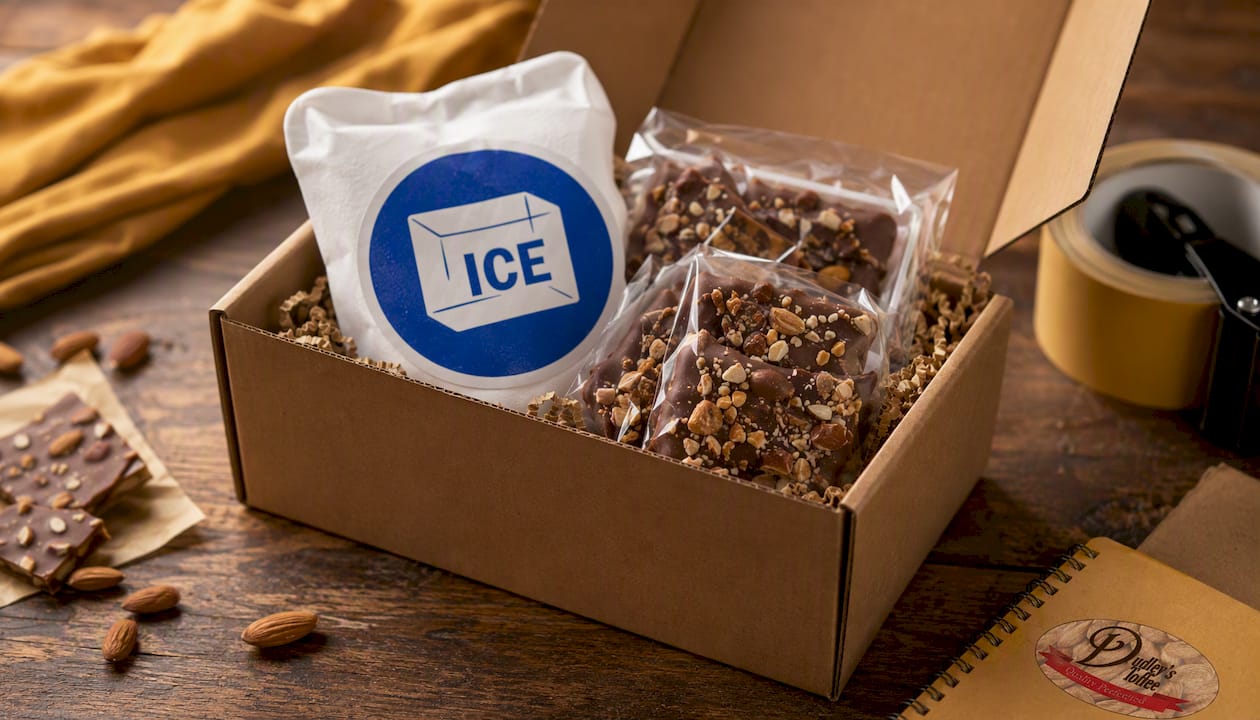
When you order, select expedited shipping, choose the cold-pack add-on if your route is 2 days or longer, and look for the heat-advisory note in the product listing so you know what to expect. Dudley’s Toffee ships its small-batch, gluten-free, Indiana-made toffee nationwide, and the cold-pack option is there specifically for summer orders where quality matters most. Browse the full collection and add your cold pack at dudleystoffee.store.
Useful sources and further reading
These resources support the guidance in this article and are worth bookmarking for ongoing reference.
- How to Ship Chocolates — TemperPack: Temperature range guidance and insulation recommendations for chocolate shippers.
- Chocolate Shipping Guide — IPC: Liner comparison, seasonal route profiling, and packaging specifications.
- How to Ship Chocolate Without Melting — ParcelPath: Gel pack hold times, dry ice guidance, and transit-time recommendations.
- Shipping Chocolate in Summer — Retail Confectioners International: Industry-backed tips on condensation control and large cold-mass performance.
- Chocolate Shipping Temperature Guidance — Suaid Global: Scheduling best practices including Thursday/Friday avoidance.
- How to Prevent Chocolate from Melting During Shipping — GBT Inc.: Service-level recommendations and checkout heat-advisory guidance.
- Shipping Chocolate — Pelton Shepherd: Cost trade-off analysis for overnight air versus reship exposure.
- Chocolate Shipping Guide — EasyPost: Step-by-step carrier booking and packaging overview.
For carrier-specific dry ice rules and quantity limits, check directly with UPS, FedEx, and USPS before booking any shipment that includes dry ice. Preserve your tracking records and packing documentation for at least 30 days after delivery in case a claim is needed.
FAQ
Can you mail chocolate in the summer?
Yes. Shipping chocolate in summer is possible when you use insulated packaging, adequate refrigerant, and overnight or 2-day air service with a Monday through Wednesday departure to avoid weekend delays.
What temperature should chocolate be shipped at?
Chocolate ships best between 50°F and 70°F. Softening begins near 72°F, so keeping the package consistently below that threshold throughout transit is the core goal.
How do you keep chocolate from melting during shipping?
Pre-chill the product and your insulated liner, use sealed gel packs or phase-change packs with a reflective or thick cellulose liner, and choose expedited transit. Never let gel packs touch the chocolate directly.
Does chocolate go bad in hot weather?
Chocolate doesn’t become unsafe from heat alone, but it can develop sugar bloom (a grayish, grainy surface) or fat bloom, lose its shape, and arrive with a degraded texture. For premium handcrafted toffee, that appearance loss matters as much as the structural damage.
Can I add a cold pack to my Dudley’s Toffee order?
Yes. Dudley’s Toffee offers an optional cold pack for warm-weather shipping that you can add at checkout, recommended for any order with a 2-day or longer transit route during warm months.
Recommended
Share