

Stop Chocolate Bloom When Shipping or Gifting: Wait 30 Minutes
Chocolate bloom is a whitish coating caused by fat migrating to the surface or sugar dissolving and recrystallizing there, and either version looks unappealing but is usually safe to eat. The two forms come from different problems: one is about cocoa butter losing its structure, the other is about moisture finding its way in. The sections ahead explain how each type forms, how to tell them apart, and how to keep it from happening to a gift box of chocolate or toffee in the first place.
TL;DR:
- Fat bloom occurs when cocoa butter shifts from stable to unstable crystal forms, especially after temperature swings and poor tempering.
- Sugar bloom results from moisture contact causing sugar to dissolve and recrystallize, creating a gritty, powdery surface that often appears after refrigeration.
- Fat bloom is identifiable by a greasy sheen and slick feel, while sugar bloom appears dusty and grainy; mold differs as fuzzy patches with a musty smell.
- Temperature cycling and humidity increase bloom risk by encouraging fat migration and surface sugar dissolution; stable storage at around 18°C prevents this.
- Re-tempering can reverse fat bloom, but sugar bloom is best used in baking, and careful handling plus stable environmental conditions prevent bloom altogether.
Table of Contents
- Fat bloom: the cocoa-butter crystal story and how tempering and temperature matter
- Sugar bloom: moisture, condensation, and why refrigeration often backfires
- How to tell fat bloom, sugar bloom, and mold apart
- Specific causes and contributing factors behind chocolate bloom
- Prevention and storage: a practical checklist for home, gifting, and shipping
- Dudley’s Toffee’s approach to shipping and arrival checks
- How Dudley’s Toffee keeps bloom risk low on every order
- A practical view on preventing bloom without wasting a gift
- Sources
- FAQ
Fat bloom: the cocoa-butter crystal story and how tempering and temperature matter
Cocoa butter can crystallize into several different structures, and only one of them, known as Form V, gives chocolate its glossy finish and clean snap. When that stable form shifts into a less orderly state, often called Form VI, liquid fat works its way to the surface, recrystallizes, and scatters light instead of reflecting it evenly. That is what produces the dull, streaky, sometimes greasy-looking film associated with fat bloom, and it happens according to research from Michigan State University Extension.
Poor tempering during manufacturing sets the stage, but temperature swings after purchase do plenty of damage on their own. Small particle sizes and oily fillings, like nut pastes or caramel centers, give fat more pathways to migrate, which is why filled chocolates often bloom faster than solid bars.
- Form V crystals create the smooth, glossy structure chocolatiers aim for during tempering.
- Heat exposure or poor tempering pushes cocoa butter toward unstable forms that migrate to the surface.
- Fillings with their own fat content speed up migration compared to solid chocolate.
A decrease in cocoa butter density as chocolate warms toward 30°C helps explain why warmth alone can trigger migration, according to food science research from the University of Wisconsin-Madison. Storage around 18°C, or roughly 64°F, keeps that structure stable, while temperatures above 30 to 32°C, or about 86 to 90°F, sharply raise the odds of bloom.
Sugar bloom: moisture, condensation, and why refrigeration often backfires
Sugar bloom starts with water, not heat. Moisture lands on the chocolate’s surface, dissolves some of the sugar sitting there, and then evaporates, leaving behind larger, coarser sugar crystals that catch light differently than the smooth surface underneath. The result often looks similar to fat bloom from a distance but feels distinctly different up close.
The most common trigger is temperature whiplash: pulling chocolate out of a refrigerator and into a warm, humid kitchen causes condensation to form on the surface almost immediately, according to Michigan State University Extension. Humid storage rooms and direct contact with water, like a splash from a sink or a damp countertop, cause the same reaction.
- Cold-to-warm transitions cause condensation that dissolves surface sugar.
- Humid storage environments feed the same dissolution and recrystallization cycle.
- Direct water contact, even a small amount, is enough to start the process.
Sugar bloom tends to feel grainy or gritty rather than slick, and it carries more risk when you try to fix it by melting. Because the sugar has already partially dissolved, reheating can cause the chocolate to seize into a clumpy, unworkable mass rather than smoothing back out.
How to tell fat bloom, sugar bloom, and mold apart
A quick look and touch test settles most of the confusion. Fat bloom shows up as a pale, sometimes greasy-looking sheen that feels slightly slick to the touch, while sugar bloom looks more like a dusty or powdery coating and feels rough or grainy. Mold looks entirely different: fuzzy, raised, and often accompanied by a musty smell that neither type of bloom produces.
- Check for a greasy, streaky sheen with a slick texture: that is fat bloom, and it is safe to eat.
- Check for a dusty, powdery, grainy coating: that is sugar bloom, also safe to eat, though the texture may be off.
- Check for fuzzy, colored patches or a musty odor: discard the item, since that points to mold rather than bloom.
When in doubt, trust your nose before your eyes. Bloom has no smell beyond the chocolate itself, while mold almost always does.
Specific causes and contributing factors behind chocolate bloom
Most bloom traces back to a handful of repeat offenders, and they tend to combine rather than act alone. Temperature cycling is the biggest one: repeated warming and cooling lets fat migrate a little further each time, a process researchers describe using capillary flow and diffusion, essentially tiny channels that liquid fat travels through as the chocolate’s internal structure shifts.
Humidity plays its own separate role. Moving chocolate between a cool room and a warm, humid one creates condensation almost instantly, which is exactly why refrigerating chocolate is often the wrong instinct even though it feels protective.
- Temperature cycling encourages fat to migrate through microscopic channels in the chocolate’s structure.
- Humid air or condensation dissolves surface sugar and sets up sugar bloom.
- Poor tempering, alternative fats, and fine particle sizes all raise a batch’s susceptibility to fat bloom.
- Oily fillings and long shelf storage give migration more time and more pathways to work with.
Cocoa butter density declines as chocolate warms toward 30°C, a shift tied to fat migration documented in research from the University of Wisconsin-Madison. That density change is a quiet process, but over weeks of storage it adds up to a visible bloom.
Prevention and storage: a practical checklist for home, gifting, and shipping
Most bloom is preventable with a few consistent habits rather than any single fix. The goal is always the same: keep the chocolate’s temperature steady and keep moisture away from its surface.
- Store chocolate in a cool place with stable temperatures and avoid sudden shifts.
- Keep the original packaging sealed until you are ready to eat it, since packaging buffers against humidity.
- Let refrigerated or chilled chocolate acclimate to room temperature inside its wrapper before opening it, which prevents the condensation that causes sugar bloom, a method recommended by the Callebaut Chocolate Academy.
- For shipping in warm weather, use insulated packaging and pay attention to transit timing rather than relying on speed alone.
- If a bar already shows fat bloom, re-tempering by gently melting and cooling it can restore the glossy finish.
- If a bar shows sugar bloom, skip re-tempering and use it in baking or melting recipes instead, since the dissolved sugar raises the risk of seizing.
Pro Tip: Never place chocolate straight from a cold shipping box into a warm kitchen. Let it sit sealed at room temperature for about 30 minutes first.
For shippers and small sellers, timing matters as much as insulation. Our own notes on testing pack out methods and shipping chocolate without melting cover how to plan around seasonal heat rather than reacting to it after a box arrives warm.
Dudley’s Toffee’s approach to shipping and arrival checks
We ship toffee, not just chocolate bars, but the same physics apply to the chocolate coating on every batch. Warm-weather orders get extra attention, since a box sitting on a porch in July behaves nothing like one delivered in October. We rely on tested cold-pack shipping methods and pay close attention to cutoff timing for gift orders so toffee spends less time in transit heat.

When a package arrives, a quick check goes a long way: feel for softness, look for a dull film instead of the usual sheen, and if anything looks off, let it sit sealed at room temperature for 30 minutes before deciding whether to eat it or set it aside for baking.

How Dudley’s Toffee keeps bloom risk low on every order
Small-batch handling means our toffee spends less time exposed to temperature swings between production and packaging, which is one of the biggest factors in keeping cocoa butter stable. We offer both milk and dark chocolate coatings, and for anyone ordering during warmer months, an Optional Cold Pack for Warm Weather Shipping is available for $2.99 to help keep the chocolate coating intact in transit.
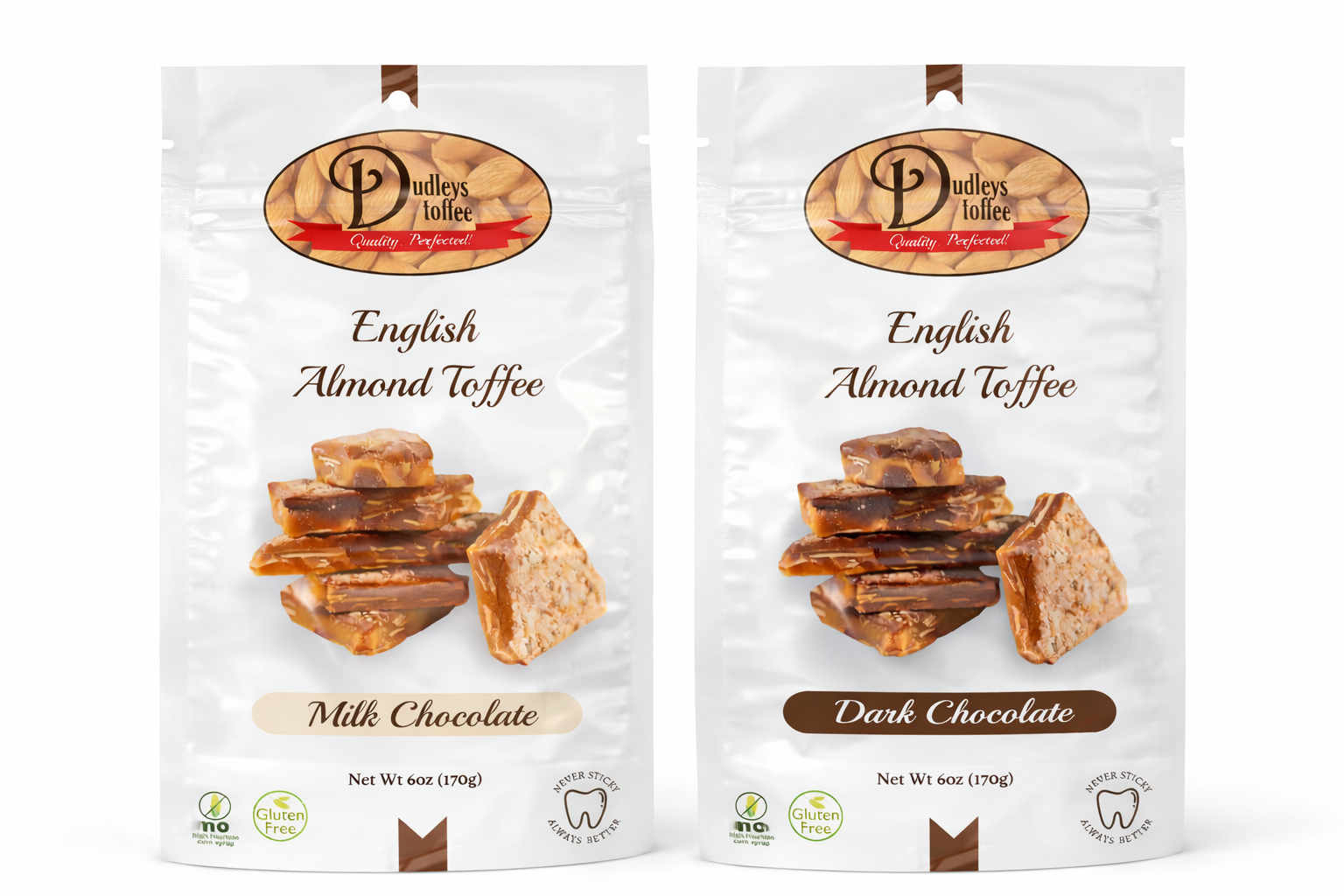
- Handcrafted in small batches using premium ingredients, with no high fructose corn syrup.
- Available in both milk and dark chocolate, and gluten-free for anyone avoiding wheat.
- Cold-pack shipping add-on available for orders heading into warm-weather transit.
Browse Dudley’s English Almond Toffee to see current milk and dark chocolate options, or add the cold pack at checkout if your order is heading somewhere warm.
A practical view on preventing bloom without wasting a gift
Bloom is frustrating mostly because it looks like something went wrong, when usually nothing did except a swing in temperature or a little stray moisture. We have learned that the fix is rarely dramatic: steady storage, sealed packaging, and a little patience when chocolate comes out of a cold box beat any complicated remedy. A bloomed bar is still worth eating or baking with, and treating it that way instead of tossing it saves both the chocolate and the goodwill of a thoughtful gift. If you are shopping for a gift that travels well, our notes on storing toffee to keep it fresh cover the same habits that protect any chocolate-coated treat, whether it came from us or somewhere else.
— Dudley’s Toffee
Sources
- Blooming chocolate | Michigan State University Extension
- Troubleshooting: Chocolate bloom — Callebaut Chocolate Academy
- Why does chocolate turn white? It’s not mold – Food Science (University of Wisconsin–Madison)
- What Is Chocolate Blooming? | Bon Appétit
FAQ
Can chocolate bloom be reversed?
Fat bloom can often be reversed by gently re-tempering the chocolate, melting it and cooling it back into a stable crystal structure. Sugar bloom is harder to reverse because the sugar has already dissolved and recrystallized, so melting it risks seizing rather than restoring a smooth finish, according to Bon Appétit’s food science reporting.
Is bloomed chocolate still safe to eat?
Yes, bloomed chocolate is safe to eat in almost every case, since bloom is a cosmetic and textural change rather than a sign of spoilage. The exception is if you see fuzzy patches or smell mustiness, which points to mold rather than ordinary bloom, according to Michigan State University Extension.
How do you stop chocolate from blooming?
Keep chocolate at a stable temperature, ideally around 18°C or 64°F, and avoid moving it quickly between cold and warm environments. Sealed packaging and acclimating chilled chocolate before opening it, as recommended by the Callebaut Chocolate Academy, both cut down on the temperature and moisture swings that trigger bloom.
How can you tell chocolate bloom from mold?
Bloom looks like a dusty or greasy film with no smell beyond the chocolate itself, while mold looks fuzzy or raised and usually carries a musty odor. If you see any fuzzy texture or off smell, discard the item rather than eating around it.
Recommended
Share