
English Toffee Calories: About 560 per 100 g and a Simple Estimator
A single piece of English toffee runs about 60 to 75 calories for a small 12 to 15 gram piece, while a standard 28 to 37 gram serving lands closer to 150 to 200 calories. The fastest way to check your own piece is to weigh it and multiply by roughly 5 to 6 calories per gram, since toffee’s butter and sugar base keeps it calorie dense no matter the brand.
TL;DR:
- Most small toffee pieces range from 60 to 75 calories, with larger servings exceeding 150 calories, so portion control is essential for moderation.
- Fat, primarily from butter, accounts for the majority of calories in toffee, with saturated fat often making up more than half of total fat content.
- Homemade toffee calorie estimates rely on weighing pieces and multiplying by a consistent calorie-per-gram figure, typically between 5.6 and 6 calories.
- Toffee’s high sugar and saturated fat content make it an occasional treat, with about 59 percent of calories coming from fat in typical 30-gram servings.
- Exact nutrition labels from small-batch brands can help accurately track calorie intake, especially for special gift or fundraiser orders.
Table of Contents
- How Many Calories Are in English Toffee Per Serving?
- What Makes Up Most of Toffee’s Calories?
- Can You Estimate Calories in Homemade Toffee?
- Is English Toffee a Healthy Snack?
- Dudley’s Toffee Nutrition Notes and What’s on Our Labels
- Enjoy It, Don’t Overthink It
- Where to Find Exact Nutrition Facts and Order Dudley’s Toffee
- Sources
- FAQ
How Many Calories Are in English Toffee Per Serving?
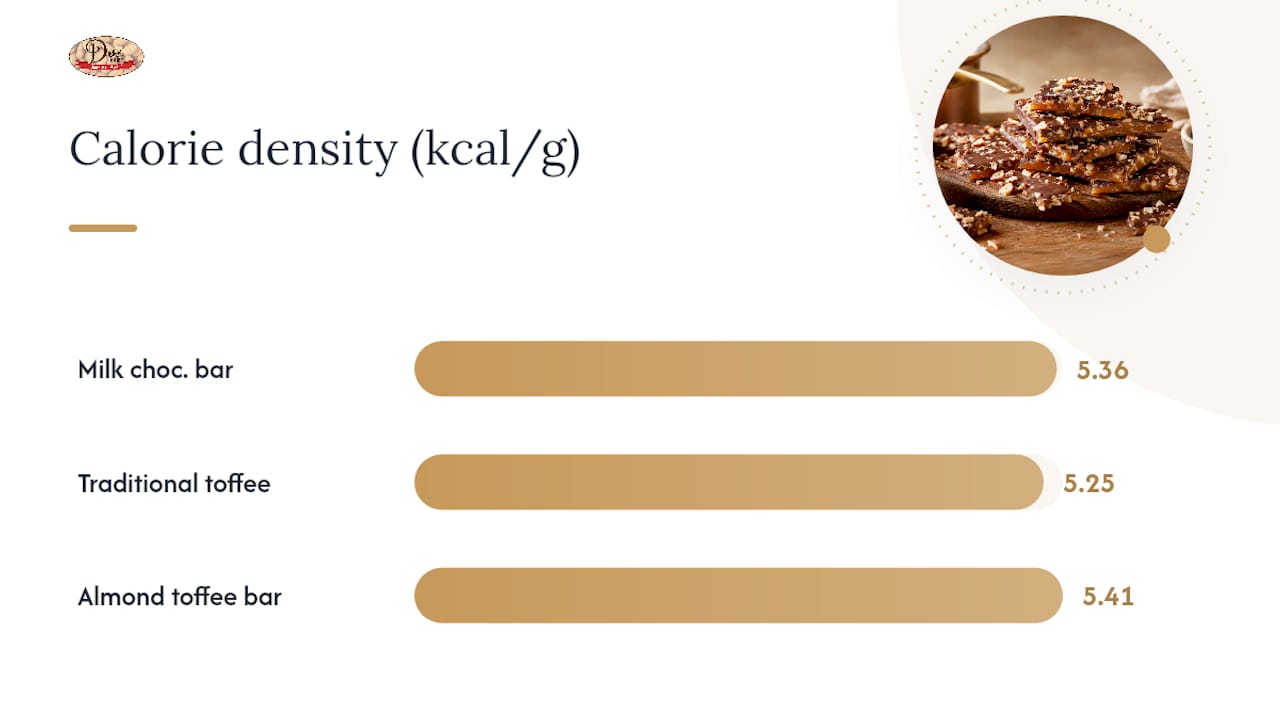
Nutrition labels on English toffee rarely agree with each other, and that’s not a red flag. It’s a reflection of how much butter, sugar, and chocolate coating go into each recipe. A milk chocolate English toffee bar comes in at 150 calories per 28 gram serving, while a traditional English toffee recipe with a heavier butter ratio reports 210 calories per 40 gram serving. Branded almond toffee bars split the difference, with one popular option landing at 200 calories per 37 gram serving.
At the small end, a 12 gram piece typically runs around 67 calories, which lines up closely with prepared-from-recipe toffee estimates in the same range. Retail options vary too. A common grab-and-go English toffee piece contains calories close to 170 for a 30 gram serving, with fat supplying a majority of those calories.
The most useful baseline number to keep in your back pocket is about 560 calories per 100 grams. That works out to about 5.6 calories per gram, a ratio that holds fairly steady across most English toffee recipes because butter and sugar dominate the ingredient list regardless of brand.
| Example | Serving size | Calories | Source |
|---|---|---|---|
| Milk chocolate toffee bar | 28 g | 150 | NutritionValue |
| Traditional English toffee | 40 g | 210 | CalorieDetails |
| Branded almond toffee bar | 37 g | 200 | MyFoodData |
| Small toffee piece | 12 g | 67 | FoodStruct |
| Standardized reference | 100 g | 560 | FoodStruct |
If you’re comparing a bag at home to a number you saw online, convert everything to grams first. Ounces and “pieces” mean different things depending on who cut the batch, but grams don’t lie.
What Makes Up Most of Toffee’s Calories?
Fat does the heavy lifting in almost every English toffee recipe, and that’s largely because butter is the backbone of the candy.
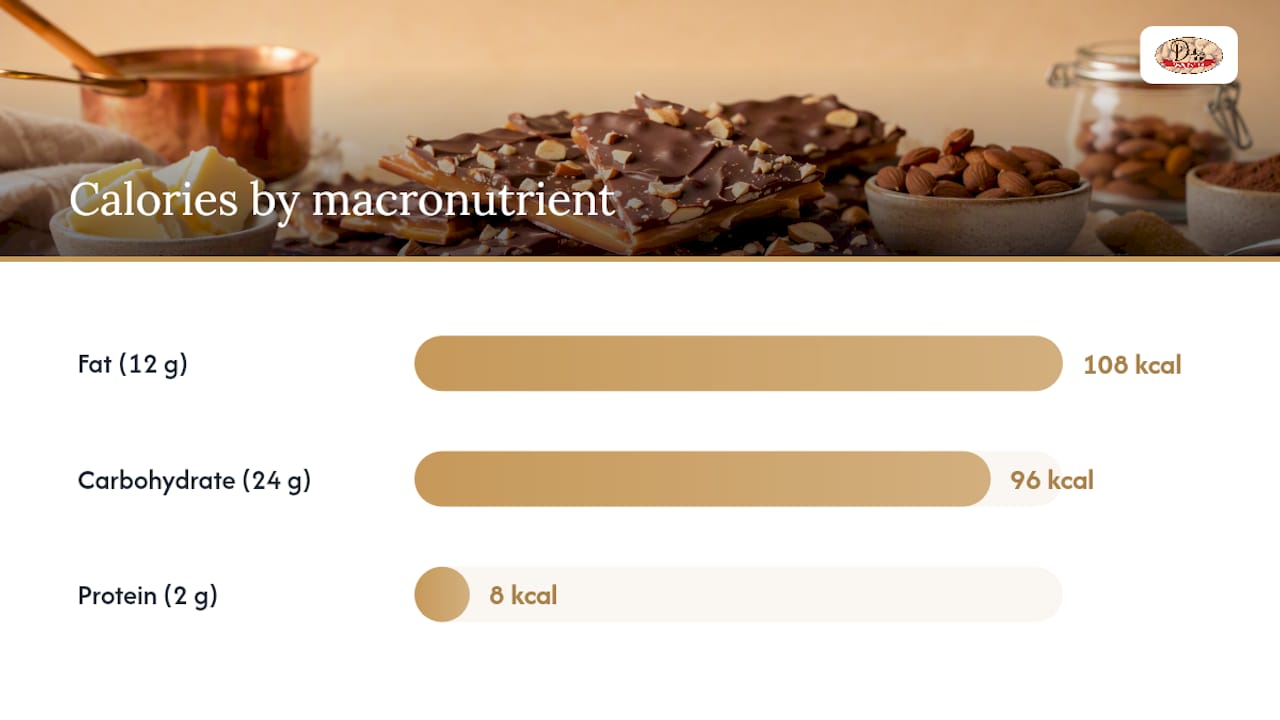
Here’s how that breaks down using standard conversions of 9 calories per gram of fat, 4 calories per gram of carbohydrate, and 4 calories per gram of protein:
- A 40 gram serving with 12 grams of fat contributes about 108 calories from fat alone.
- The same serving’s 24 grams of carbohydrate adds roughly 96 calories.
- Two grams of protein tack on only about 8 calories, a rounding error next to the fat and sugar.
Saturated fat deserves a second look on any label you’re scanning. The traditional English toffee example carries 7 grams of saturated fat in that same 40 gram serving, more than half of its total fat content. Added sugars follow the same pattern. Toffee’s signature snap and chew come from cooking butter and sugar to a specific temperature, which means there’s no getting around a sugar-heavy nutrition panel. If you’re watching saturated fat or added sugar intake for health reasons, toffee nutrition facts are worth reading before you grab a handful.
Can You Estimate Calories in Homemade Toffee?
Homemade batches almost never come with a label, and recipes vary wildly depending on how much butter, sugar, and chocolate the cook uses. You can still get a reasonably accurate estimate with a kitchen scale and a little math.
- Weigh a single piece in grams. A kitchen scale is more reliable than eyeballing size against a store-bought reference.
- Pick a calorie-per-gram range based on richness. Lean toffee recipes with less butter tend to sit closer to 5 calories per gram, while butter-heavy or nut-studded versions push toward 5.6 to 6 calories per gram.
- Multiply weight by your chosen multiplier. A 15 gram piece at 5.6 calories per gram lands at about 84 calories.
- Adjust upward for chocolate coating or almonds. Both add fat and calories, so a dipped or nut-topped piece runs higher than a plain toffee square of the same weight.
Butter and sugar are what push calories per gram higher in the first place, since both are calorie dense with almost no water content to dilute them. Nuts add their own fat and a small amount of protein, which is why an almond-studded piece outweighs a plain one at the same size on the scale.
Pro Tip: Keep a kitchen scale near your candy dish. Weighing three or four pieces once and averaging the result gives you a far more reliable per-piece calorie estimate than guessing based on size alone.
Is English Toffee a Healthy Snack?
English toffee is calorie dense, high in saturated fat, and heavy on added sugar, which makes it a treat for occasional enjoyment rather than an everyday snack choice. That’s not a knock against toffee. It’s simply what butter, sugar, and chocolate add up to when you cook them into candy.
A few practical rules make it easy to enjoy toffee without derailing your goals:
- Stick to one or two small pieces (roughly 15 to 30 grams) per sitting rather than snacking from an open bag.
- Pair a piece with coffee, tea, or a small serving of fruit to stretch out the experience without adding volume.
- Save toffee for special occasions or planned treats instead of keeping it as a daily habit.
In one branded example, fat alone accounts for roughly 59% of total calories in a single 30 gram piece. That’s the clearest illustration of why portion size matters more with toffee than with lower-density snacks like popcorn or fruit.
Dudley’s Toffee Nutrition Notes and What’s on Our Labels
Dudley’s Toffee handcrafts our English almond toffee in small batches right here in Indiana, using a recipe built for a softer, buttery texture that melts instead of sticking to your teeth. Our Dark Chocolate English Toffee (6oz) and milk chocolate varieties both come in 6 ounce (170 gram) packages, and both are gluten-free with no high fructose corn syrup.
The almond inclusion and chocolate coating on our toffee add fat and calories compared to a plain, uncoated piece, which is typical of any nut-studded, chocolate-dipped toffee. If you’re tracking exact numbers for a gift order or fundraiser, check the product page for each SKU. That’s where you’ll find the precise nutrition facts panel for the batch you’re ordering.
Enjoy It, Don’t Overthink It
We believe toffee earns its place at the table as a treat, not a diet food, and there’s no reason to feel guilty about a piece or two with your afternoon coffee. What we do want is for shoppers, gift-givers, and fundraiser organizers to have real numbers when they need them, whether that’s for a holiday gift box or a school fundraiser order. Our fundraiser packaging options make it easy to check exact per-piece calories before you commit to a bulk order.
— Dudley’s Toffee
Where to Find Exact Nutrition Facts and Order Dudley’s Toffee
Dudley’s Toffee gives you something most calorie databases can’t: a nutrition label built for the exact batch you’re buying, not an estimate pulled from a similar-sounding product.
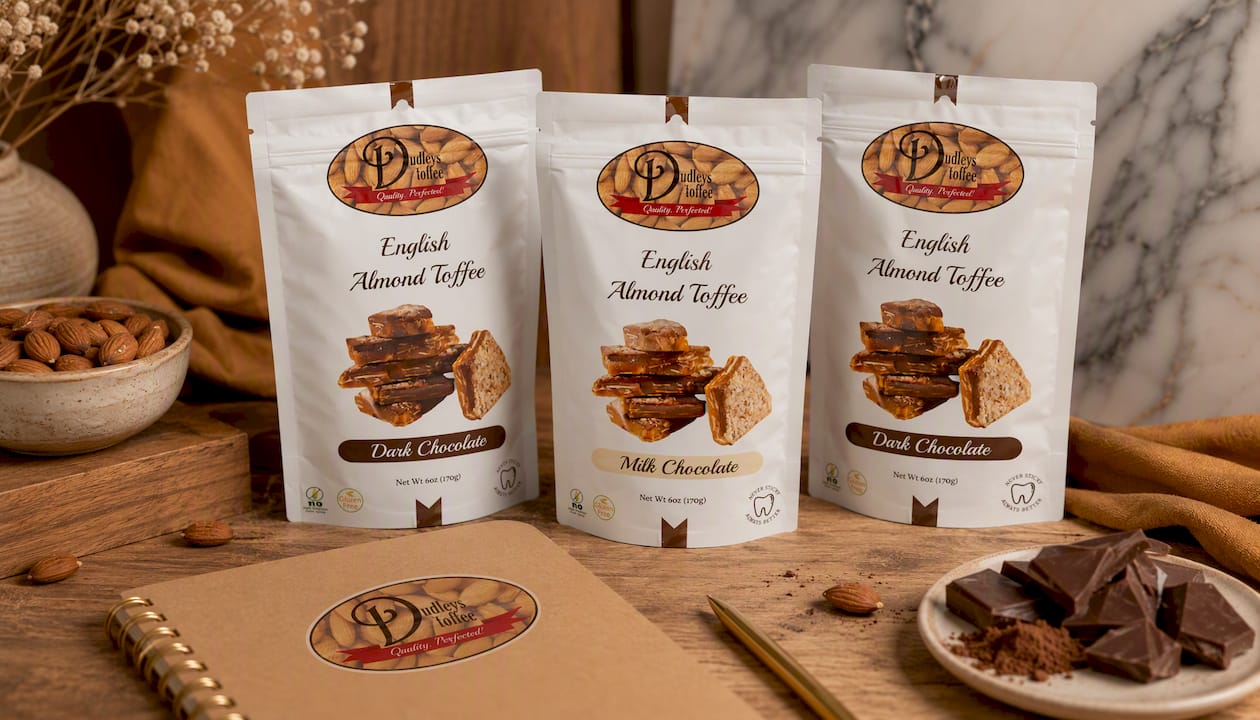
Every package we ship is handcrafted in small batches in Indiana, gluten-free, and made without high fructose corn syrup, in both milk and dark chocolate. If you want the precise calorie count before you order, our Dark Chocolate English Toffee (6oz) product page lists the full nutrition facts panel for that batch.
Organizing a school fundraiser or office collection? Our Milk Chocolate English Toffee (6oz) fundraiser option and Dark Chocolate English Toffee (6oz) fundraiser option both ship nationwide and come with the same per-piece nutrition transparency as our standard retail packs. Head to the product page that matches your order, check the label, and add it to your cart when you’re ready.
Sources
- FoodStruct — Toffee nutrition
- CalorieDetails — Traditional English Toffee
- MyFoodData — Chocolove Toffee & Almonds (nutrition facts)
FAQ
How Many Calories Are in Two Pieces of Toffee?
Two small 12 to 15 gram pieces typically add up to about 120 calories combined, though the exact number depends on piece size and whether the toffee is chocolate coated.
What’s the Difference Between English Toffee and Regular Toffee?
English toffee is traditionally cooked to a firmer, more buttery texture and often coated in chocolate with nuts pressed into the surface, while some other toffee styles skip the chocolate layer or use a chewier base. Dudley’s Toffee uses a signature recipe designed to be softer and less sticky than typical hard English toffee.
How Many Calories Are in One Piece of Toffee?
A single small piece, around 12 to 15 grams, generally contains 60 to 75 calories, while a larger 28 to 37 gram piece can run 150 to 210 calories depending on the recipe and chocolate coating.
Is Toffee a Healthy Snack?
Toffee is calorie dense and high in saturated fat and added sugar, so it’s best treated as an occasional indulgence rather than a regular snack. Sticking to one or two small pieces and pairing them with coffee or fruit keeps portions reasonable.
Recommended
Share