

Does Toffee Contain Nuts? Allergy Shoppers: Read 'May Contain' First
Short answer: sometimes. Toffee is not inherently nutty, since classic English toffee is just sugar, butter, and sometimes cream, but many commercial and gourmet toffees add almonds, pecans, or walnuts, or are made on equipment that also processes nuts. If you have a severe allergy, the only way to know for sure is to read the ingredient list and allergen statement on the specific product in front of you, or contact the maker directly before you buy.
TL;DR:
- Many commercial and gourmet toffees add nuts or process in facilities that handle nuts, posing a risk even if nuts are not listed as ingredients.
- The presence of “may contain” or facility warnings in allergen statements significantly increases the chance of cross-contact and potential allergic reactions.
- Nut substitutes like toasted coconut or crushed pretzels can provide crunch and flavor without introducing allergens, but they do not replicate the taste of actual nuts.
- Product labels are the only reliable source for allergen information, and contacting manufacturers directly is recommended for severe allergy concerns.
- Classic English toffee originally contains only sugar, butter, and cream, but many variations incorporate nuts, so always verify ingredients carefully.
Table of Contents
- What Toffee Actually Is (and Why Recipes Vary So Much)
- When Toffee Contains Nuts, and Which Nuts Show Up Most
- How to Verify a Toffee Product Is Actually Safe for You
- Smart Buying Habits That Reduce Your Risk
- Dudley’s Toffee: Brand Facts and How We Handle Ingredients
- Reading the Fine Print: Contains, May Contain, and Facility Notices
- Cross-Contamination Risk in Shared Production Facilities
- Nut Allergy Symptoms Connected to Eating Toffee
- Nut-Free Toffee vs. Toffee Containing Nuts: What Actually Changes
- Common Nut Substitutes When a Recipe Calls for Crunch
- Our Take: Why “Just Check the Label” Isn’t Quite Enough
- Where to Find Toffee You Can Trust
- Sources
- FAQ
What Toffee Actually Is (and Why Recipes Vary So Much)
Classic English toffee has a short ingredient list: sugar, butter, and often a splash of cream or milk, cooked slowly until it turns golden and firm. That’s it. No nuts required, no nuts implied. The nut-free reputation English toffee carries in some explainers comes directly from that simplicity.
American and gourmet versions tell a different story. Once you start layering chocolate, toppings, and mix-ins onto that base, you open the door to almost anything, including nuts.
- Mix-ins: nuts folded directly into the molten toffee before it sets, distributing crunch throughout every bite.
- Toppings: chopped nuts pressed onto the surface, often over a chocolate coating, for visual appeal and texture contrast.
- Flavor labels: “toffee nut” on a coffee syrup or candle usually describes a caramelized, buttery flavor profile rather than actual nut content.
That last point trips up a lot of shoppers. Seeing “toffee nut” on a product doesn’t guarantee nuts are present, and it doesn’t guarantee they’re absent either. Some consumer FAQs note the phrase is often a flavor descriptor. The label’s actual ingredient panel is the only reliable source of truth.
When Toffee Contains Nuts, and Which Nuts Show Up Most
Nuts land in toffee for a reason: texture. Toffee on its own is smooth and dense, and a scattering of almonds, pecans, or walnuts breaks that up with a satisfying crunch that many recipes are built around. Almonds bring a milder, slightly sweet flavor and a firm bite, which is why they’re the most common addition in traditional English almond toffee. Pecans add a buttery richness that pairs naturally with the caramelized sugar. Walnuts contribute a more assertive, slightly bitter edge that some dark chocolate toffees lean into deliberately.
Nuts get incorporated one of three ways, and each affects how visible they are on the label and how easy they are to spot on the candy itself.
- Folded in: nuts mixed into the toffee itself before it cools, meaning they show up in every piece even if you can’t see them from the outside.
- Pressed on top: nuts embedded into the surface before or after chocolate enrobing, usually visible at a glance.
- Sprinkled after coating: nuts added as a garnish once the chocolate shell has set, the easiest version to spot and the easiest to avoid in a nut-free line made separately.
Traditional English toffee doesn’t inherently contain nuts, but many varieties, especially American-style toffees, commonly add almonds, pecans, or walnuts, which is exactly why a blanket assumption in either direction is risky.
Here’s the number that actually matters for allergy safety: it isn’t a percentage or a ratio, it’s a label phrase. If a package says “may contain tree nuts” or “processed in a facility that also handles peanuts,” that toffee carries real cross-contact risk even if nuts never touch the recipe. That single line of text is more predictive of your risk than whether the product name mentions nuts at all.
Manufacturers add “may contain” language when they share equipment or production lines with nut-containing products, even if a specific batch has none. For someone with a severe allergy, that warning deserves the same weight as an actual ingredient.
How to Verify a Toffee Product Is Actually Safe for You
Confirming whether a specific toffee is safe takes a few minutes and a little persistence. Here’s the order to work through it.
- Find the “Contains” statement. Federal rules require major allergens to be called out clearly, and the FDA’s food labeling guidance is why you’ll typically see a bolded “Contains: Almonds” or similar line directly under the ingredient list.
- Read the “may contain” warning separately. This is a voluntary disclosure, not a legal requirement, but reputable makers include it when cross-contact is possible. Treat it as a real warning, not fine print.
- Look for facility-processing notes. Phrases like “made in a facility that also processes tree nuts” tell you about shared equipment risk even when the recipe itself is nut-free.
- Contact the manufacturer directly if anything is unclear. A quick email or phone call asking about dedicated equipment, allergen testing, or certified nut-free status is worth the few minutes it takes, especially for a severe allergy.
- Decide based on your personal risk threshold. Some people with mild sensitivities tolerate “may contain” products; others with severe, anaphylactic-level allergies avoid them entirely. That’s a conversation to have with your allergist, not a guess.
Pro Tip: Keep a running list on your phone of brands you’ve already verified as safe. Allergen statements can change when a manufacturer switches suppliers or facilities, so recheck the label every time you buy, not just the first time.
If you make toffee at home, nut-free is entirely achievable with a dedicated workspace: separate cutting boards, bowls, and utensils that never touch nuts, plus a thorough wipe-down of any shared surfaces before you start. Swap chopped nuts for toasted coconut flakes, crushed pretzels, or toffee bits alone for texture without the allergen risk.
Smart Buying Habits That Reduce Your Risk
Shopping for safe toffee comes down to reading habits more than brand names. A few practices make the difference between guessing and knowing.
- Look for explicit “nut-free” labeling on the packaging or product page, not just the absence of nuts in the product name.
- Check whether the “Contains” line lists almonds, pecans, walnuts, or peanuts, and skip the product if it does and your allergy is severe.
- Weigh “made in a facility” warnings against your personal risk tolerance. A shared-facility notice isn’t automatically disqualifying for milder sensitivities, but it should stop anyone with a history of severe reactions.
- When a product page doesn’t spell out allergen details clearly, treat that gap as a reason to contact the seller before buying, not a reason to assume it’s safe.
Retailers that take allergen labeling seriously tend to make this information easy to find. Some confectionery retailers list ingredient and allergen details directly alongside their product listings, which is the standard every candy shop should meet. If you’re researching classic toffee recipes to understand what belongs in the pan versus what’s optional, our breakdown of toffee vs. brittle walks through those ingredient distinctions in more depth.
Dudley’s Toffee: Brand Facts and How We Handle Ingredients
Dudley’s Toffee is a family-owned Indiana company that handcrafts English almond toffee in small batches using premium ingredients, and we build our recipe around almonds by design, not by accident. Our signature process creates a softer, buttery toffee that melts in your mouth instead of sticking to your teeth, a texture difference that comes from how slowly and carefully each batch is cooked.
We offer both milk and dark chocolate varieties, and both are gluten-free and made without high fructose corn syrup. Because almonds are a core, intentional ingredient in our toffee rather than an optional add-in, our product is not a nut-free option, and we want that stated plainly rather than buried in fine print. If you’re checking whether our almond toffee fits your dietary needs, the ingredient list and allergen statement on each product page are the place to start, and reaching out directly is always welcome if you have questions before you order.
Reading the Fine Print: Contains, May Contain, and Facility Notices
Allergen statements on toffee packaging generally fall into three distinct categories, and confusing them is one of the most common mistakes shoppers make.
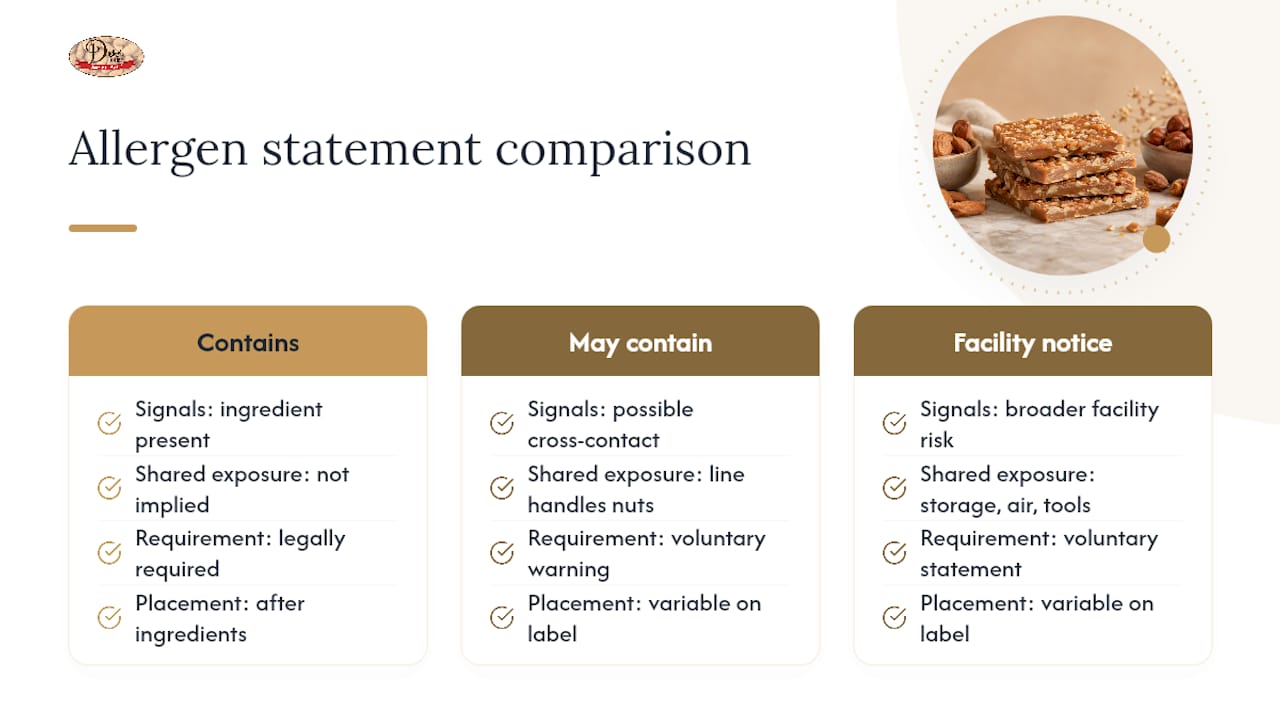
A “Contains” statement is the most direct and legally required disclosure. If almonds, peanuts, or another major allergen are actual ingredients in the recipe, federal labeling rules require the package to say so clearly, usually in bold text right after the ingredient list.
A “May contain” statement is voluntary, and that’s exactly why it matters so much. Manufacturers add this language when their production line handles nut products at some point, even if the specific item you’re holding doesn’t include nuts as an ingredient. There’s no legal requirement to include this warning, so its presence tells you the maker is being proactive about disclosure, and its absence doesn’t guarantee the product is risk-free.
A facility-processing notice, something like “made in a facility that also processes tree nuts,” addresses a broader risk than shared equipment alone. It can mean shared storage, shared air handling in some production environments, or shared cleaning tools. FDA labeling guidance covers the required disclosures, but voluntary statements like these vary by manufacturer, which is exactly why comparing two toffee brands’ labels side by side can produce two very different risk pictures even if neither lists nuts as an ingredient.
Treat all three types of statements as equally important. A product with no nuts listed but a facility warning can carry real risk for someone with a severe allergy, sometimes more risk in practice than a product that lists nuts plainly and lets you make an informed decision to avoid it.
Cross-Contamination Risk in Shared Production Facilities
Cross-contact is often the bigger threat, not the recipe itself. A toffee batch can be completely nut-free by formulation and still pick up trace amounts of nut protein from shared cooking equipment, shared cooling tables, or shared packaging lines.
This matters because trace exposure is enough to trigger a reaction in people with severe allergies, even when the amount involved would be invisible to the naked eye. For someone managing a life-threatening allergy, verifying manufacturing processes and facility warnings is a critical step that food safety guidance consistently recommends, not an optional extra precaution.
Smaller confectioners that handcraft in dedicated, single-purpose kitchens can sometimes offer more certainty here than large-scale manufacturers running multiple product lines through the same equipment. That’s not a guarantee across the board. Always confirm directly with the maker rather than assuming size or scale tells you anything definitive about their cross-contact controls.
If a company can’t or won’t answer specific questions about shared equipment, dedicated tools, or cleaning protocols between nut and non-nut batches, treat that as useful information in itself.
Nut Allergy Symptoms Connected to Eating Toffee
Reactions to nut-containing toffee follow the same pattern as reactions to nuts in any other food, ranging from mild to severe. Mild symptoms include itching or tingling in the mouth, hives, or a runny nose, usually appearing within minutes of exposure. Moderate reactions can involve stomach cramps, nausea, or swelling of the lips, tongue, or throat.
The most serious response is anaphylaxis, a rapid, whole-body reaction that can include difficulty breathing, a sudden drop in blood pressure, and loss of consciousness. Anaphylaxis requires immediate emergency treatment, typically epinephrine followed by emergency medical care, and it can occur even from trace exposure through cross-contact rather than a direct ingredient.
Because toffee is often eaten quickly, in small pieces, and sometimes without a careful label check in social settings like holiday parties or office gift exchanges, it’s worth being extra deliberate about verifying a product before you’re standing at a dessert table. If you or someone you’re buying for carries an epinephrine auto-injector, that’s a signal the stakes are high enough to skip any product with ambiguous labeling entirely, not just the ones that list nuts outright.
Nut-Free Toffee vs. Toffee Containing Nuts: What Actually Changes
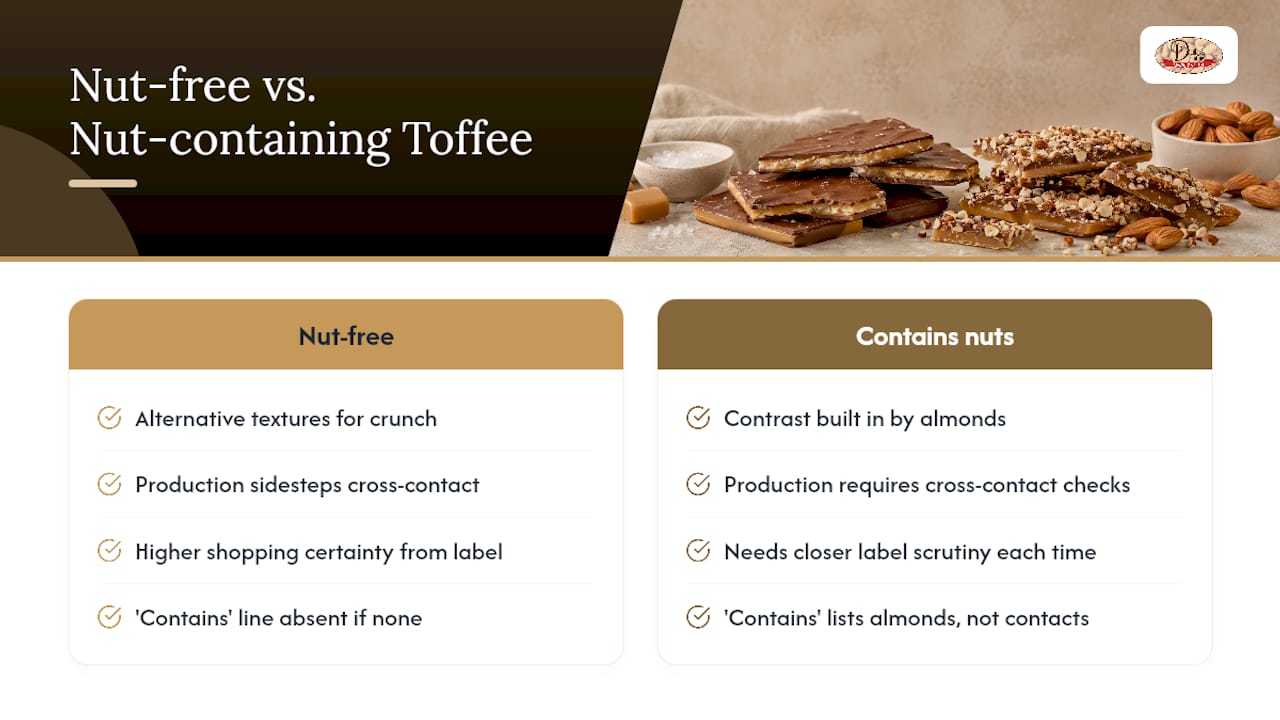
The difference between these two categories isn’t just the presence or absence of almonds. It touches texture, production process, and how confidently you can shop.
Nut-free toffee relies on alternative textures to deliver the crunch or contrast that nuts typically provide, since a completely smooth toffee can feel one-dimensional to some palates. Toffee containing nuts gets that contrast built in, but it also carries the labeling and cross-contact considerations covered above, which nut-free versions sidestep entirely when produced correctly.
From a shopping standpoint, nut-free toffee gives you far more certainty in a single label check. If the “Contains” line is clear and there’s no facility warning, you’re generally looking at a straightforward yes. Toffee containing nuts requires a closer look every time, because “toffee with almonds” tells you what’s intentionally added, but not what else the product line might have touched.
Neither version is inherently better in terms of quality or flavor. It genuinely comes down to what you’re looking for and what you can safely eat. A dedicated gift shopper buying for a mixed group, some with allergies and some without, often ends up choosing both types deliberately, keeping them clearly separated and labeled at the table.
Common Nut Substitutes When a Recipe Calls for Crunch
Home bakers and gourmet producers alike have found workable substitutes when nuts are off the table, whether for allergies or personal preference. The goal is usually replicating texture and a bit of toasty flavor without the allergen risk.
- Toasted coconut flakes add crunch and a mild sweetness, though coconut is technically classified separately from tree nuts by the FDA, so it’s worth checking your own or your recipient’s specific allergy profile.
- Crushed pretzels bring salty crunch and work particularly well folded into milk chocolate toffee.
- Toffee bits or extra caramelized sugar crystals intensify the toffee’s own flavor without introducing any new ingredient at all.
- Puffed rice or crisped cereal offers a lighter, airier crunch for bakers who want texture without density.
None of these substitutes perfectly replicate the flavor almonds or pecans bring, and that’s worth being honest about. But for someone who needs a nut-free treat without sacrificing texture entirely, they’re a reasonable middle ground, and one that home cooks use frequently in nut-free baking communities.
Our Take: Why “Just Check the Label” Isn’t Quite Enough
Most articles on this topic stop at “read the label,” and while that’s necessary, it’s not sufficient. The real gap is that allergen labeling in the United States treats “Contains” statements as mandatory and “may contain” statements as voluntary, which means two nearly identical products can carry very different levels of disclosure depending on how cautious the manufacturer chooses to be.
That inconsistency is what deserves more attention than it gets. A shopper who assumes silence on a label means safety is making a dangerous assumption, because silence might just mean the manufacturer didn’t volunteer the warning, not that no risk exists. The responsible move is contacting the maker directly when a severe allergy is involved, especially for smaller producers whose websites may not spell out every detail.
We’d also push back gently on treating “toffee nut” flavoring and actual nut ingredients as interchangeable concerns. They’re different problems requiring different label checks, and conflating them leads to either unnecessary panic or false confidence, both of which are avoidable with five extra minutes of reading.
— Dudley’s Toffee
Where to Find Toffee You Can Trust
If you’ve read this far, you already know that trustworthy toffee starts with a maker who’s upfront about what’s in the batch. That’s exactly how Dudley’s Toffee approaches every recipe: handcrafted in small batches in Indiana, using premium ingredients with no high fructose corn syrup, and built around almonds intentionally rather than as an afterthought.
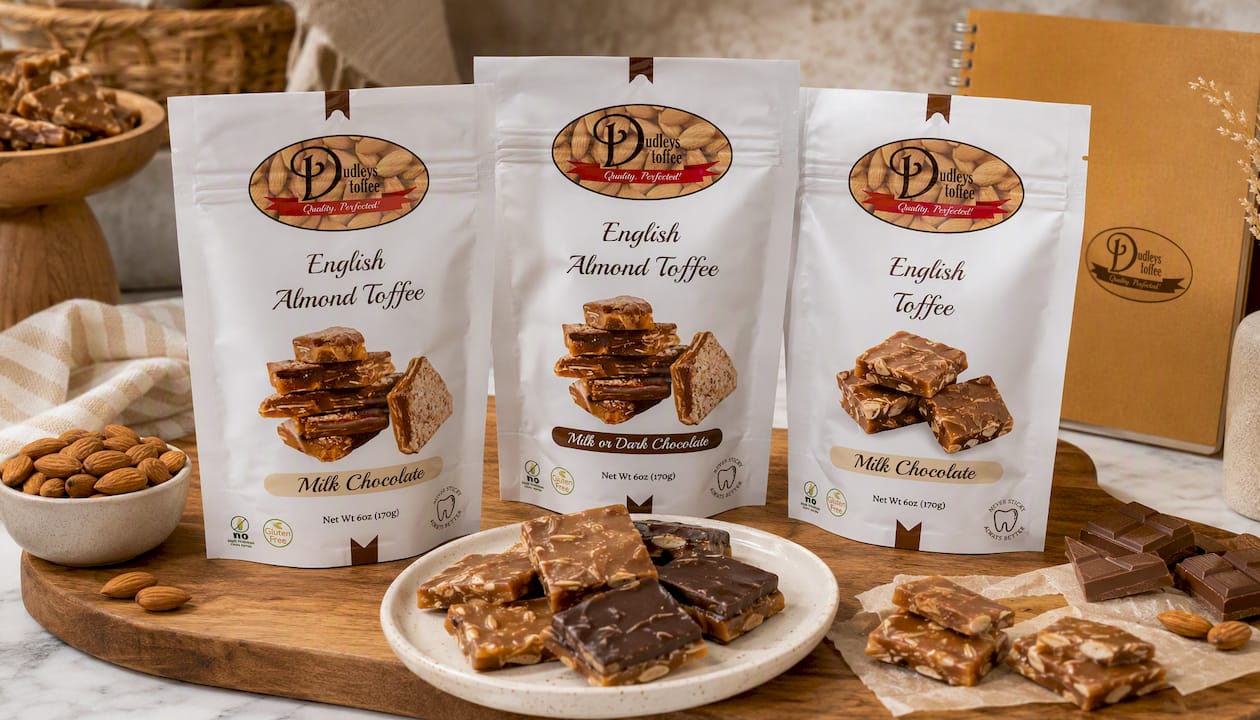
Our Milk Chocolate English Almond Toffee (6oz) and our handcrafted almond toffee in milk or dark chocolate are both gluten-free, both made without high fructose corn syrup, and both feature that signature soft, buttery texture that sets our small-batch recipe apart. If you’re organizing a group order, our fundraiser toffee option is built for bulk purchases without sacrificing the same handcrafted quality. Shipping somewhere warm? Add the cold pack for warm weather shipping for $2.99 to keep every piece in perfect shape.
Because almonds are central to our recipe, we’re not a nut-free candy shop, and we’d rather you know that upfront than find out after you order. If you have questions about our ingredients or want details before buying for someone with allergies, reach out through our website or place your order at Dudleystoffee and taste the difference small-batch, Indiana-made toffee makes.
Sources
FAQ
Can You Eat Toffee With a Nut Allergy?
It depends entirely on the specific product. Toffee made without nuts and produced in a dedicated nut-free facility is generally safe, but toffee containing almonds, pecans, or walnuts, or made in a shared facility, poses a real risk and should be avoided by anyone with a diagnosed nut allergy.
What Is the Deadliest Nut Allergy?
Peanut and tree nut allergies (which include almonds, pecans, and walnuts) are both capable of triggering severe, life-threatening anaphylaxis, and severity depends on the individual rather than the specific nut. Anyone with a diagnosed nut allergy should carry prescribed emergency medication and treat all nut exposure, including trace cross-contact, as potentially serious.
Is Toffee Nut Free?
Not universally. Classic English toffee made with just sugar, butter, and cream is nut-free by recipe, but many commercial and gourmet toffees, including Dudley’s Toffee’s almond varieties, intentionally include nuts, so checking the ingredient list on each specific product is essential.
Does Heath English Toffee Have Nuts?
Heath English toffee bars are generally made without nuts in the core recipe, relying on toffee and chocolate rather than nut mix-ins, but shoppers with severe allergies should still check the current label and allergen statement, since facility-processing warnings can change and vary by production run.
Recommended
Share