
Corn Syrup Free Toffee: An Easy Stovetop Recipe
Yes, you can make reliably crunchy toffee without corn syrup. Cook granulated sugar and butter to the hard-crack stage, around 300°F, using a candy thermometer to track the temperature instead of guessing by color. An optional tablespoon of maple syrup or honey adds flavor and a small buffer against crystallization, though it softens the finished snap slightly.
TL;DR:
- Achieving perfect crunch in toffee without corn syrup depends on precise temperature control, with the caramel reaching 300°F for a hard snap.
- Using butter, sugar, water, and optional maple syrup or honey, along with steady heat, can replicate the smoothness traditionally achieved with corn syrup.
- Proper equipment, especially a pre-clipped candy thermometer and even-heating saucepan, is essential to avoid burning, crystallization, or separation issues.
- Proper storage involves air-tight containers at room temperature, and avoiding refrigeration prevents chocolate bloom or texture deterioration.
- Substituting maple syrup or honey slightly softens the toffee, and avoiding low-fat butter or margarine helps maintain its structure and crunch.
Table of Contents
- What Ingredients Go Into Toffee Without Corn Syrup?
- What Equipment Do You Need Before You Start?
- How Do You Make Toffee Without Corn Syrup, Step by Step?
- Why Is My Toffee Grainy or Separated?
- What Substitutions and Variations Actually Work?
- How Should You Store Homemade Toffee?
- Why Dudley’s Toffee Skips Corn Syrup Too
- Prefer to Skip the Stovetop? Here’s What We Offer
- Sources
- FAQ
What Ingredients Go Into Toffee Without Corn Syrup?
Corn syrup earned its spot in old-school candy recipes because it interferes with sugar crystals forming, which is what keeps caramel and toffee smooth instead of gritty. But you don’t need it. A tight butter-to-sugar ratio and steady heat do the same job, and that’s exactly how traditional English toffee got made long before corn syrup became a pantry staple.
Here’s what a single batch requires:
- 1 cup (2 sticks) unsalted butter, real butter only
- 1 cup granulated sugar
- 2 tablespoons water (optional, helps sugar dissolve evenly)
- 1 tablespoon maple syrup or honey (optional)
- 1/4 teaspoon baking soda
- 1/2 teaspoon vanilla extract
- 1 cup chopped or sliced almonds, toasted
- 8 ounces milk or dark chocolate, melted
Butter is doing double duty here. It supplies fat for that signature melt-in-your-mouth texture, and it helps emulsify the mixture so the toffee doesn’t turn oily as it cooks. Sugar builds the structure, the actual crystalline backbone that gives toffee its crunch. Water simply helps the sugar dissolve at the start so it heats evenly rather than scorching in patches. Maple syrup or honey, if you use it, brings flavor and a mild anti-crystallization effect, though it’s not doing the heavy lifting corn syrup once did. Baking soda and vanilla go in off the heat, at the very end, where they add lift and aroma without disrupting the boil.
Skip low-fat butter substitutes or margarine. They carry too much water and not enough fat, and they will separate on you almost every time.
What Equipment Do You Need Before You Start?
Toffee making moves fast once the sugar hits temperature, so get everything ready before you turn on the stove.
- A heavy-bottomed saucepan (2 to 3 quarts) that distributes heat evenly
- A candy thermometer, clipped to the side of the pan so the tip sits in the mixture, not touching the bottom
- A rimmed baking sheet lined with parchment paper (not wax paper, which melts)
- A heatproof spatula or wooden spoon
- Toasted almonds and melted chocolate, both ready to go before the sugar comes off the stove
The thermometer matters more than most home cooks assume. Color changes late, sometimes after the sugar has already passed the point you wanted, and a few degrees separate a chewy toffee from a burnt one. Warming any cream or dairy addition slightly before it hits the hot sugar also cuts down on violent bubbling and helps everything blend smoothly.
Pro Tip: Clip your thermometer in place before you add anything to the pan. Fumbling with it once the sugar is boiling is how kitchens end up with sugar burns.
How Do You Make Toffee Without Corn Syrup, Step by Step?
-
Melt the butter over medium heat. Add the sugar and water (if using) once the butter has fully melted. Stir continuously with a heatproof spatula to help the sugar dissolve into the fat rather than sitting in clumps at the bottom.
-
Bring it to a steady boil. Keep the heat at medium, not high. Rushing this stage is the single most common reason home cooks end up with scorched sugar. Most tested no-corn-syrup recipes run 15 to 30 minutes of active cook time for this phase, and that patience pays off in flavor and texture.
-
Stir in maple syrup or honey now, if you’re using it. One tablespoon is plenty. Adding it early lets it distribute evenly rather than pooling near the surface later.
-
Watch the thermometer, not the clock. Keep stirring gently as the mixture climbs past 250°F, then 275°F. The color will deepen to an amber shade, but don’t rely on that alone. Pull the pan off the heat the moment it reaches 300°F, the hard-crack stage. If you don’t own a thermometer, the classic cold-water test works as a backup: drop a small amount of syrup into ice water, and it should form brittle threads that snap. Most recipe developers still recommend the thermometer over the cold-water method for consistency, especially the first few times you make this.
-
Remove from heat immediately. This is the moment to stir in the baking soda and vanilla extract. Adding them off-heat, rather than mid-boil, is what prevents the mixture from foaming over or breaking its emulsion at the wrong moment. The baking soda will cause a quick, satisfying fizz. That’s normal and it’s what gives the toffee its light, aerated crunch instead of a dense, tooth-breaking bite.
-
Pour immediately onto your prepared sheet. Work fast here. Toffee sets quicker than you’d expect. Use the spatula to spread it into an even layer roughly a quarter inch thick.
-
Top while it’s still warm. Pour the melted chocolate over the surface and spread it edge to edge. Scatter the toasted almonds over the chocolate while it’s still soft enough to grip them.
-
Let it cool completely, undisturbed, for at least 2 hours at room temperature before breaking it into pieces. Rushing this step is how you end up with cracked chocolate and toffee that hasn’t fully set.
A quick safety note: molten sugar sits well above boiling water temperature and causes serious burns on contact. Keep kids and pets out of the kitchen during the cook, and have a bowl of ice water nearby just in case.
Why Is My Toffee Grainy or Separated?
Grainy toffee almost always means a sugar crystal formed early and pulled others along with it, often from stirring too aggressively once the mixture starts boiling, or from sugar granules clinging to the side of the pan above the liquid line. If you catch it early, adding a splash of hot water and gently reheating to dissolve the crystals can sometimes save the batch. Once it’s fully seized and gritty, though, it’s usually not worth chasing. Start the next batch instead.
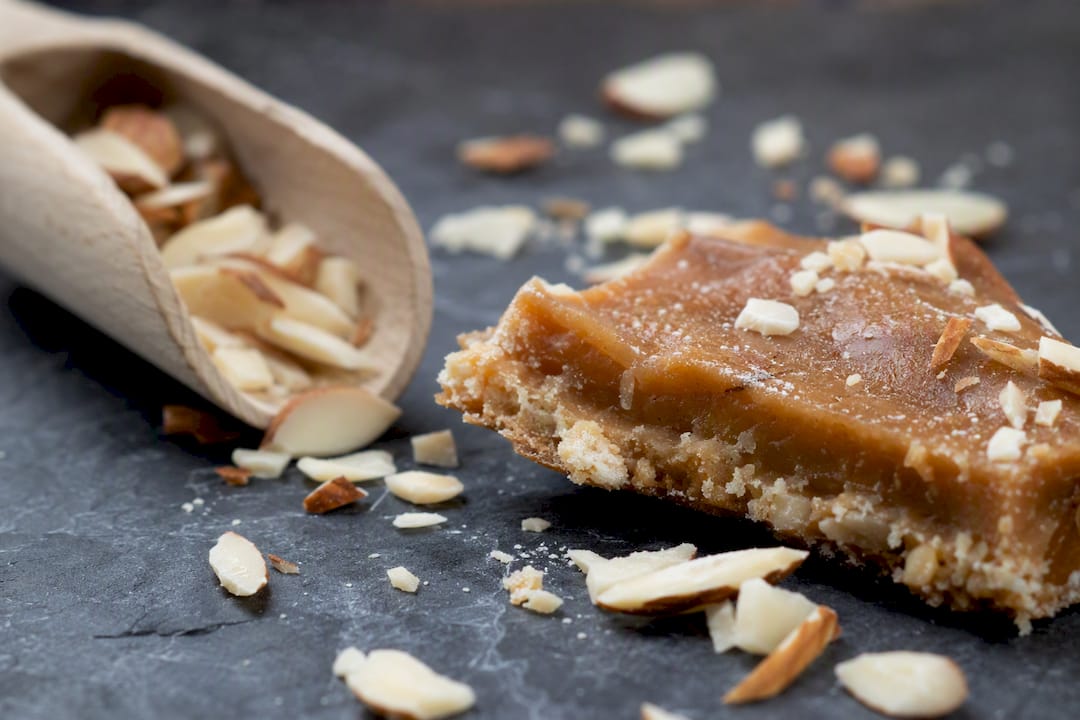
Separation, where the butter looks greasy and pools away from the sugar, usually comes down to heat that’s too aggressive or a stir that stopped too soon. Following your recipe’s exact ratios rather than eyeballing the butter or sugar amounts prevents most separation issues before they start. Keep the heat at a steady medium and stir consistently rather than walking away.
Burned sugar smells sharp and acrid, almost like scorched caramel gone wrong, and it turns a deep mahogany rather than golden amber. There’s no fixing this one. Toss it and start over with a clean pan.
Soft, chewy toffee that won’t snap usually means it never reached the full 300°F hard-crack mark. If you catch this before pouring, you can sometimes return the pan to low heat and bring it back up to temperature, though the texture may suffer slightly from the second heating.
- Stir constantly once the mixture starts boiling
- Keep heat at medium, never high
- Confirm your thermometer’s tip sits in the liquid, not against the pan
- Don’t walk away during the final 5 degrees of climb to 300°F
Pro Tip: If your thermometer seems off, test it in boiling water first. It should read 212°F at sea level. If it reads high or low, adjust your target temperature accordingly.
What Substitutions and Variations Actually Work?
Maple syrup and honey are the two most reliable stand-ins for corn syrup in a toffee base, and they each bring their own personality. A tablespoon or two is usually enough. Go much beyond that and you’ll notice the toffee turning softer and chewier rather than snapping cleanly, since both syrups introduce more moisture than corn syrup does at an equivalent volume.
- Maple syrup: Adds a warm, slightly smoky depth. Works especially well in Heath-bar style toffee bits meant for baking into cookies rather than eating as a slab.
- Brown sugar swap: Replacing part of the granulated sugar with brown sugar adds a light molasses note and a touch of extra moisture, so reduce added liquid slightly to compensate.
- Toffee bits vs. slab toffee: Bits are chopped smaller and often skip the chocolate coating, so they cook slightly less time and set faster; a whole slab needs the full cooling window before breaking.
- Nut-free version: Skip the almonds and top with a sprinkle of sea salt instead. The chocolate layer holds up fine on its own.
- Dairy-free attempts: These are genuinely difficult. Butter’s fat content is what makes toffee behave, and most dairy-free spreads carry too much water to hold the emulsion through the full boil.
How Should You Store Homemade Toffee?
Toffee keeps best in an airtight container at room temperature, away from direct sunlight or a warm kitchen window. Refrigeration isn’t necessary and can actually introduce condensation that dulls the chocolate’s shine.
- Wrap in parchment paper or layer between wax-free sheets inside a tin, never loose wax paper, which sticks to the chocolate
- Store at room temperature for up to two weeks in a sealed container
- Watch for a dull, chalky bloom on the chocolate (harmless but a sign it’s aging) or any off smell (a sign to discard)
- If shipping as a gift, use a cold pack in warm months and label the package clearly with allergy information, since almonds and dairy are both present
If you’re gifting or shipping a batch, our guide on how to store toffee and keep it fresh longer walks through packaging details specific to candy that has to survive a trip through the mail.
Why Dudley’s Toffee Skips Corn Syrup Too
We’ve built our recipe around the same principle this article walks through: a careful butter-to-sugar ratio, cooked with patience, produces better toffee than leaning on corn syrup as a crutch. Dudley’s Toffee is a family-owned company based in Indiana, and every batch we make follows our own small-batch process, handcrafted rather than mass-produced on an industrial line.
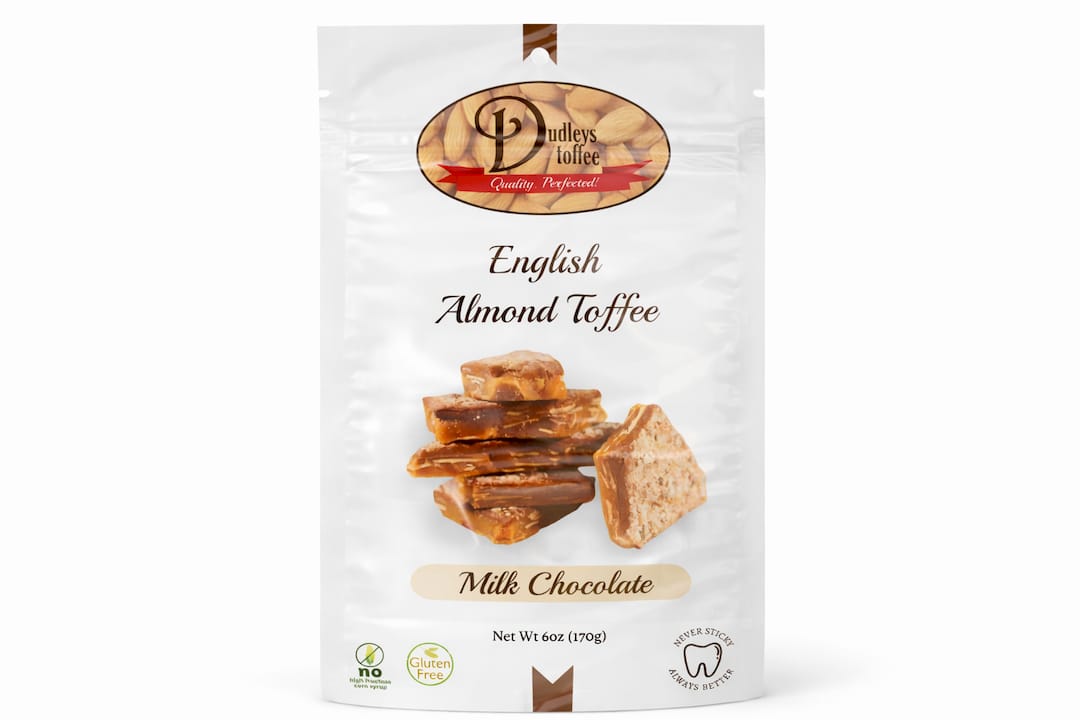
We don’t use high fructose corn syrup in any of our toffee, and both our milk and dark chocolate varieties are gluten-free. That wasn’t a trend decision. It reflects the same reasoning in this recipe: a good butter-forward toffee doesn’t need corn syrup to set up properly or hold its snap. If you’ve ever wondered why some toffee sticks to your teeth while other toffee shatters cleanly and melts away, the answer often comes down to the same variables covered here: fat ratio, cook temperature, and how the sugar was handled along the way. Our texture guide breaks down exactly what separates a soft, chewy bite from a hard, glassy one.
One packaging lesson we’ve learned running an actual toffee business: pieces ship and gift far better broken into consistent, bite-sized shapes rather than large irregular slabs. It’s a small detail, but it’s the difference between a tin that looks like a gift and one that looks like it survived a move.
— Dudley’s Toffee
Prefer to Skip the Stovetop? Here’s What We Offer
Making toffee at home rewards patience, but there are plenty of good reasons to buy it instead: a fundraiser deadline, a corporate gift list of fifty names, or simply not owning a candy thermometer. Dudley’s Toffee handcrafts small batches right here in Indiana, and every bag is gluten-free with no high fructose corn syrup, the same standard this whole recipe is built around.
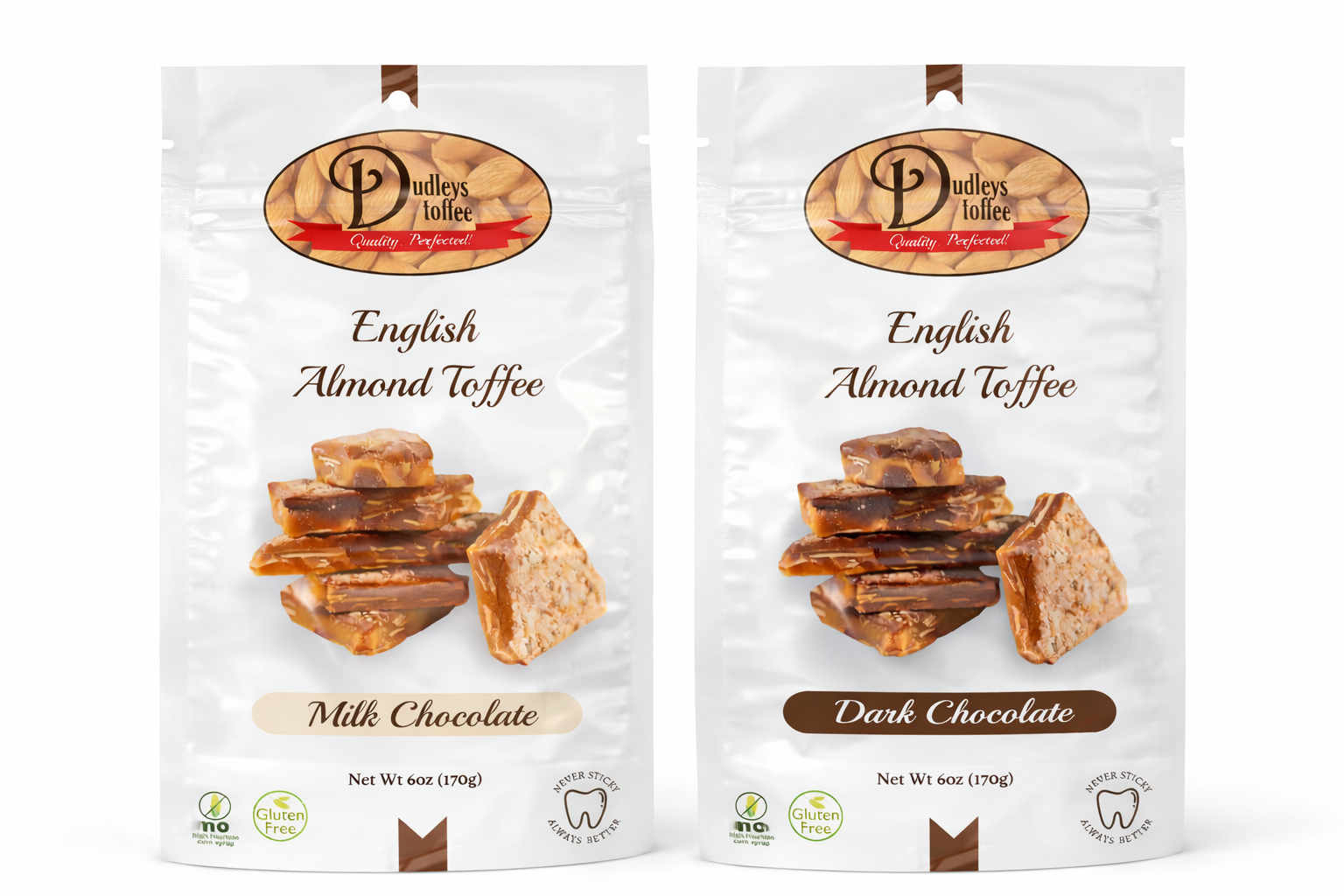
For individual gifting or a personal treat, the Milk Chocolate English Almond Toffee (6oz) and Dark Chocolate English Toffee (6oz) cover both classic preferences. If you’re stocking a fundraiser table, the Milk Chocolate English Toffee Fundraiser pack and its Dark Chocolate Fundraiser counterpart are built for exactly that. Buying a case, whether it’s the Milk Chocolate case of 24 or the Dark Chocolate case of 24, makes sense the moment you’re gifting a whole office instead of one household. Undecided between milk and dark? The Dudley’s English Almond Toffee sampler lets you try both.
If you love toffee-adjacent confections in general, it’s also worth browsing options like Toffifee’s hazelnut nougat toffee for a different take on the category. Retailers and shops interested in stocking our toffee can find details on our wholesale page. Ready to skip the candy thermometer altogether? Order a bag today and see what a corn syrup free toffee tastes like when it’s handcrafted by people who make it every day.
Sources
- Toffee Recipe | Sugar Spun Run
- How to Make Homemade Toffee Without Corn Syrup | The Rising Spoon
- 3 Ingredient Buttery English Toffee Recipe Without Corn Syrup | Gimme Yummy Recipes
- Toffee Bits From Scratch – Heath Bar Copy Cat – No Corn Syrup | Grains In Small Places
FAQ
What can I use instead of corn syrup in caramels or toffee?
Maple syrup or honey both work as partial substitutes, typically one to two tablespoons per batch, and they add flavor while helping prevent crystallization, though the final texture turns out a touch softer than a corn-syrup version.
Can I make soft caramel or toffee without corn syrup?
Yes. The butter-to-sugar ratio and cooking temperature matter more than corn syrup does, and stopping the cook a bit before the full 300°F hard-crack point yields a softer, chewier result rather than a hard snap.
What candy doesn’t have corn syrup?
Traditional English toffee, like the recipe in this article and the batches Dudley’s Toffee handcrafts in Indiana, relies on a butter-and-sugar cook rather than corn syrup, and plenty of homemade brittles and fudges can be made the same way.
How do I know when toffee has reached hard-crack without a thermometer?
Drop a small bit of the hot syrup into ice water. If it hardens instantly and snaps cleanly rather than bending, it’s at hard-crack, though a thermometer reading 300°F gives a far more reliable result every time.
Why did my corn syrup free toffee turn out grainy?
Grainy toffee usually means sugar crystals formed early, often from stirring too hard once it started boiling or from sugar clinging to the sides of the pan above the liquid line, and a fresh batch is usually easier than trying to save one that’s already seized.
Recommended
Share