

$15–$40 to Ship Chocolate Gifts in the US Without Melts
Budget $15 to $40 for shipping a small boxed chocolate gift domestically, with the exact number depending on speed and how much heat protection the box needs. Two-day shipping is the best all-around choice for most chocolate gifts, balancing cost against melt risk. Overnight makes sense only for high-value orders or last-minute deadlines, and warm-weather protection can tack on another $5 to $25 or more.
TL;DR:
- Two-day shipping typically costs $20 to $50 and offers the best balance between cost and melt risk for most chocolate gifts.
- Shipping costs are driven more by dimensional weight and insulation choices than the actual package weight, which can inflate expenses significantly.
- Cold protection materials like PCM packs and dry ice increase costs but are necessary for hot weather or long transit lanes; choosing the right type depends on lane severity.
- Upgrading to faster services or adding cold packs is crucial for shipments during warm seasons or to distant, remote, or hot climate destinations.
- Properly sizing boxes and matching packaging materials to the shipping lane can save more money than negotiating carrier rates or adding extra coolant.
Table of Contents
- How Much Does Chocolate Gift Shipping Cost?
- What Actually Drives Shipping Cost Up?
- Which Carrier and Speed Should You Choose?
- Which Pack-Out Materials Are Worth the Extra Cost?
- Do Warm Weather and Holidays Change the Price?
- How Do You Estimate Your Total Shipping Cost?
- How Can You Cut Shipping Costs Without Risking Melted Chocolate?
- How Dudley’s Toffee Approaches Shipping and Pack-Out
- What Does It Cost to Ship Chocolate Internationally?
- What Pack-Out Testing Taught Us About Shipping
- Where to Check Current Rates and Policies
- Shop Dudley’s Toffee for Your Next Gift
- Sources
- FAQ
How Much Does Chocolate Gift Shipping Cost?
The price you pay depends on three things: how fast you need it there, how much the box weighs (or appears to weigh, once carriers measure it), and whether it needs to stay cool along the way. Here’s how that breaks down by service level.
Domestic ground or USPS Priority Mail typically runs $10 to $25 for a small gift box, depending on the shipping zone and package weight. This works fine for cooler months or short-distance deliveries where a few extra days in transit won’t turn your toffee into soup.
Two-day expedited service (USPS Priority Mail Express, FedEx 2-Day, or UPS 2nd Day Air) usually lands between $20 and $50. The wider range reflects how much dimensional weight and shipping zone affect the final price. Industry guides consistently point to two-day as the sweet spot for cost versus temperature exposure for premium chocolate shipped in temperate seasons.
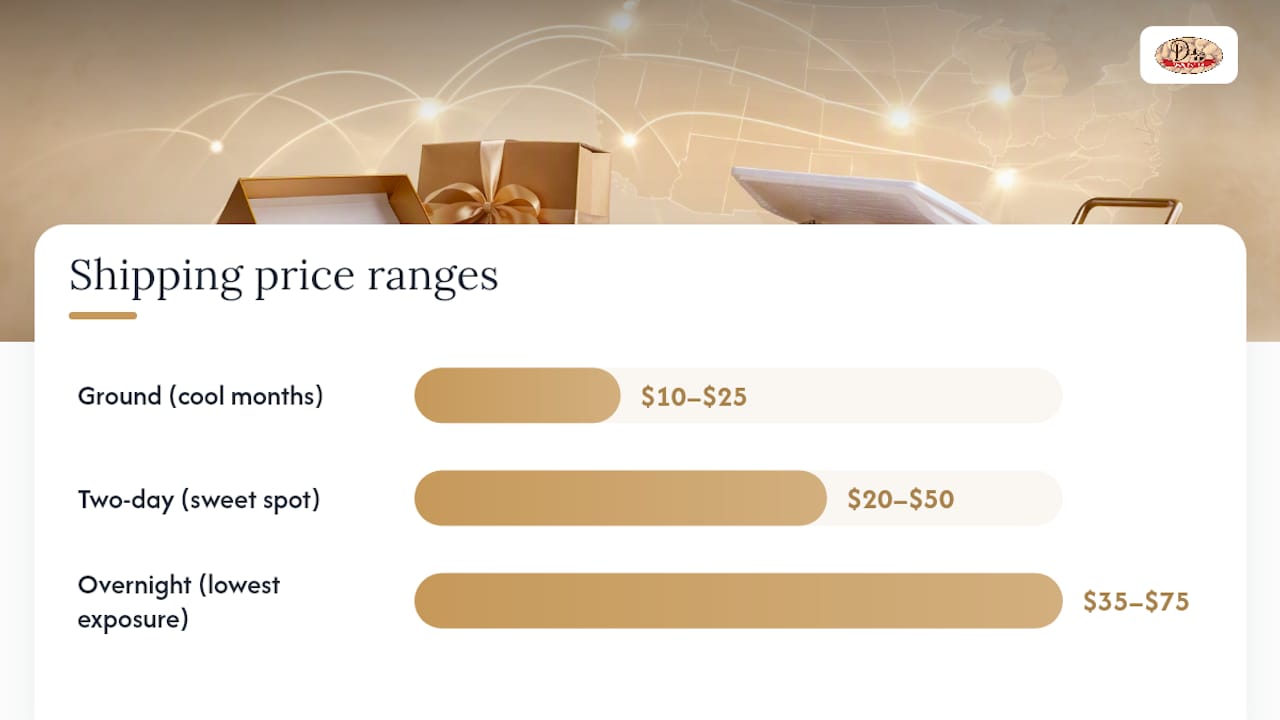
Overnight delivery climbs to $35 to $75 or more. Save it for shipments where the chocolate is genuinely irreplaceable by the delivery date, or where summer heat makes anything slower too risky.
Bulk corporate shipments work differently. Instead of paying per box, you’re often negotiating a per-recipient freight estimate that drops as volume increases. A company shipping 50 individually wrapped thank-you gifts might pay $12 to $18 per recipient at scale, versus $20 or more for a single one-off shipment, because carriers offer better rates on consolidated pickups and some vendors extend volume discounts on packaging materials too.
Cost snapshot: A typical 1-pound domestic chocolate package runs $15 to $25, with perishable items adding roughly 10% to that baseline compared to non-perishable goods of the same weight.
A few things push these numbers in either direction:
- Shipping zone (cross-country costs more than shipping within your region)
- Package weight versus dimensional weight (more on that below)
- Season and destination temperature
- Whether you choose seller-paid or buyer-paid shipping upgrades
- How many units you’re consolidating into one shipment
One pattern worth noting: vendors often structure fees in tiers tied to order value rather than a flat rate. A gift retailer’s published rate structure might charge $10 for orders up to $50, then step up in bands as merchandise value rises, with a separate upgrade charge layered on for express or overnight service. That tiering matters because it means a bigger gift order sometimes ships for a lower percentage of the total cost, not a higher one.
What Actually Drives Shipping Cost Up?
Most people assume shipping cost tracks the scale weight of their package. It doesn’t, and that misunderstanding costs shoppers real money every year.
Carriers bill based on dimensional weight (DIM), not just what your package weighs on a scale. The formula multiplies length by width by height, then divides by a carrier-set divisor (commonly 139 for domestic US shipments). A box measuring 16 by 12 by 10 inches produces a DIM weight of roughly 14 pounds, even if the actual toffee and packaging inside weigh just 3 pounds. You get billed for whichever number is higher, scale weight or DIM weight, so an oversized box quietly inflates your shipping bill regardless of how light the contents are.
Insulation and coolant compound this problem. Gel packs, foam liners, and insulated box liners all add bulk, which pushes your DIM weight higher even as they protect the chocolate. Choosing coolant strategically rather than defaulting to maximum protection on every shipment is one of the biggest levers available for controlling cost.
| Cost Driver | What It Affects | Typical Impact |
|---|---|---|
| DIM weight vs. scale weight | Billed weight on the label | Can add several pounds to the billed rate on an oversized box |
| Gel pack coolant | Box bulk and weight | Adds bulk without much cooling duration per unit |
| PCM (phase change material) coolant | Cooling duration per unit weight | Often allows a smaller shipper overall |
| Failure/reship rate | Effective cost per successful delivery | A melted or bloomed shipment means paying for freight twice |
That last row deserves its own explanation. Cost-per-successful-delivery is the number that actually matters, not the sticker price on the shipping label. If a $20 shipment melts and you have to reship it, your real cost just doubled to roughly $40, plus a frustrated recipient. Tracking failure rate as a cost line item rather than an afterthought changes how you think about spending an extra few dollars on better pack-out materials.
Pro Tip: Before you pay for a bigger insulated shipper “just in case,” measure your actual box dimensions and run the DIM formula yourself. Often a snugger, better-fitted box with a single PCM pack costs less overall than a larger box stuffed with gel packs, even though the gel packs themselves are cheaper per unit.
Which Carrier and Speed Should You Choose?
Ground shipping works fine when the destination is within a day or two of transit and outdoor temperatures stay below roughly 70°F. If you’re shipping toffee or chocolate truffles to a neighboring state in October, standard ground service is a reasonable, budget-friendly choice.
Upgrade to two-day service once either of two conditions applies: the destination is more than a couple of shipping zones away, or the calendar shows warm weather anywhere along the route. Two-day shipping cuts the number of hours your gift sits in a truck or sorting facility, which matters enormously for anything containing real butter and chocolate.
Reserve overnight for situations where failure isn’t an option: a corporate gift tied to a specific event date, a last-minute holiday order, or a shipment heading into genuinely hot conditions where even two-day transit risks a melted box.
A few practical notes on how vendors and carriers structure your options:
- Seller-paid priority shipping is sometimes built into the price of a gift box, so check whether upgraded shipping is already included before paying extra.
- Buyer-paid upgrades let you choose faster service at checkout, usually shown as a flat add-on fee rather than a percentage.
- Insurance and special handling cost extra but make sense for high-value bulk or corporate orders where a lost package would be expensive to replace.
- Remote destinations like Hawaii and Alaska often fall into higher shipping zones automatically, which raises both cost and transit time regardless of carrier.
- PO boxes and APO/FPO addresses sometimes restrict which carriers can deliver or which coolant types are allowed (dry ice, for instance, faces extra restrictions on military mail), so confirm delivery method before ordering.
For most single gifts shipped within the continental United States during spring or fall, two-day service remains the most defensible middle ground between cost and risk. Summer shipments to hot-climate states are the clearest case for either overnight service or added cold protection, which the next section breaks down in detail.
Which Pack-Out Materials Are Worth the Extra Cost?
Not all cold protection is created equal, and picking the wrong type for your shipping lane wastes money without actually solving the melt problem.
Gel packs are the cheapest option per unit, usually adding a dollar or two in materials cost, but they only hold a cold temperature for roughly 24 to 36 hours and they add noticeable bulk to a box. They work well for short ground shipments in mild weather but struggle on longer or hotter routes.
PCM (phase change material) packs cost more per unit than gel packs, but they hold a stable temperature range for longer and often let you use a smaller outer shipper overall. Because DIM weight is calculated from box dimensions, a smaller box with PCM coolant can sometimes cost less to ship in total than a larger box stuffed with cheaper gel packs, even though the PCM material itself carries a higher price tag.
Dry ice provides the most aggressive cooling and suits the longest, hottest lanes, but it comes with handling restrictions, hazardous-material shipping rules, and the highest materials cost of the three options. Most direct-to-consumer chocolate gifts don’t need dry ice unless they’re crossing multiple climate zones during peak summer.
- Mild lane (cooler months, short transit): insulated liner only, no active coolant needed
- Warm lane (spring/fall, moderate transit): one or two gel packs plus an insulated liner
- Hot lane (summer, cross-country or Southern destinations): PCM pack or dry ice plus a fully insulated shipper
Right-sizing the box is often the single fastest way to lower cost. Reducing DIM exposure by choosing a snugger outer shipper typically saves more money than spending time negotiating better carrier rates.
Matching your pack-out to the actual lane, rather than defaulting to the same materials for every shipment, is the difference between a gift that arrives perfect and one that costs you a second shipment.
Do Warm Weather and Holidays Change the Price?
Yes, and in two separate ways: temperature surcharges and calendar-driven peak pricing.
Many chocolate and confection vendors add an explicit warm-weather surcharge once destination temperatures cross a certain threshold, commonly around 74°F. One published example charges a $2.99 warm-weather surcharge on top of standard shipping once that temperature line is crossed. This isn’t a punitive fee. It funds the gel packs, PCM, or insulated liners needed to keep the product intact, and vendors that skip this surcharge either build the cost into every order or accept a higher failure rate.
Holiday season adds its own pressure. Between Thanksgiving and Christmas, carriers see peak volume that can mean:
- Earlier order cutoff dates for guaranteed arrival
- Higher demand for expedited and overnight slots, sometimes at premium pricing
- Longer transit windows even for services normally considered fast
Remote or slow shipping lanes compound both issues. A package heading to a rural address or a multi-zone cross-country route already faces longer transit times, and longer transit means more exposure to whatever temperature swings happen along the way. That combination, slow lane plus warm weather plus holiday volume, is exactly when failure and reship rates climb the most. If your shipping window overlaps any two of those three factors, upgrading speed or protection is usually the cheaper choice in the long run.
How Do You Estimate Your Total Shipping Cost?
Calculating the real cost of shipping a chocolate gift means adding up more than the number on the shipping label. Here’s a simple worksheet you can run through before placing any order.
- Product value — what you’re actually protecting if something goes wrong
- Box dimensions and scale weight — needed to calculate DIM weight, not just the number on your kitchen scale
- Coolant choice — gel pack, PCM, or none, based on season and lane
- Carrier service level and shipping zone — determines base freight cost
- Failure allowance — a reasonable planning figure is around 5%, covering the occasional melted or damaged shipment that needs a reship
Total all-in cost: approximately $33.75 on top of the product price, or about $68.75 delivered.
Running these numbers before you order, rather than after a melted box shows up, is the entire difference between guessing and budgeting.
How Can You Cut Shipping Costs Without Risking Melted Chocolate?
The fastest savings come from decisions you make before the box ever reaches a carrier counter.
- Right-size your outer box. A snugger fit reduces DIM weight more reliably than almost any other single change, and it costs nothing to implement.
- Match pack-out to the lane, not the calendar. Don’t default to dry ice for a three-day ground shipment in April when a gel pack and liner will do the job.
- Use PCM only when it actually shrinks your shipper. If PCM lets you drop to a smaller box, it usually pays for itself. If it doesn’t change your box size, a cheaper gel pack may work just as well.
- Avoid stacking excess gel packs “just to be safe.” Extra gel packs add bulk and DIM weight without extending cooling duration much beyond what one or two well-placed packs already provide.
- Consolidate orders when possible. Combining multiple gifts into one larger shipment often costs less per unit than several small separate boxes.
- Watch for free-shipping thresholds. Some vendors waive shipping above a certain order total, which can make a slightly larger single order cheaper than two smaller ones.
Pro Tip: Charging or budgeting a small seasonal protection fee, rather than trying to absorb warm-weather costs into a flat year-round shipping rate, tends to work out more fairly for everyone. This approach keeps winter shipments affordable while still funding the extra materials summer shipments genuinely need.
How Dudley’s Toffee Approaches Shipping and Pack-Out
We’ve spent real time testing pack-out configurations to figure out what actually keeps toffee in good shape during transit, not just what looks good on paper. Our internal tested pack-out guidance recommends keeping chocolate in the 55 to 68°F range throughout shipping, and our packaging choices are built around hitting that window reliably.
For orders heading to warmer climates or shipping during summer months, we offer an Optional Cold Pack for Warm Weather Shipping as an add-on. If your destination is running hot or you’re not sure whether standard packaging will hold up over a multi-day transit window, adding this cold pack is the more reliable move, especially paired with two-day service rather than standard ground.
For gifting and bulk needs, here’s what to consider:
- Individual 6oz bags work well for smaller personal gifts or sampler-style presents
- The Dark Chocolate English Toffee case of 24 suits corporate gifting, fundraising drives, or retail restocking
- The Milk Chocolate English Toffee case of 24 covers the same bulk use cases for recipients who prefer milk chocolate
| Need | Recommended Choice |
|---|---|
| Single gift, mild season | Standard packaging, ground or two-day |
| Single gift, warm season/destination | Add cold pack, upgrade to two-day |
| Bulk corporate or fundraising order | Case-of-24 SKUs, plan ahead for holiday cutoff dates |
Ordering ahead of major holidays gives us room to pack carefully rather than rush, which matters more than people expect once volume climbs.
What Does It Cost to Ship Chocolate Internationally?
International shipping runs considerably higher than domestic rates, and it comes with restrictions many gift-givers don’t expect until they’re already at checkout.
For a roughly 1-pound chocolate shipment, sending to Europe typically costs $40 to $60, while shipments to Asia that require added cold protection for a 2-pound package can run $70 to $100. Those figures reflect longer transit distances and the customs handling built into international freight, not just the weight of the chocolate itself.
Restrictions matter as much as price. Some countries limit or ban chocolate imports containing certain dairy or alcohol content, and customs delays can stretch transit time well past what a domestic shipment would face, which raises melt risk substantially. Duties and import taxes also apply in many destination countries, and those costs land on the recipient unless the sender prepays them, which most consumer shipping options don’t do automatically.
Given the combination of higher freight cost, customs uncertainty, and extended transit time, international chocolate gifting carries meaningfully more risk than a domestic shipment covering the same distance in miles. If you’re sending a gift internationally, budget for both the higher shipping cost and the possibility of transit delays that a domestic two-day shipment would never encounter, and consider whether a domestic recipient forwarding the gift, or a locally sourced alternative, might serve the occasion better.
What Pack-Out Testing Taught Us About Shipping
Cutting reship rates came down to one change more than any other: matching our pack-out to the actual shipping lane instead of using the same setup for every order. Once we started varying materials by destination and season rather than defaulting to maximum protection everywhere, the number of melted or damaged shipments dropped noticeably, without raising our average shipping cost per order.
That lesson shaped how we think about every box we send. Handcrafted toffee deserves packaging that respects the work that went into it, made right here in Indiana, in small batches, without cutting corners on the trip to your recipient’s door.
— Dudley’s Toffee
Where to Check Current Rates and Policies
Shipping rates and vendor policies change, so it’s worth checking primary sources directly before finalizing a big order:
- Vosges Haut-Chocolat’s shipping information page shows how one gourmet chocolate vendor structures tiered shipping charges and warm-weather provisions.
- World’s Finest Chocolate Gifts’ shipping and delivery page illustrates a merchandise-total-based rate tier structure.
- TempControlPack’s cold-chain cost guide breaks down the DIM and coolant math behind cold-chain shipping costs in more technical detail.
- For a comparative look at perishable shipping economics outside chocolate, The J Coffee Collection’s coffee shipping cost guide covers similar freight and packaging trade-offs for fresh coffee orders.
Shop Dudley’s Toffee for Your Next Gift
You’ve seen how much thought goes into shipping chocolate safely, and that’s exactly the work Dudley’s Toffee has already done for you. Every batch of our handcrafted English almond toffee is made in small batches right here in Indiana, using a signature recipe that stays soft and buttery instead of sticking to your teeth. Both our milk and dark chocolate varieties are gluten-free and contain no high fructose corn syrup, so you’re not choosing between a thoughtful gift and one you’d actually want to eat yourself.
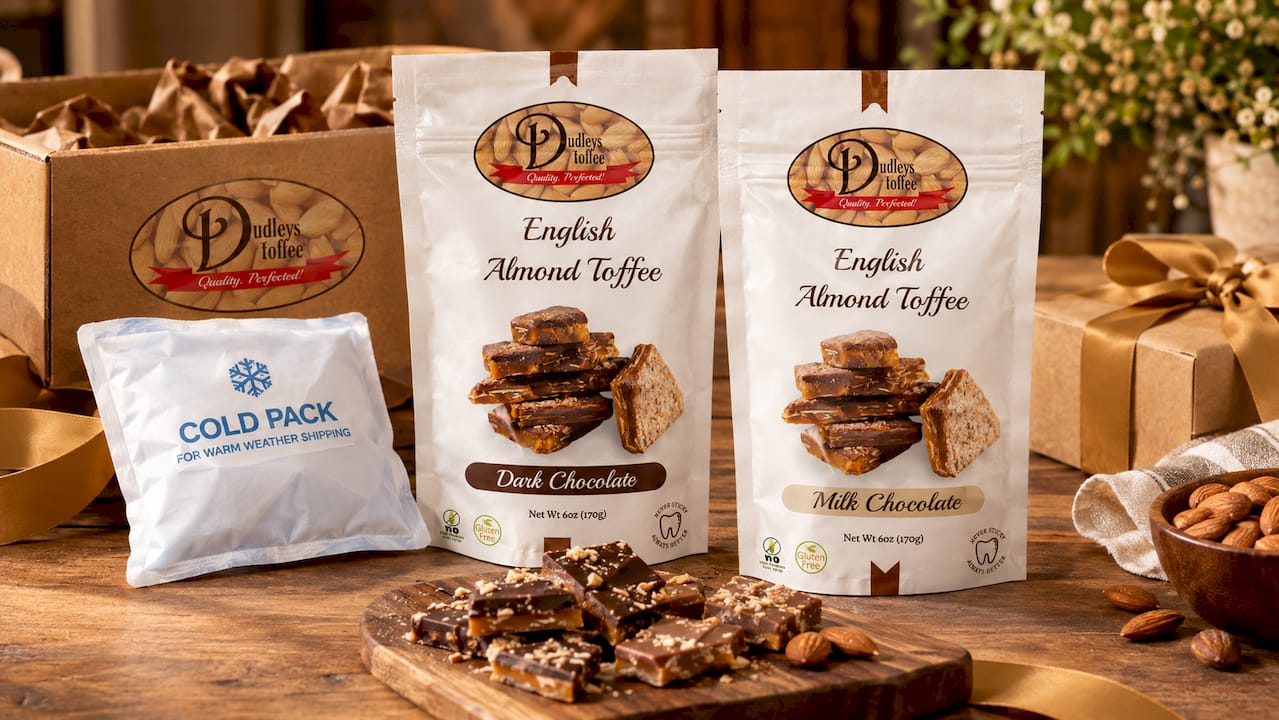
Whether you’re sending a single 6oz bag to a friend or ordering a case of 24 dark chocolate bags for a corporate holiday gift list, our team can help you figure out the right shipping speed and pack-out for your destination and season. If your gift is heading somewhere warm, add our cold pack for warm weather shipping at checkout for extra peace of mind during transit. Ready to send toffee that arrives the way it left our Indiana kitchen? Browse our gift boxes and bulk options at Dudley’s Toffee and place your order today.
Sources
- Sweet Delivery: A Guide to Sending Desserts by Mail for Mother’s Day | FreightAmigo
- Cold-chain artisanal chocolate cost: 2025 guide | TempControlPack
- How to Ship Chocolate: Packaging Tips That Beat the Heat – Arka
- Important Shipping Information – Vosges Haut-Chocolat
FAQ
Can You Mail Chocolate Through USPS?
Yes, USPS accepts chocolate shipments through Priority Mail and Priority Mail Express, both of which offer reasonably fast transit times suited to perishable gifts.
How Do You Mail Chocolate Without It Melting in the Summer?
Use an insulated shipper with an appropriate coolant, gel packs for shorter routes or PCM packs for longer ones, and upgrade to two-day or overnight service during warm months to reduce time in transit.
How Much Does It Cost to Ship a Chocolate Gift Basket?
A small chocolate gift basket typically costs $15 to $40 to ship domestically depending on speed and weight, while larger baskets with dimensional bulk can run higher due to DIM weight billing.
Where Can You Order Chocolate Gifts by Mail?
You can order handcrafted chocolate gifts directly from producers like Dudley’s Toffee, which ships gluten-free milk and dark chocolate English almond toffee nationwide with optional cold-pack protection for warm-weather routes.
Is Two-Day Shipping Worth the Extra Cost for Chocolate?
For most chocolate gifts outside of winter, yes. Two-day shipping is widely considered the best balance of cost and temperature exposure compared to slower ground service or pricier overnight options.