

1/4–1/2 lb per Guest: Plan Candy by Jars, Not Pounds
Plan on roughly 1/4 to 1/2 pound of candy per guest, and lean toward the higher end (1/2 pound, or 8 ounces) whenever the candy table doubles as dessert or guests fill take-home bags. The right number for your event depends less on guest count than on two things: what job the candy is doing (favor, dessert, or grazing snack) and how your jars and containers are set up. Worked math for common guest counts and a container-first planning method follow below.
TL;DR:
- For events, plan on 1/4 to 1/2 pound of candy per guest, with 1/2 pound suitable for dessert or take-home favors, depending on event type.
- A 5-pound bag of candy provides roughly 10 servings at 8 ounces per guest, or 20 servings at 4 ounces, influencing bulk purchase decisions.
- Adjust candy quantity based on event type: higher for kids’ parties and lower for weddings or formal gatherings with other desserts.
- Always add a 10 to 15 percent buffer to your candy order to account for leftovers, early arrivals, or visual fullness of jars.
- Use container size and layout as a starting point, selecting jars first, then calculating the pounds needed based on how full each container should appear.
Table of Contents
- Candy Per Guest: Ounces, Pounds, and Quick Conversions
- Calculating Total Candy for Your Guest Count
- Adjusting for Event Type and Guest Mix
- Planning Your Jars Before You Plan Your Pounds
- Buying Smart and Handling Leftovers
- Dudley’s Toffee: When Handcrafted Favors Make Sense
- Order Options for Your Event
- Where to Double-Check Your Numbers
- Sources
- FAQ
Candy Per Guest: Ounces, Pounds, and Quick Conversions
Every event planner eventually asks the same question: how much candy per guest actually fills a table without wasting money on leftovers nobody eats? The industry rule of thumb puts the answer between 1/4 and 1/2 pound per guest, with the top of that range reserved for events where candy replaces dessert or doubles as a party favor. That single guideline covers most weddings, birthdays, and office parties, but the exact number still shifts based on how sweet your crowd runs and how long the event lasts.
Here’s how that range breaks down in practice:
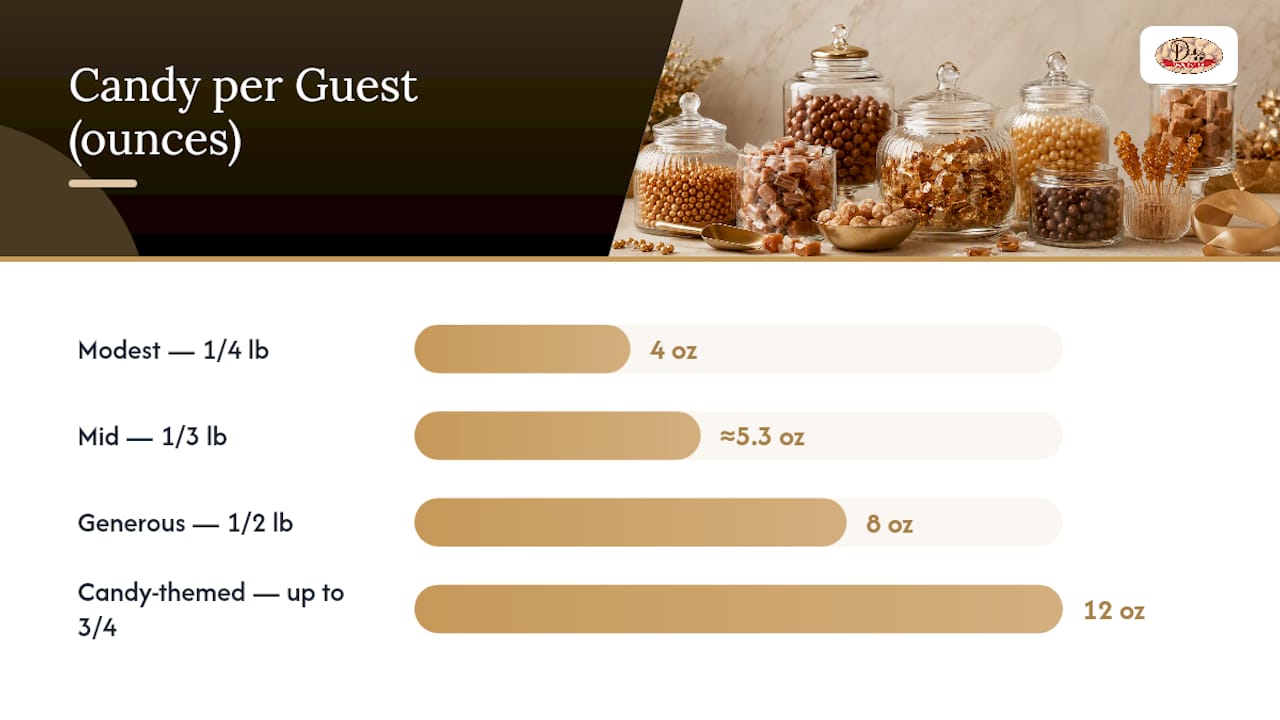
- 1/4 pound (4 oz) per guest: A modest supplement to another dessert, or favor-only situations where guests grab a small handful on the way out.
- 1/3 pound (about 5.3 oz) per guest: A mid-level buffet that guests will visit once, maybe twice, during a two to three-hour event.
- 1/2 pound (8 oz) per guest: A generous buffet that serves as the dessert course, or one where guests are expected to fill goodie bags.
- Up to 3/4 pound per guest: Rare, but common at candy-themed parties or events with extended grazing time and no other dessert offered.
Pro Tip: Ounces and pounds trip people up more than any other part of this math. Remember that 16 ounces equal 1 pound, so 4 ounces is a quarter pound, 8 ounces is a half pound, and a standard candy scoop typically holds between 2 and 4 ounces depending on candy size.
A 5-pound bag of candy, which is a common bulk unit at both wholesale suppliers and retail stores, contains 80 ounces total. At the standard 8-ounce guideline, that bag serves about 10 guests. Drop to the lighter 4-ounce guideline and the same bag stretches to roughly 20 guests, which matters if you’re pricing out bulk purchases for a larger event. Retail candy suppliers commonly cite this same 5-pound benchmark when helping hosts estimate quantities for parties under 50 people.
Wrapped candies and small pieces (think mini toffees or hard candies) run lighter by volume than chunky items like fudge or bark, so a cup of wrapped pieces might weigh less than a cup of solid chocolate bark. When in doubt, weigh a sample cup of your chosen candy before finalizing your order.
Calculating Total Candy for Your Guest Count
The formula is simple: total pounds needed equals your guest count multiplied by ounces per guest, divided by 16. If you prefer working in pounds directly, use the midpoint heuristic: guests multiplied by 0.375 gives you a solid middle-ground pound total that splits the difference between light and generous servings.
Here’s how that plays out across common guest counts:
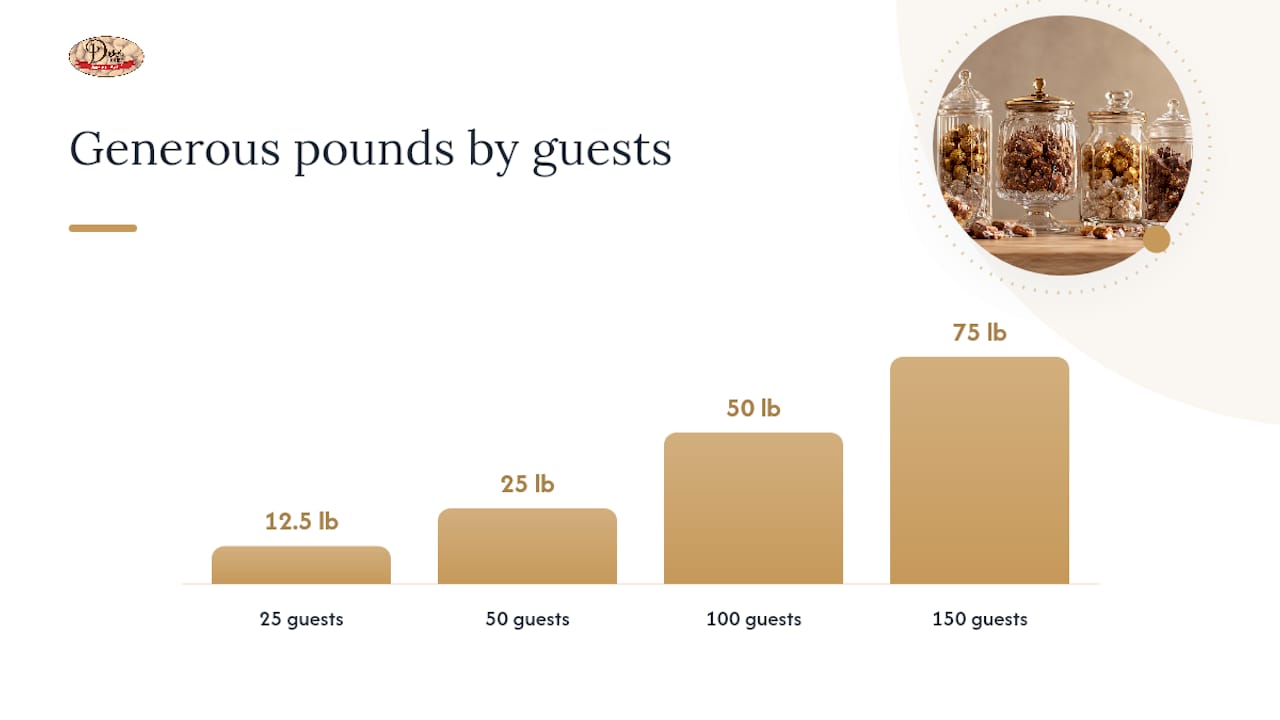
- 25 guests: At the light end (4 oz per guest), you need 6.25 pounds. At the generous end (8 oz per guest), that jumps to 12.5 pounds. The midpoint lands around 9.4 pounds.
- 50 guests: Light planning calls for 12.5 pounds, while generous planning needs 25 pounds. This range lines up closely with the OnePageParty calculator’s benchmark of about 18 to 22 pounds for a standard 50-guest table, which sits right at the mid-to-generous range.
- 100 guests: Light planning requires 25 pounds; generous planning doubles that to 50 pounds. Most planners land somewhere around 37 to 40 pounds unless the candy is the sole dessert.
- 150 guests: Light planning starts at 37.5 pounds, climbing to 75 pounds at the generous end. Events this size almost always benefit from ordering in case quantities rather than individual bags.
Once you’ve settled on a base number, add a buffer. Planners who track leftovers and shortfalls consistently recommend padding your order by 10 to 15 percent to cover grazing, early arrivals who take extra, and the visual problem of half-empty jars two hours into the party. For that 50-guest event at the 25-pound generous estimate, a 12 percent buffer brings your real order to about 28 pounds. Round up to the nearest whole bag or case size when you place your order. Buying slightly more than the math demands costs less than running out of candy an hour before your event ends.
Adjusting for Event Type and Guest Mix
The 1/4 to 1/2 pound range is a starting point, not a fixed rule. Where your event lands within it depends on who’s attending and what else they’ll be eating.
- Kids’ birthday parties: Push toward the higher end, often 1/2 to 3/4 pound per guest, since children tend to graze longer and take extra pieces for later.
- Weddings with a plated dinner: Stay closer to 1/4 pound per guest. Candy is a favor and light treat here, not a replacement for cake or dessert service.
- Corporate events and office parties: A 1/3 pound estimate usually works well, since adults tend to take one or two handfuls rather than filling a bag.
- All-day festivals or open houses: Guests come and go, so total foot traffic matters more than headcount. Estimate based on expected total visits, not the number of unique attendees.
Alcohol service also shifts consumption. Guests at events with an open bar tend to snack more throughout the evening, which nudges your estimate toward the generous end even for adult-only crowds. If your guest list mixes kids and adults, calculate each group separately using their own per-guest number, then add the totals together rather than averaging across the whole group.
Pro Tip: When dessert is served separately from the candy table, treat the candy as a favor rather than a dessert substitute. That single distinction can cut your total order by half.
Planning Your Jars Before You Plan Your Pounds
Skip the temptation to calculate total pounds first and containers second. Experienced event designers work the other way around: pick your jars and layout, then figure out how much candy fills them properly. Guests judge a candy table by how full and colorful it looks, not by whether you hit an exact per-guest formula, and a container-first approach keeps you from overbuying just to be safe.
A useful starting point on jar counts:
- 30 to 50 guests: 8 to 10 jars, mixing sizes for visual variety.
- 50 to 100 guests: 10 to 12 jars, with at least 2 to 3 designated as tall focal pieces.
- 100+ guests: 12 to 14 jars, often split across two smaller stations rather than one long table.
A classic three-zone layout splits your candy roughly 40 percent focal jars, 30 percent center scoop jars, and 30 percent front trays of wrapped treats for easy grab-and-go. Tall focal jars look best filled about two-thirds full for visual impact without wasting candy at the bottom nobody can reach. Center scoop jars work better closer to three-quarters full since guests dig into them directly, and front trays should stay shallow so wrapped pieces are easy to grab without spilling. Once your jars are chosen, estimate cups needed per jar based on its size, then convert cups to pounds using your candy’s weight-per-cup figure. That gives you a total that matches your table’s actual visual footprint instead of a number pulled from a formula alone.
Buying Smart and Handling Leftovers
Bulk pricing changes the math on what you can afford to buy. Wholesale and bulk candy purchases typically run $2.50 to $4.00 per pound, while retail candy at grocery or party stores often costs $4.50 to $7.00 per pound. For a 50-guest event needing 25 pounds, that difference means a budget somewhere between $125 and $175 at bulk pricing versus $225 to $350 at retail. Scale that up to 100 guests and 40 pounds, and the gap widens to $100 to $160 versus $180 to $280.
- Buy bulk whenever your total order exceeds 15 to 20 pounds; the savings usually outweigh the convenience of small retail bags.
- Build in that 10 to 15 percent buffer at the ordering stage, not as an afterthought once you’re already short.
- If leftovers remain after the event, package them into small favor bags for guests to take home, donate unopened items, or store them in an airtight container away from heat and humidity for use at your next gathering.
- Check expiration windows before your event date, especially if you’re ordering candy weeks in advance for a large fundraiser or wedding.
Buying slightly more than your calculated total rarely goes to waste, since most hard and wrapped candies keep well for months when stored properly.
Dudley’s Toffee: When Handcrafted Favors Make Sense
Not every event calls for bulk bins of loose candy. When you want something that feels like a gift rather than a scoop from a jar, individually packaged favors do more work per guest. Dudley’s English Almond Toffee comes in 6-ounce bags, which fits neatly into favor math: one bag per guest, rather than the weight-per-guest formula used for loose buffet candy.
Our toffee is handcrafted in small batches right here in Indiana, and it’s gluten free with no high fructose corn syrup, which matters for hosts managing dietary questions from guests. Both milk and dark chocolate varieties travel well and hold up on a table for hours without melting into a mess. For weddings, gourmet favor bags built around a 6-ounce toffee bag tend to outperform loose candy bins on guest satisfaction, even though the per-unit cost runs higher.
For fundraisers or larger events, mixed cases and fundraiser packs let organizers order in bulk without sacrificing that handcrafted quality. Order two to three weeks ahead for standard quantities, and reach out directly for wholesale or fundraiser volume support.
— Dudley’s Toffee
Order Options for Your Event
Once you know whether your event calls for a buffet-style weight calculation or a favor-per-guest count, choosing the right product becomes straightforward. Dudley’s Toffee offers formats built for both approaches.
For weddings and small gatherings under 50 guests, the 6oz milk chocolate toffee bag or its dark chocolate counterpart work well as one-bag-per-guest favors. If your guest list has mixed preferences, the mixed case with 12 milk and 12 dark bags covers both without guessing which flavor each guest prefers.
Larger events and trade shows benefit from ordering by the case. A case of 24 milk chocolate bags covers a 100-guest event with reasonable buffer built in, and pairs well with the trade-show giveaway strategies many exhibitors rely on to stand out at a crowded booth. Organizations running fundraisers can lean on the dedicated fundraiser packs in milk or dark chocolate, which are priced and packaged specifically for resale campaigns.
For color and table styling ideas that pair well with wrapped favor bags, this holiday presentation guide offers useful tips on arranging treats for visual appeal.
Browse the full lineup on the Dudley’s Toffee storefront to compare bag sizes and case options side by side, and place your order with enough lead time to match your event date.
Where to Double-Check Your Numbers
- The Ultimate Candy Buffet Calculator for jar-based math on any guest count.
- Chocolate party favor ideas for pairing toffee bags with table themes.
- Candy fundraiser planning guidance for bulk order strategy.
Sources
- How to Calculate How Much Wholesale Candy You Need for Your Event — Weaver Nut
- The Ultimate Candy Buffet Calculator — OnePageParty
- Candy Table Ideas: Ultimate Buffet Setup, Quantities & Cost Breakdown — PartyAndBeyond
FAQ
How much candy do I need for 100 guests?
Plan on 25 to 50 pounds total, depending on whether candy is a light favor (25 pounds at 4 oz per guest) or the main dessert (50 pounds at 8 oz per guest). Most planners land around 37 to 40 pounds and add a 10 to 15 percent buffer.
What should I charge for a candy table per guest?
Budget for the candy itself first: bulk pricing runs about $2.50 to $4.00 per pound, so a 50-guest table using 25 pounds costs roughly $125 to $175 before markup, containers, or labor.
What are some good candy buffet ideas?
Mix textures and colors across three zones: tall focal jars for visual height, center scoop jars for easy access, and front trays of wrapped pieces like toffee bags for quick grab-and-go favors.
How many people does a 5-pound bag of candy feed?
A 5-pound bag equals 80 ounces, which serves about 10 guests at the standard 8-ounce guideline, or up to 20 guests at the lighter 4-ounce rate.
Should I use per-guest weight or per-guest bags for favors?
Use weight-based math (pounds per guest) for self-serve buffets, but switch to one bag per guest, such as a 6-ounce toffee bag, when the candy functions as a take-home favor rather than a grazing snack.
Ready to plan your event candy order? Shop Dudley’s Toffee for handcrafted, gluten-free options in milk and dark chocolate, made in small batches right here in Indiana.
Recommended
Share