

Are Client Gifts Tax Deductible? Yes, up to $25 Per Person
Yes, client gifts are tax deductible in the United States, but the IRS caps the deduction at $25 per recipient, per tax year. That cap is one of the most misunderstood rules in small-business tax planning, and it trips up even experienced owners every holiday season.
Here’s the nuance that matters most: the $25 limit applies to what you can deduct, not what you’re allowed to spend. You can buy a client a gift basket that costs more than $25. You just can’t write off more than $25 of it. Everything above that threshold comes out of your after-tax dollars.
Before you place a holiday order or budget for client appreciation gifts, know the headline exceptions that change the math:
- Promotional items under $4 with your company’s name permanently imprinted count as advertising, not gifts, and are fully deductible.
- Incidental costs like shipping, gift wrap, and engraving don’t count toward the $25 cap.
- Gifts intended for business use (like a shared box left in a client’s break room) may bypass the per-person cap entirely.
Key Takeaways
Client gifts are deductible up to $25 per recipient per year, but promotional items, incidental costs, and business-use gifts can legally push your total deductible amount well beyond that figure.
| Point | Details |
|---|---|
| $25 cap applies to deduction | You can spend any amount on a client gift, but only $25 per recipient per year is deductible. |
| Promotional items skip the cap | Items $4 or less with permanent branding count as advertising, fully deductible. |
| Incidental costs are separate | Shipping, standard wrap, and engraving are deductible in full outside the $25 limit. |
| Document at time of purchase | Record cost, date, recipient, and business purpose immediately, not months later. |
| Dudley’s Toffee fits the cap | Individually packaged 6oz bags price comfortably under $25, simplifying deduction math and bookkeeping. |
This article is general information, not a substitute for advice from a qualified financial advisor. Consult a qualified financial professional about your own circumstances before acting on anything here.
Table of Contents
- Are Client Gifts Tax Deductible? What Counts as a Business Gift
- The $25 Limit: Where It Comes From and How It Actually Works
- Legal Ways to Increase Your Deductible Gift Value
- Gift Cards, Cash, and the Employee Gift Trap
- Recordkeeping That Survives an IRS Audit
- Client Gift Scenarios: The Math Worked Out
- How Dudley’s Toffee Fits Client Gift Rules and Bookkeeping
- Gift Tax vs. Income Tax: Two Separate Systems
- Do State Taxes Change the Client Gift Deduction?
- Sources
- FAQ
Are Client Gifts Tax Deductible? What Counts as a Business Gift
The IRS treats a “business gift” as a specific category with its own rules under 26 CFR § 1.274-3, separate from advertising expenses, employee compensation, and entertainment. Getting this classification right determines whether you’re working with a $25 cap or a full deduction.
A business gift is any item you give to an individual in the course of your trade or business, without expecting something specific in return, and outside a direct compensation arrangement. A holiday fruit basket sent to a client’s office fits this definition. A branded coffee mug handed out at a trade show usually does not, because the IRS carves out a separate lane for promotional materials.
That carve-out matters more than most business owners realize. Items costing $4 or less, imprinted permanently with your business name, are classified as advertising rather than gifts. A $3 pen with your logo laser-etched into the barrel doesn’t touch the $25 limit at all. Swap that pen for a $3 unbranded notepad, though, and it falls back under gift rules.
There’s a second boundary worth knowing: gifts intended for an organization’s general use, rather than an identifiable individual, sometimes escape the per-person cap entirely. A box of toffee dropped off for the whole office to share is treated differently than a wrapped gift handed to one named contact.
Quick distinction: Business gifts and business meals are governed by separate rules entirely. Taking a client to dinner falls under meal-expense provisions, not the gift cap, which is why some tax preparers advise picking up the check instead of handing over a gift card if you want a larger deduction.
Three quick classification checks worth running before you finalize any purchase:
- Does it have your logo permanently affixed and cost $4 or less? It’s advertising, not a gift.
- Is it addressed to one named person? The $25 cap applies.
- Is it left for shared use at a business (a lobby, a break room)? It may qualify as a business-use gift instead.
The $25 Limit: Where It Comes From and How It Actually Works
The $25 cap traces directly to IRC §274(b), a provision that has capped business gift deductions at $25 per recipient since 1962. Congress has never adjusted it for inflation, which is why $25 buys noticeably less appreciation today than it did six decades ago.
The regulatory language is dense, but the practical takeaway is simple:
That single sentence carries three implications small-business owners frequently miss.
- The limit is per recipient, per tax year, not per gift. Send the same client three gifts totaling $90 in one year and you can still deduct only $25 total.
- The word “indirectly” is doing real work. If you give a $50 gift to a client’s spouse, the IRS aggregates that gift with anything given to the client unless the spouse has an independent business relationship with you.
- Partnerships and married couples face a shared cap. A husband-and-wife team of business owners is treated as a single taxpayer when both give gifts to the same client relationship, and partnerships apply the $25 limit at both the partnership level and the individual partner level.
That last point catches a lot of small partnerships off guard. If you and your business partner both send holiday toffee to the same client, thinking you’ve each got a separate $25 allowance, the IRS sees one relationship and one $25 cap. Coordinate gift-giving across your team before assuming the limit multiplies with headcount.
Legal Ways to Increase Your Deductible Gift Value
The $25 cap isn’t the ceiling it appears to be once you understand the categories that sit outside it. Four legitimate strategies let businesses deliver a more generous gift while keeping more of it deductible.
- Lean into the promotional-item exception. Items priced at $4 or less, permanently imprinted with your company name, skip the gift cap entirely and count as advertising. This works well for smaller add-ons, not as a way to reclassify your main gift.
- Direct gifts to the business, not the individual. A shared box left for an entire office or department is treated as a business-use item under IRS Publication 463, potentially avoiding the per-person $25 ceiling that applies to individually addressed gifts.
- Stack incidental costs outside the cap. Shipping, standard gift wrap, and engraving are deductible in full and don’t count against the $25 limit, as long as they don’t add “substantial value” to the gift itself. An elaborate ornamental basket, by contrast, can get folded into the gift’s total cost.
- Use the married-donor structure deliberately. While spouses share one $25 cap per client relationship, a partnership with multiple partners who each maintain distinct, independent relationships with different contacts at the same client company may be able to apply separate caps, depending on how those relationships are documented.
Pro Tip: Ask your gift supplier to itemize the invoice, separating the product cost from packaging, engraving, and shipping. That paper trail is what lets your bookkeeper split incidental costs from the capped gift cost cleanly, and it’s exactly what an auditor wants to see.
The line between “incidental” and “substantial value” isn’t always obvious. Standard tissue paper and a ribbon are incidental. A custom wooden crate with a brass nameplate probably isn’t. When in doubt, keep the packaging simple and let the toffee do the talking.
Gift Cards, Cash, and the Employee Gift Trap
Gift cards feel like the easy, foolproof gift. Tax-wise, they’re one of the riskiest choices you can make.
The IRS treats gift cards and cash-equivalent items as cash itself, not as tangible property. For client gifts, that means a $25 gift card still falls under the $25 deduction cap, same as any physical item. For employee gifts, the consequences are steeper: cash and gift cards of any amount generally count as taxable wages, subject to income tax withholding, Social Security, and Medicare.
A handful of distinctions worth memorizing:
- De minimis fringe benefits for employees, like an occasional turkey, ham, or modest gift box, can be excluded from wages if they’re infrequent and small in value. A holiday gift card, no matter how small, doesn’t qualify for this exclusion because it’s a cash equivalent.
- Client gift cards stay capped at $25 in deductibility, same as physical gifts.
- Employee cash and gift cards generally require payroll reporting, which changes your bookkeeping entirely and can surprise owners who assumed a “gift” avoided payroll taxes.
If you’re weighing gift cards against a physical item like gourmet toffee for your team, the tangible option usually creates a cleaner tax picture, especially at modest price points that qualify as de minimis benefits.
Recordkeeping That Survives an IRS Audit
Client gift deductions get flagged during audits more often than most small-business expenses, largely because the documentation is easy to skip and hard to reconstruct months later. Building the habit now saves a scramble later.
Every deductible gift needs four pieces of information captured at the time of purchase:
- Cost of the gift, itemized separately from shipping, wrap, or engraving.
- Date of purchase or the date given, whichever your bookkeeping system tracks.
- Recipient name and business relationship (which client, which contact, why they matter to your business).
- Business purpose, written as a short contemporaneous note rather than reconstructed later.
A receipt by itself doesn’t cut it. Practitioner guidance is consistent on this point: a receipt proves you spent money, but it doesn’t prove the business purpose, and that’s the piece the IRS actually wants to see if your return gets a second look.
Keep your books split into separate lines for gifts, promotional materials, and incidental costs. Lumping everything into one “client gifts” category makes it harder to apply the right deduction rules when tax season arrives, and it makes an audit slower and more stressful than it needs to be.
Most sole proprietors report business gift deductions on Schedule C, Line 27a (Other Expenses), with a supporting statement listing the gift category. C-corporations report them as ordinary business expenses on Form 1120, and partnerships flow them through Form 1065. If your gifting program has grown past a handful of holiday cards, a tax professional can confirm you’re applying the aggregation and partnership-level rules correctly, especially once multiple partners or locations are involved.
Client Gift Scenarios: The Math Worked Out
Numbers make this rule click faster than definitions do. Here’s how the $25 cap plays out across common small-business gifting scenarios.
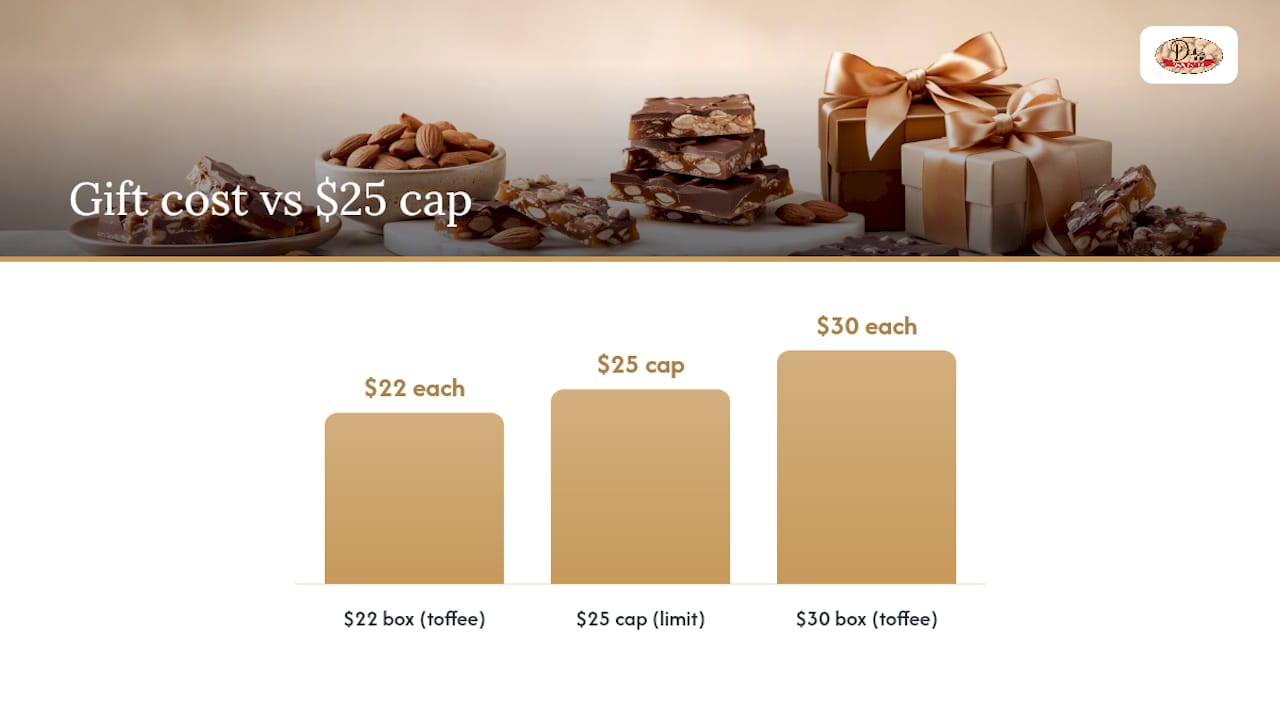
The shipping line in the first row is the detail most owners miss. Because shipping is incidental, it rides along fully deductible on top of the $25 gift cap, rather than getting absorbed into it.
The individually boxed toffee scenario also deserves a second look, as explained in Corporate Travel Terminology Explained for Hospitality Vendors – Wild Foodz by Hotel Entree Brugge, which provides practical advice on records and logistics for corporate gifting. At $22 per box, you’re already under the cap, so the full $440 is deductible. Push the price to $30 per box, though, and you’d only recover $25 of each gift, leaving $100 non-deductible across 20 recipients.
Before you place an order, run through this quick checklist:
- Is this gift going to one named person, or to a shared business space?
- Does the invoice separate the item cost from shipping and packaging?
- Have I written down who received it and why, before I forget the context?
How Dudley’s Toffee Fits Client Gift Rules and Bookkeeping
Handcrafted English almond toffee happen to map cleanly onto these rules, which is part of why it’s become a steady favorite for client appreciation gifting. Dudley’s Toffee is made in small batches in Indiana, it’s gluten free, and it contains no high fructose corn syrup, qualities that matter to recipients with dietary restrictions and to businesses that want a gift that feels considered rather than generic.
Here’s how our core offerings tend to map to gifting scenarios:
- Individually packaged 6oz bags, ordered as a case of 24, work well when you’re sending a distinct gift to each named client. Each bag’s cost stays comfortably under the $25 cap, leaving room for shipping and a nice card without pushing past the deductible portion.
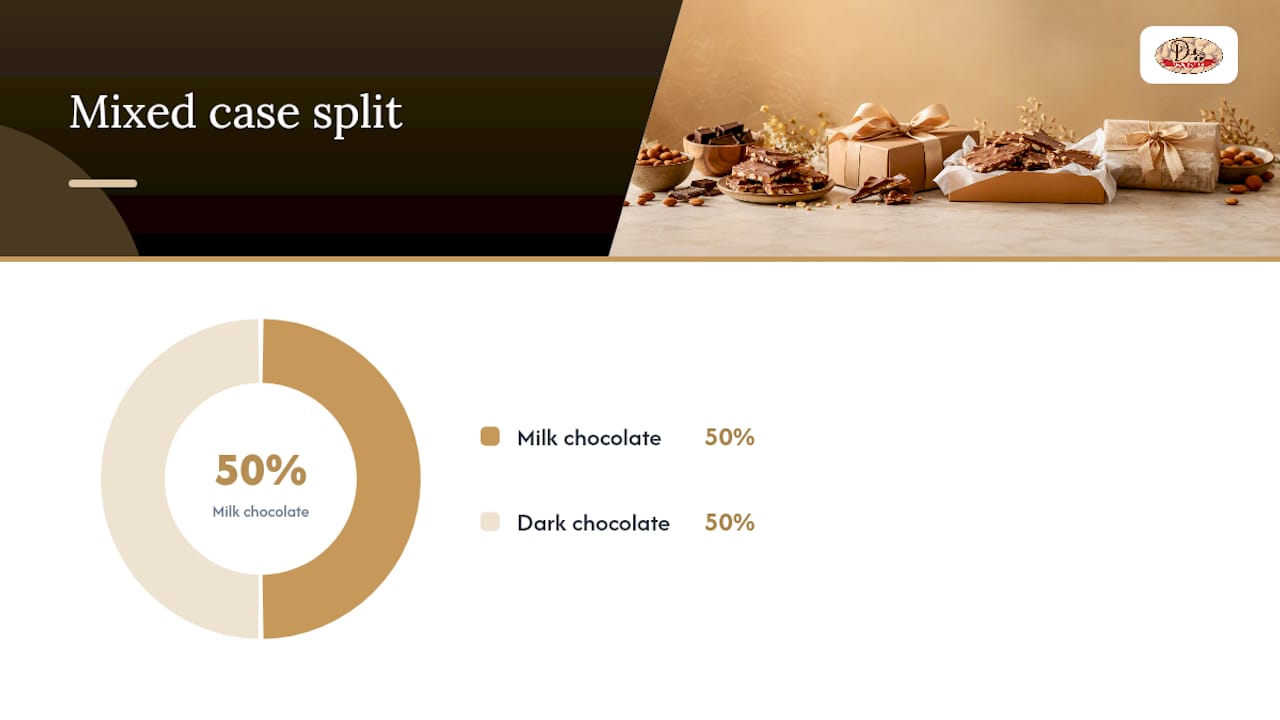
- A mixed case with milk and dark chocolate, split 12 and 12, suits businesses who don’t know every recipient’s chocolate preference and want variety on hand.
- The Big Batch Box, sold as a case of 24, fits scenarios where toffee is destined for a shared office, a fundraising event, or a company-wide client appreciation drop rather than one named individual, which is exactly the kind of business-use gifting that can sidestep the per-person cap.
Custom packaging, gift wrap, and cold-pack shipping (necessary for keeping toffee fresh in transit) all count as incidental costs, fully deductible on top of whatever portion of the gift itself falls under the cap.
Pro Tip: When you place a bulk order, ask for an invoice broken into gift cost per unit and shipping/packaging as separate lines. That single request makes your year-end bookkeeping dramatically simpler.
Whichever option you choose, jot down the recipient’s name and the business reason the moment you place the order. It takes thirty seconds and it’s the exact detail an auditor asks for first.
Gift Tax vs. Income Tax: Two Separate Systems
Business owners sometimes conflate the $25 business gift deduction with federal gift tax, and the confusion is understandable since both involve the word “gift.” They’re entirely separate systems with different purposes.
The $25 limit discussed throughout this article governs your income tax deduction, meaning how much of your business gift expense you can subtract from taxable income. Federal gift tax, by contrast, applies to the giver of personal gifts above a much higher annual exclusion amount, and it’s designed to prevent individuals from avoiding estate tax by giving away assets before death.
For the vast majority of small businesses sending client gifts, federal gift tax simply doesn’t enter the picture. A $25 to $100 client gift falls nowhere near the gift tax exclusion threshold, and business gifts made in the ordinary course of business are treated as deductible business expenses on your return, not personal gifts subject to gift tax reporting.
Where the two systems can intersect is in unusual cases: an owner personally gifting expensive property to a client outside the normal course of business, for instance, rather than the business itself sending a modest appreciation gift. That scenario is rare enough that most client-gifting programs never touch gift tax rules at all. If your gifting extends into high-value personal transfers, that’s a conversation for a tax advisor familiar with estate and gift tax planning, separate from the business deduction rules covered here.
Do State Taxes Change the Client Gift Deduction?
The $25 federal cap doesn’t automatically carry over to every state return the same way. Most states that impose a corporate or personal income tax use federal taxable income as their starting point, which means the federal $25 limitation typically flows through by default.
That said, a handful of states apply their own addition and subtraction modifications to federal taxable income, and business expense rules occasionally diverge in ways that catch owners off guard. If your business operates in multiple states, or if your state has decoupled from certain federal provisions in recent years, it’s worth confirming with a state-licensed tax preparer whether your state follows the federal $25 gift limit exactly or applies a different standard.
For most small businesses filing in a single state, the practical guidance is straightforward: apply the federal $25 cap and documentation rules as your baseline, then let your tax preparer flag any state-specific adjustment during return preparation. This is one area where a quick conversation with a professional costs far less than an unexpected state notice.
Publisher perspective: modest, well-documented gifts build relationships and keep taxes tidy
We’ve always believed the best client gifts aren’t the flashiest ones. They’re the ones that feel personal, arrive well-packaged, and don’t leave a business owner untangling a tax mess in April. That’s part of why we build Dudley’s Toffee around small batches and honest ingredients rather than oversized gestures. A thoughtfully chosen $22 box of toffee, properly documented, often lands better with a client than an extravagant gift that blows past the deduction cap for no real relationship benefit. Keep a simple log of who received what and why, and lean on a tax professional the moment your gifting program grows more complex than a holiday list.
— Dudley’s Toffee
Order Client Gifts That Are Easy to Document and a Pleasure to Receive
Compared to gift baskets assembled from a dozen odds and ends, a case of pre-portioned toffee bags gives you one clean line item per client, which makes the documentation checklist in this article almost automatic. For businesses handling ten client gifts or two hundred, that simplicity is worth as much as the toffee itself.

If you’re gifting to individual contacts, the Milk Chocolate English Toffee case of 24 lets you assign one bag per client at a cost that comfortably fits inside the $25 deduction. Want variety for clients whose preferences you don’t know? The mixed milk and dark case covers both without extra ordering steps. For office-wide drops, fundraisers, or larger client-appreciation events, The Big Batch Box is built for volume, and its use as a shared business item may sidestep the per-person cap entirely.
Every order comes with an itemized invoice, so separating gift cost from shipping and packaging for your books takes minutes, not guesswork. Request a bulk quote or place an order today, and keep a short note of the recipient and business purpose the moment it ships. Visit Dudley’s Toffee to browse case options and get your holiday or corporate gifting order started.
Sources
- Business Gift Deduction: The $25 Limit
- 26 CFR § 1.274-3 — Entertainment, amusement, recreation, or similar expenses and business gifts
- Publication 463 (Travel, Gift, and Car Expenses)
- The $25 Business Gift Deduction Limit: Rules & Receipts for Freelancers (2026) | CentSense
FAQ
Can I claim client gifts as a business expense?
Yes. Client gifts qualify as a deductible business expense, though the deduction is capped at $25 per recipient per tax year under IRC §274(b).
What is the IRS gift limit for business deductions?
The business gift deduction limit is $25 per recipient per year, a figure that has remained unchanged since 1962 and is not adjusted for inflation.
Can I write off a client appreciation event?
Client appreciation events typically fall under entertainment or meal expense rules rather than the gift cap, and those categories carry separate deductibility standards, so check with a tax preparer before assuming full deductibility.
Which gifts are tax deductible?
Tangible gifts to individual clients are deductible up to $25 each, promotional items under $4 with permanent branding are fully deductible as advertising, and shared business-use items like a box of toffee for a client’s office may avoid the per-person cap entirely.