
Corporate Gift Budget: Practical Ranges and Tiers for 2026
Most U.S. corporate gifting programs work within four defensible ranges: $20–$50 per employee for routine occasions, $50–$100 per standard client, $100–$250 for key clients, and $250–$500+ for VIPs and executive relationships, according to 2026 benchmarks used by many programs. Milestone gifts — work anniversaries, retirements, major deal closings — often start at $150–$200 regardless of tier.
Your immediate next step: open a spreadsheet, list your recipient segments, assign a count to each, and multiply by the range midpoint. That number is your draft program budget before shipping and personalization.
- Employees (routine): $20–$50 per person
- Standard clients: $50–$100 per person
- Key clients: $100–$250 per person
- VIPs and executive relationships: $250–$500+
- Milestone gifts (any tier): $150–$200 minimum
Pro Tip: Lock your per-recipient ranges before you count recipients. Counting first and then setting ranges almost always results in a budget that finance rejects because the math looks arbitrary.
Key Takeaways
A defensible corporate gift budget starts with per-recipient tiers, a program-level formula, and a procurement timeline locked before October.
| Point | Details |
|---|---|
| Set tiers before counting recipients | Use $20–$50 (employees), $50–$100 (standard clients), $100–$250 (key clients), $250–$500+ (VIPs) as your starting ranges. |
| Use the per-head formula | Multiply recipient count by range midpoint, then add a 15% buffer for shipping and personalization. |
| Know the IRS deduction cap | Business gift deductions are capped at $25 per recipient per year; cash and gift cards to employees are always taxable wages. |
| Lock procurement by October | Custom orders need 3–6 weeks; orders above 500 units need 6–8 weeks. Late ordering inflates cost per impression. |
| Dudley’s Toffee fits multiple tiers | Single 6oz bags fit the under-$50 tier; case packs and fundraiser SKUs suit volume and team gifting programs. |
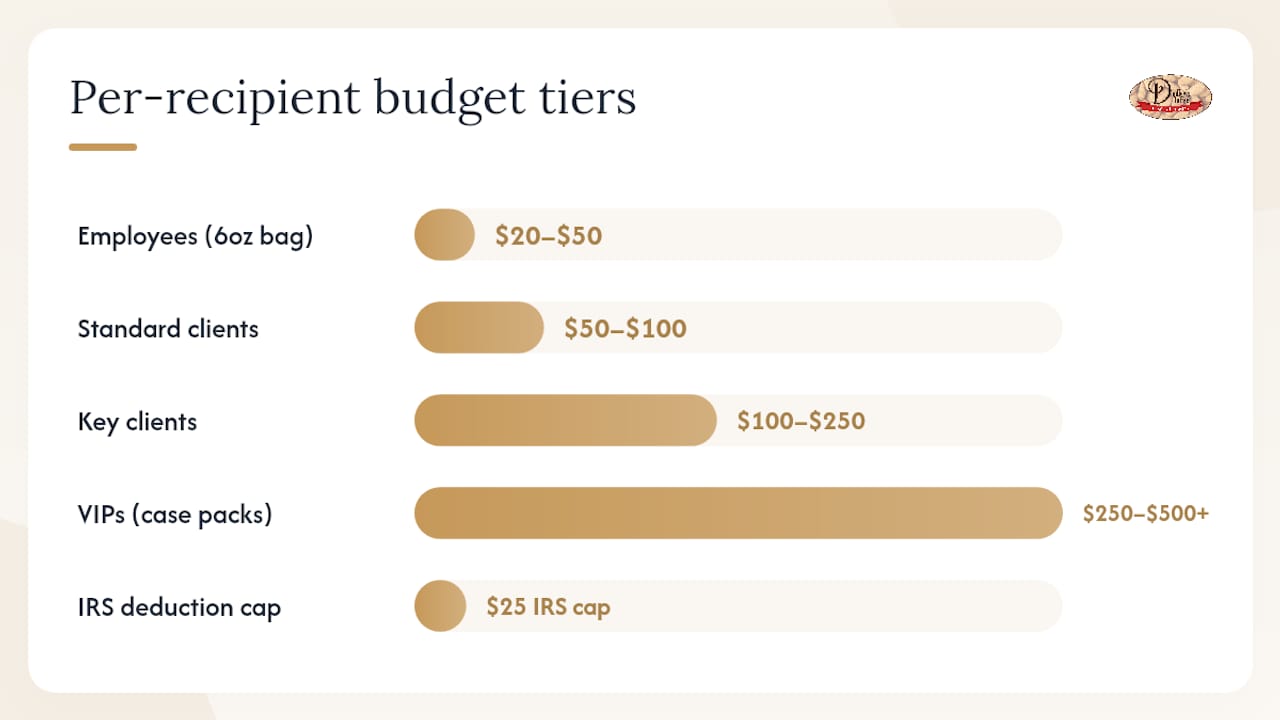
Table of Contents
- What does a defensible corporate gift budget tier table look like?
- How do you set a total corporate gift budget for your program?
- What are the U.S. tax rules for corporate gift deductions?
- Procurement checklist and timeline for a smooth gifting program
- Gift ideas mapped to each price band
- How do you measure and defend your gifting spend?
- Common mistakes that waste your gifting budget
- Why handcrafted gourmet candy works for corporate gifting
- What we believe about gifting at Dudley’s Toffee
- Dudley’s Toffee for your corporate gifting program
- Sources
- FAQ
What does a defensible corporate gift budget tier table look like?
A tiered framework gives finance a clear rationale for every dollar. Each tier maps to a recipient relationship, a typical use case, and a one-line justification your CFO will recognize.
| Tier | Recipient Type | Recommended Range | Typical Use Case | Finance Rationale |
|---|---|---|---|---|
| Thank-You | Broad network, prospects | $20–$50 | Holiday card + small gift, event follow-up | Less than the cost of a business lunch |
| Standard Client | Active accounts, mid-value | $50–$100 | Annual holiday gift, contract renewal | Flat retention investment per account |
| Key Client | Top 20% of accounts | $100–$250 | Milestone, renewal, appreciation | Proportional to account ARR |
| VIP / Executive | Strategic partners, C-suite | $250–$500+ | Major deal close, long-term relationship | Retention value exceeds gift cost many times over |
| Employee (routine) | All staff, recurring occasions | $20–$50 | Holidays, birthdays, work anniversaries | Consistent, equitable, and below IRS de minimis thresholds |
| Employee (milestone) | Long-service, promotions | $150–$200+ | 5- or 10-year anniversary, retirement | Tangible recognition tied to a documented achievement |
Industry guidance consistently shows that timing and relationship fit matter more than raw spend. A $60 gift ordered thoughtfully in October lands better than a $120 gift rushed in December.
- Use the Thank-You tier for conference swag, referral acknowledgments, or prospect nurture.
- Reserve Key Client and VIP tiers for relationships where a single renewal covers the gift cost many times over.
- Keep employee tiers consistent across the same job level to avoid morale issues.
- Document the rationale for any gift above $100 in your procurement system.
Pro Tip: The DLISH framework suggests tying each tier to a measurable outcome — renewal rate, retention rate, or eNPS — so spend is defensible not just as a cost but as a business gift spending investment with a trackable return.
How do you set a total corporate gift budget for your program?
Two methods work well in practice. Use whichever fits your organization’s planning style.
Method A: Per-head multiplication
- List each recipient segment (employees, standard clients, key clients, VIPs).
- Assign a count to each segment.
- Multiply count by the midpoint of your chosen range.
- Add a 15% buffer for shipping, personalization, and rush costs.
- Sum all segments for your total program budget.
Example for a mid-market firm (150 employees, 80 standard clients, 20 key clients, 5 VIPs):
- Employees: 150 × $35 = $5,250
- Standard clients: 80 × $75 = $6,000
- Key clients: 20 × $175 = $3,500
- VIPs: 5 × $375 = $1,875
- Subtotal: $16,625
- 15% buffer: $2,494
- Total program budget: ~$19,119
Method B: Percent of marketing budget
SMEs can use 2–5% of their annual marketing budget as a practical starting point. A company with a $400,000 marketing budget would allocate $8,000–$20,000 to gifting. This method is faster to defend in planning cycles because it ties gifting to an existing approved line item.
A client generating $50,000 in annual revenue would warrant a $500–$1,500 gift investment, which maps cleanly to the Key Client or VIP tier.
What are the U.S. tax rules for corporate gift deductions?
The IRS limits the business gift deduction to $25 per recipient per year for gifts to individuals. You can spend more, but only the first $25 is deductible. Incidental costs like engraving or gift wrapping that do not add substantial value to the gift are generally excluded from that $25 cap.
Employee gifts follow different rules. Cash and cash equivalents (including gift cards) are always taxable wages regardless of amount. Non-cash gifts under the IRS de minimis threshold — generally low-value items given infrequently — are typically excluded from income. Employee achievement awards for length of service or safety can be excluded from income up to $400 per employee ($1,600 for qualified plan awards), but they must be tangible property, not cash or gift cards.
Record-keeping checklist for deductions and audits:
- Recipient’s name and business relationship
- Date and occasion of the gift
- Description and cost of the gift
- Business purpose (renewal, appreciation, onboarding)
- Receipt or invoice from the vendor
Pro Tip: Keep gift records in your procurement or expense system, not just email threads. Auditors want a clear log, and a spreadsheet with vendor invoices attached is far easier to defend than a folder of forwarded emails.
Procurement checklist and timeline for a smooth gifting program
Late ordering is the single most avoidable cost in corporate gifting. Custom programs need 3–6 weeks of lead time; orders above 500 units typically require 6–8 weeks. For holiday programs, the calendar milestones below keep you out of rush-fee territory.
- Late August: Lock budget and recipient counts. Get finance sign-off.
- September: Finalize vendor selection. Request samples for any new product.
- Early October: Place bulk or custom orders. Confirm MOQs and personalization specs.
- Mid-October: Finalize recipient address list. Verify shipping restrictions by state.
- Early November: Confirm order status with vendor. Arrange cold-pack or special handling if needed.
- Mid-November: Ship standard orders. Hold VIP gifts for hand-delivery or white-glove shipping.
- December 1: Deadline for any replacement or re-order on damaged shipments.
Vendor selection tips:
- Confirm minimum order quantities (MOQs) before committing to a vendor.
- Request a physical sample before placing a large order, especially for food gifts.
- Ask about shelf life for perishable items and whether cold-pack shipping is available.
- Clarify whether custom branding (logo, ribbon, card) adds to lead time.
Packaging and shipping costs are where budgets quietly inflate. Branded boxes, tissue paper, and custom cards can add $5–$15 per unit. Cold-pack shipping for perishable food gifts adds another $8–$15 depending on distance and season. Build both into your per-unit cost estimate, not as a separate line item you discover at checkout.
Pro Tip: For gourmet candy gift programs, confirm shelf life and shipping window together. A toffee or chocolate gift with a 6-month shelf life gives you far more scheduling flexibility than a fresh-baked item.
Gift ideas mapped to each price band
Under $50: thank-you tier and routine employee gifts
Food gifts perform well here because they feel personal without being extravagant. A single-bag artisan confection, a specialty coffee or tea set, or a branded snack box all land in this range. The key is choosing one quality item rather than a bundle of forgettable low-cost pieces.
- Single-bag handcrafted toffee (6oz): fits the under-$50 band with premium presentation
- Specialty coffee or loose-leaf tea sampler
- Branded notebook with a quality pen
- Local or regional food item with a short origin story
Dudley’s Toffee Milk Chocolate English Toffee (6oz) and Dark Chocolate English Toffee (6oz) both fit this band. Gluten-free, made in small batches in Indiana, and free of high fructose corn syrup, they work for a wide range of dietary preferences — a real advantage when you are gifting across a large employee or client list.
$50–$150: standard and key client gifts
This is the most active range for client gifting. Curated food and beverage boxes, premium branded merchandise, or a well-chosen experience (wine tasting, cooking class) all work here. Avoid generic branded swag at this price point — a $75 fleece with a logo rarely creates the impression a $75 artisan gift box does.
- Curated gourmet food box (charcuterie, specialty chocolate, artisan crackers)
- Premium branded item with genuine utility (quality insulated tumbler, leather notebook)
- Experience voucher (local cooking class, tasting event)
- Case of handcrafted toffee for a team or small office
The Milk Chocolate English Toffee | 6oz Bags | Case of 24 fits a team-level gift at this tier, with a predictable per-unit cost that makes bulk budgeting straightforward.
Pro Tip: When gifting to a client’s whole team rather than one contact, a shareable food item at the $50–$100 total spend often creates more goodwill than a single $75 item for one person.
$150 and above: VIP, executive, and milestone gifts
At this level, personalization and presentation carry the most weight. Experiences, curated luxury food sets, custom engraved items, or a named-maker gift with a handwritten note from a senior leader all work well. The gift should feel considered, not purchased.
- Luxury experience (private tasting, chef’s dinner, spa day)
- Custom engraved premium item (cutting board, decanter, watch)
- Curated gift set from a named artisan producer
- Charitable donation in the recipient’s name (confirm preference first)
How do you measure and defend your gifting spend?
Measurement turns gifting from a feel-good expense into a defensible investment. The metrics that matter differ slightly for employees versus clients.
For client gifting:
- Renewal rate: compare renewal rates for gifted versus non-gifted accounts in the same period.
- Expansion rate: track upsell or cross-sell activity in the 90 days following a gift.
- Net Promoter Score (NPS): survey gifted clients 30–60 days post-gift.
For employee gifting:
- Employee Net Promoter Score (eNPS): run a pulse survey 2–4 weeks after a gifting event.
- Retention rate: compare 12-month retention for cohorts that received milestone gifts versus those that did not.
- Engagement scores: pull from your existing engagement platform (Lattice, Culture Amp, or similar).
Sample mini-report template for finance:
Keep a 90-day measurement window for client metrics and a 30-day window for employee metrics. Longer windows introduce too many confounding variables to make a clean attribution case to finance.
Common mistakes that waste your gifting budget
Most gifting budget problems fall into a handful of repeatable patterns. Recognizing them early saves both money and awkward recipient experiences.
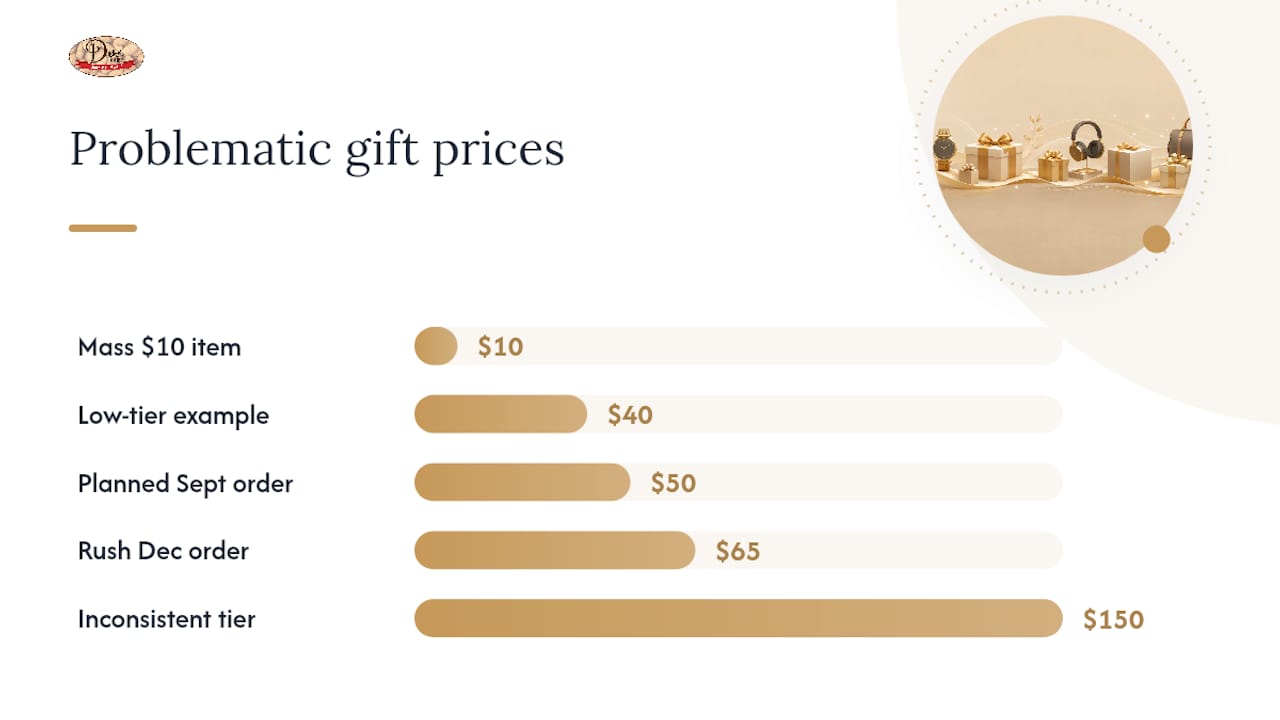
- Mixing tiers inconsistently: Sending a $150 gift to one key client and a $40 gift to another of equal value signals that the program is ad hoc, not strategic. Finance will notice, and so will clients.
- Last-minute ordering: Rush fees and limited selection inflate cost per impression more than a modest planned increase in unit price would. A $50 gift ordered in September costs less and arrives better than a $65 gift ordered in December.
- Over-branding: A gift covered in your company logo is a marketing item, not a personal gesture. At the $50+ tier, recipients notice the difference.
- Cash and gift cards for employees: These are always taxable wages under IRS rules, regardless of amount. They also tend to feel impersonal. A thoughtfully chosen non-cash gift at the same price point creates a better impression and avoids a payroll complication.
- Spreading a small budget too thin: Sending a $10 item to 200 people creates 200 forgettable moments. Sending a $50 item to 40 carefully chosen recipients creates 40 memorable ones.
Red flags that require escalation to finance or legal: any single gift above $500 to a government employee or official, gifts that could be perceived as influencing a procurement decision, and any gift to a foreign official (which may trigger FCPA considerations). When in doubt, set clear approval thresholds so standard gifts proceed without delay and high-value gifts get the review they need.
Pro Tip: Decentralizing gift selection to account managers or team leads — while keeping spend within approved tiers — tends to improve ROI because those individuals know what the recipient actually values.
Why handcrafted gourmet candy works for corporate gifting
Food gifts occupy a unique position in the gifting tier framework: they are consumable (no clutter), broadly inclusive (easy to share), and carry an inherent story when they come from a named, small-batch maker. That combination is hard to replicate with branded merchandise.
Dudley’s Toffee maps cleanly to the tier framework across multiple SKUs:
- Under $50 (Thank-You / Employee tier): Dark Chocolate English Toffee (6oz) and Milk Chocolate English Almond Toffee (6oz) — single-bag gifts with premium presentation, gluten-free, no high fructose corn syrup, handcrafted in Indiana.
- Standard Client tier: Milk Chocolate English Toffee | 6oz Bags | Case of 24 — a case buy that works for team gifting or a client office with predictable per-unit cost.
- Fundraiser / Volume programs: Milk Chocolate English Toffee (6oz) - FUNDRAISER and Dark Chocolate English Toffee (6oz) - FUNDRAISER — volume SKUs suited to large gifting programs or nonprofit partnerships.
- Milk or Dark choice: Dudley’s English Almond Toffee 6oz Milk or Dark Chocolate — the canonical product page with full ingredient and variant details.
Practical procurement notes for perishable food gifts:
- Shelf life on Dudley’s toffee is generous, giving scheduling flexibility for holiday programs.
- Cold-pack shipping is available for warmer months or longer transit routes.
- Bulk and wholesale orders are available; confirm lead times with the team for orders above standard quantities.
- Gluten-free and no-HFCS attributes simplify dietary screening across large recipient lists.
Pro Tip: For employee gift programs, a food gift that recipients can share with family at home extends the impression beyond the office — a detail worth mentioning in your finance justification.
What we believe about gifting at Dudley’s Toffee
At Dudley’s Toffee, we make every batch by hand in Indiana because we believe the care that goes into a gift is part of the gift itself. When a recipient opens a bag of our toffee and reads that it was handcrafted in small batches with premium ingredients, no high fructose corn syrup, and real milk or dark chocolate, that detail lands differently than a generic branded item ever could.
The gifting programs that create lasting impressions are the ones built on intention, not budget size. A $35 handcrafted food gift from a named maker, paired with a personal note, often outperforms a $100 logo-branded item that could have come from anywhere. That is not a philosophical position — it is what recipients consistently remember and mention.
Dudley’s Toffee for your corporate gifting program
Handcrafted in small batches in Indiana, Dudley’s Toffee gives procurement teams a food gift that recipients actually remember. Every bag is gluten-free, made without high fructose corn syrup, and available in milk or dark chocolate — which means it clears most dietary screening lists without a separate inquiry.
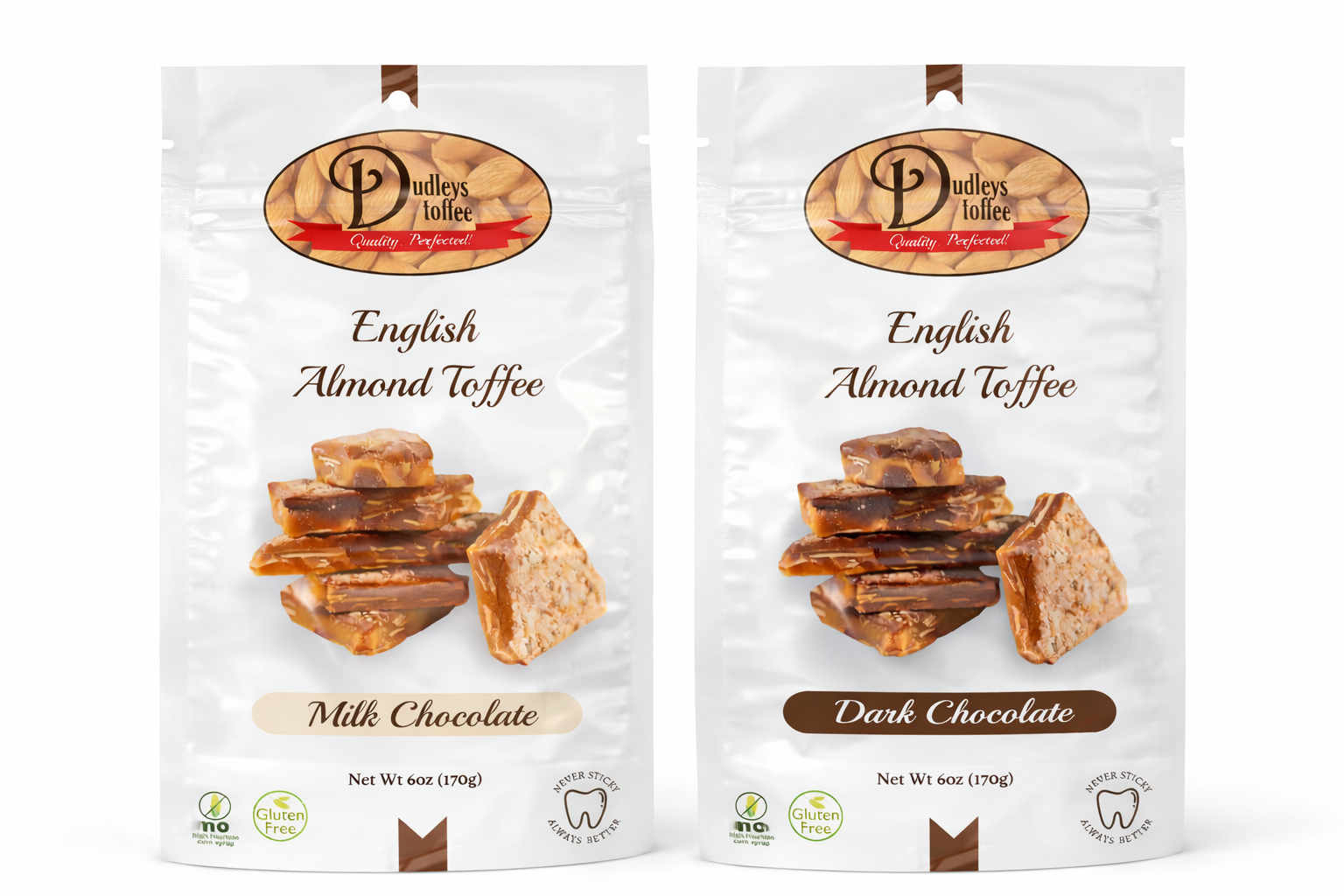
For the under-$50 tier, single bags of Milk Chocolate English Almond Toffee (6oz) or Dark Chocolate English Toffee (6oz) ship nationwide with premium presentation. For volume programs, the Milk Chocolate English Toffee | 6oz Bags | Case of 24 delivers predictable per-unit costs for bulk orders. Wholesale and fundraiser SKUs are available for larger programs. Visit the wholesale page or reach out directly to discuss lead times and volume pricing for your gifting program.
Sources
- How Much to Spend on Corporate Gifts ($25–$150/Person) - Monsuri
- Dlish
- Corporate gift budget: the guide for SMEs | Material Marketing
- Corporate Gifts Budget: How to Plan and Save - Successories
This article is general information, not a substitute for advice from a qualified financial advisor. Consult a qualified financial professional about your own circumstances before acting on anything here.
FAQ
How do you budget for corporate gifts?
Lock the budget before October for holiday programs.
How much do companies typically spend on corporate gifting?
Most U.S. programs work within $20–$50 per employee and $50–$150 per client, with VIP and executive gifts often reaching $250–$500 or more, according to 2026 industry benchmarks.
What are some budget-friendly corporate gifts?
Handcrafted food items, specialty coffee or tea sets, and premium single-item gifts from named makers all deliver strong impressions under $50. Dudley’s Toffee 6oz bags of Milk Chocolate English Almond Toffee are a practical example: gluten-free, small-batch, and memorable without exceeding a modest per-recipient budget.
What is a good team gift on a $50-per-person budget?
A shareable food gift, such as a case of handcrafted toffee or a curated snack box, works well at this level. A single quality item from a named maker tends to create more goodwill than a bundle of lower-cost branded pieces at the same total spend.
Are corporate gifts tax deductible?
The IRS caps the business gift deduction at $25 per recipient per year. You may spend more, but only the first $25 is deductible. Employee cash gifts and gift cards are always taxable wages. Confirm current rules with a qualified tax advisor before filing.
Recommended
Share