

Net Proceeds, Not Percentages: Fundraising Margins for Organizers
Fundraising profit margin is the share of money your campaign keeps after expenses, calculated as net proceeds divided by gross receipts, times 100. Most product-based school and nonprofit fundraisers land between 30% and 50%, while no-inventory formats like scratch cards or ship-to-buyer online stores can reach 70% to 90%. Events often post lower margins but still raise more total dollars because ticket prices and sponsorships scale differently. Whatever the format, the IRS expects that surplus to go back into your mission, not into anyone’s pocket.
TL;DR:
- No-inventory formats like scratch cards can reach margins of 70% to 90%, making them highly profitable compared to product sales that typically yield 30% to 50%.
- Online ship-to-buyer stores and discount cards often maintain higher margins by eliminating handling and storage costs, with online stores averaging 40% to 60%.
- Accurate margin calculations must include all direct costs, such as shipping, refunds, and platform fees, rather than relying solely on gross receipts.
- Volunteer hours and participation rates significantly impact net proceeds per hour, often more than the headline margin percentage.
- Keeping fundraising expenses below about 35% of contributions aligns with IRS guidelines for nonprofit efficiency, but sometimes lower-margin activities build long-term relationships.
Table of Contents
- How Do You Calculate Fundraising Profit Margin?
- Which Fundraiser Types Have the Best Margins?
- What Actually Drives Your Margin Up or Down?
- What Margin Range Keeps You in Good Standing?
- How Can You Actually Improve Your Numbers?
- Where Does Toffee Fit Into a Candy Fundraiser?
- Do Fundraising Platforms Change Your Margin?
- What Mistakes Skew Margin Calculations?
- What Do Real Margin Improvements Look Like?
- How Do You Set a Realistic Margin Goal?
- Net Proceeds Over Bragging Rights
- Ready to Run a Toffee Fundraiser?
- Sources
- FAQ
How Do You Calculate Fundraising Profit Margin?
Start with gross receipts: every dollar that comes in from sales, ticket purchases, or donations. Then subtract every direct cost tied to generating that revenue.
- Add up gross receipts. Total sales, registration fees, and sponsorship dollars before any deductions.
- List direct costs. Product cost, shipping, fulfillment, ticketing or payment processing fees, permits, and refunds all count.
- Subtract to get net proceeds. Gross receipts minus direct costs equals what your organization actually keeps.
- Divide and multiply by 100. Net proceeds ÷ gross receipts × 100 gives your profit margin.
Here’s the math in action. A candy sale brings in a certain amount in gross receipts. After subtracting product cost and shipping, it leaves a net proceeds margin of about half. A ticketed gala, by comparison, might gross substantially more but also spend a large portion on venue, catering, and staff, resulting in a lower margin yet higher net proceeds.
One more number worth tracking: net proceeds per volunteer hour. A campaign that nets $2,200 with 40 volunteer hours ($55/hour) may be a smarter use of your team than one netting $3,000 over 100 hours ($30/hour).
Which Fundraiser Types Have the Best Margins?
Margin ranges vary widely by format, and the right choice depends on your group’s size, volunteer capacity, and timeline. Here’s how the major categories typically shake out:
- Product sales (candy, cookie dough, wrapping paper): Roughly 30% to 50%, since inventory, packaging, and distribution eat into the top line.
- Discount and scratch cards: Often 70% to 90% because there’s no product to buy, store, or ship, just printing and a small vendor fee.
- Online, ship-to-buyer stores: Frequently 40% to 60%, with the vendor handling fulfillment so your group avoids handling and storage costs.
- Events (walks, galas, tournaments): Commonly 25% to 40% due to venue, permit, and staffing costs, though total dollars raised can dwarf smaller campaigns.
- Direct appeals (letter or email campaigns asking for cash donations): Can exceed 90% since there’s no product or event overhead at all.
Scale and participation matter as much as the percentage. Also, be skeptical of margins a vendor advertises. Those figures rarely include your actual shipping costs, return rates, or realistic participation, so run your own forecast before committing.
What Actually Drives Your Margin Up or Down?
Margin isn’t fixed once you pick a fundraiser type. Several levers inside your campaign push it higher or lower, often more than the format itself.
- Participation rate. Ten enthusiastic sellers moving 20 units each will always outperform fifty sellers who each sell two.
- Inventory and storage. Every case sitting in someone’s garage or a school hallway adds handling risk and hidden labor cost. Ship-to-buyer models sidestep this entirely.
- Payment and platform fees. Credit card processing, ticketing platform cuts, and online store fees typically run 2% to 5% and belong in every forecast.
- Refunds and returns. Build an estimated return rate into your projected net proceeds instead of assuming zero.
- Volunteer hours. A high-margin campaign that consumes 150 volunteer hours might net less per hour than a lower-margin option that runs itself.
Pro Tip: Before you commit to a fundraiser, calculate net proceeds per volunteer hour for your top two options. The one with the higher hourly rate is usually the better fit, even if its headline margin looks smaller.
What Margin Range Keeps You in Good Standing?
Charity oversight groups and IRS guidance generally point to keeping fundraising expenses, the cost to raise a dollar, below roughly 35% of total contributions.
The 35% Benchmark: Keeping fundraising expenses under about 35% of contributions is a widely used marker of an efficient, donor-friendly campaign, according to guidance the IRS references for nonprofit reporting.
Surplus from any fundraiser has to flow back into your organization’s mission. The IRS is explicit that no part of a 501©(3)'s net earnings may inure to private individuals, which is why boards and treasurers track fundraising, program, and management expenses separately on Form 990. Sometimes a lower margin is the right call anyway. Community events, donor-appreciation dinners, and major-donor cultivation often run at a deliberate loss because they build relationships that pay off in future giving, not in this quarter’s ledger.
How Can You Actually Improve Your Numbers?
Before you launch anything, build three quick scenarios: conservative, expected, and strong. Compare net proceeds across all three rather than fixating on one advertised percentage.
- Shift toward no-inventory formats. Ship-to-buyer online stores and discount cards remove storage and handling costs entirely.
- Bundle products. Pairing a $12 item with a $6 add-on raises average order value without adding much fulfillment complexity.
- Secure a sponsor. A local business covering your venue or printing costs turns a 30% margin campaign into something closer to 50%.
- Negotiate wholesale pricing. Ordering by the case instead of individually almost always drops your per-unit cost.
- Centralize order collection. One spreadsheet or online form beats a stack of paper order sheets that get lost or double-entered.
Pro Tip: Run a five-minute kickoff meeting with sellers before launch. Groups that set a clear per-seller target see participation rates climb, and participation is the single biggest lever on your final net proceeds.
Digital-forward groups also benefit from basic marketing discipline. A nonprofit digital marketing checklist built for outreach campaigns applies just as well to a candy sale promoted through email and social media as it does to a full donor campaign.
Where Does Toffee Fit Into a Candy Fundraiser?
Handcrafted candy sells itself at a fundraiser table because it’s giftable, familiar, and easy to explain to a buyer in thirty seconds. Dudley’s Toffee is family-owned in Indiana, and every batch is handcrafted in small runs using a softer, buttery recipe that’s gluten-free and made without high fructose corn syrup.
- Milk Chocolate English Toffee (6oz) - FUNDRAISER and Dark Chocolate English Toffee (6oz) - FUNDRAISER are built specifically for organizer campaigns.
- Milk Chocolate English Almond Toffee (6oz) and Dark Chocolate English Toffee (6oz) work as standalone retail bags for smaller sales.
- Case orders come as Milk Chocolate English Toffee, Case of 24 or Dark Chocolate English Toffee, Case of 24, plus a combined Milk or Dark Chocolate 6oz option for mixed orders.
Plug your per-case cost against your planned retail price on the fundraising page to see where your margin lands before you order.
Do Fundraising Platforms Change Your Margin?
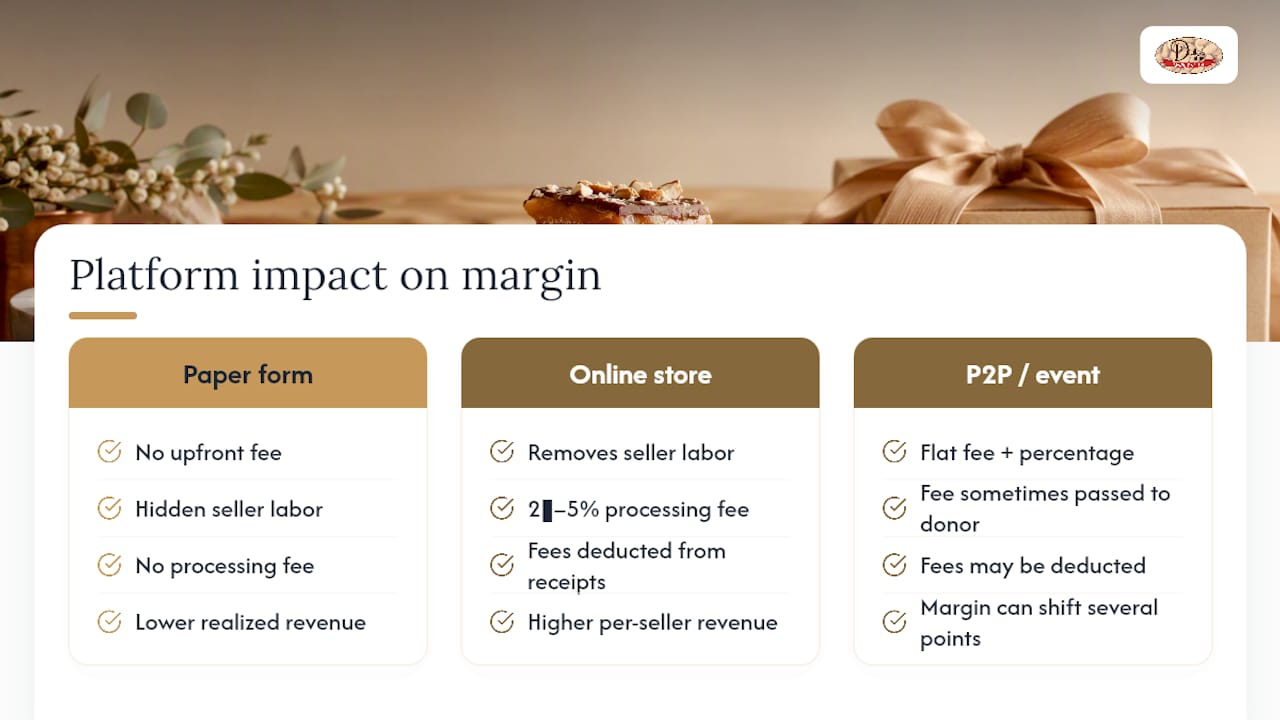
The platform you choose to sell, collect, or ship through changes your margin more than most organizers expect. A basic paper order form costs nothing upfront but creates hidden labor: someone has to tally orders, chase down payments, and hand-deliver product, and that time never shows up in a spreadsheet.
Online storefronts that ship directly to the buyer remove that labor entirely, and per-seller revenue tends to rise once buyers can order from anywhere instead of waiting for a seller to catch them in person. The tradeoff is a processing fee, usually 2% to 5%, that has to come out of gross receipts before you calculate net proceeds.
Peer-to-peer fundraising platforms and event registration tools carry their own fee structures, often a flat fee plus a percentage per transaction. Some platforms pass that fee to the donor as an optional tip; others deduct it automatically. That distinction alone can shift your realized margin by several percentage points, so read the fee schedule before you commit, not after your campaign closes.
Payment method matters too. Cash and check avoid processing fees but create reconciliation headaches and a slower path to your bank account. Some organizations are exploring alternative payment rails, including accepting cryptocurrency donations, though the fee and volatility tradeoffs there deserve their own careful look before adoption. Whatever combination you choose, add every platform fee into your forecast worksheet rather than discovering it after the deposit hits your account.
What Mistakes Skew Margin Calculations?
The most common error is calculating margin from gross receipts alone, ignoring the shipping, packaging, and processing fees that quietly eat into net proceeds.
Another frequent mistake: treating volunteer labor as free. It isn’t invisible to your organization’s capacity, even if it doesn’t appear as a cash expense. A fundraiser that nets $3,000 but requires 200 volunteer hours may be a worse deal than one netting $2,200 with 40 hours, even though the raw dollar figure looks better on paper.
Organizers also tend to compare vendor-advertised margins across different fundraiser types as if they were apples to apples.
Refunds and unsold inventory get overlooked too. A box of unsold candy bars sitting in a closet after the sale ends represents a cost that should have been subtracted from projected net proceeds, not treated as a rounding error. Finally, watch for double-counting: some groups tally sponsor dollars as both event revenue and separate donations, inflating gross receipts and making the margin look stronger than reality. Build your worksheet once, define each category clearly, and stick to it every time you run the numbers.
What Do Real Margin Improvements Look Like?
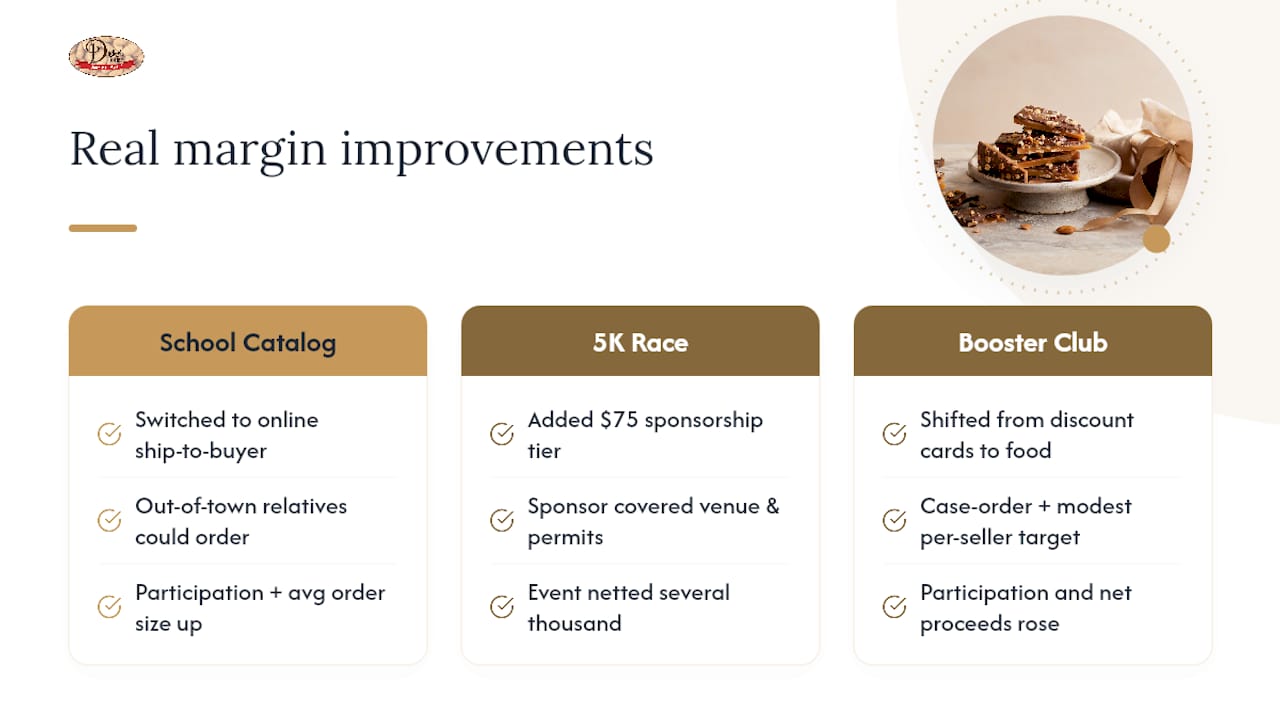
Switching to an online, ship-to-buyer catalog the following year removed the school’s distribution burden entirely, and per-seller revenue rose because out-of-town relatives could order without a paper form changing hands. Net proceeds climbed even though the headline margin only moved a few points, because participation and average order size both increased.
A small nonprofit running an annual 5K had been quietly losing money on venue and permit costs relative to registration fees. Adding a $75 sponsorship tier that covered the venue rental turned a break-even event into one netting several thousand dollars, without raising a single registration price. The lesson: sometimes the fix isn’t the fundraiser itself, it’s finding someone else to underwrite the fixed costs.
A youth sports booster club that had relied on discount cards for a decade eventually diversified into a food fundraiser, choosing familiar, giftable products that families would buy without much persuasion. Combining a case-order model with a modest per-seller target and a short kickoff meeting lifted both participation and net proceeds, echoing what most groups find: familiar food items sell easily precisely because buyers don’t need convincing.
How Do You Set a Realistic Margin Goal?
Your target margin should reflect your organization’s size, mission stage, and volunteer bandwidth, not an industry average pulled from a vendor’s sales pitch.
A brand-new grassroots group, by contrast, may need a year or two of lower-margin, relationship-building events before their systems and donor base can support that benchmark.
Mission stage matters just as much as size. An organization focused on donor acquisition might accept a lower-margin community event because it’s building a pipeline of future major donors, while an organization focused on immediate program funding should prioritize formats with strong net proceeds per volunteer hour. Set your goal in writing before the campaign starts, then reconcile forecasted versus actual results afterward. That comparison, more than any single benchmark, tells you whether your goal was realistic in the first place.
Net Proceeds Over Bragging Rights
The industry loves a big margin number, but a big margin on a tiny campaign still nets a tiny check. Compare your options on net proceeds, volunteer load, and donor-growth potential together, not on which percentage sounds most impressive at the board meeting. If you can, pilot two approaches in parallel, a product sale and an online store, and reconcile forecasted numbers against what actually landed in the account. That habit, more than any single format choice, is what separates fundraisers that improve year over year from ones that just repeat the same result on faith.
— Dudley’s Toffee
Ready to Run a Toffee Fundraiser?
Handcrafted English almond toffee gives your group a premium, giftable product that sells itself at a table, a school event, or a church bake sale, without the allergy concerns that come with many baked goods. Dudley’s Toffee is gluten-free and made without high fructose corn syrup, handcrafted in small batches in Indiana, so every seller has a genuine quality story to tell buyers instead of just another candy bar pitch.
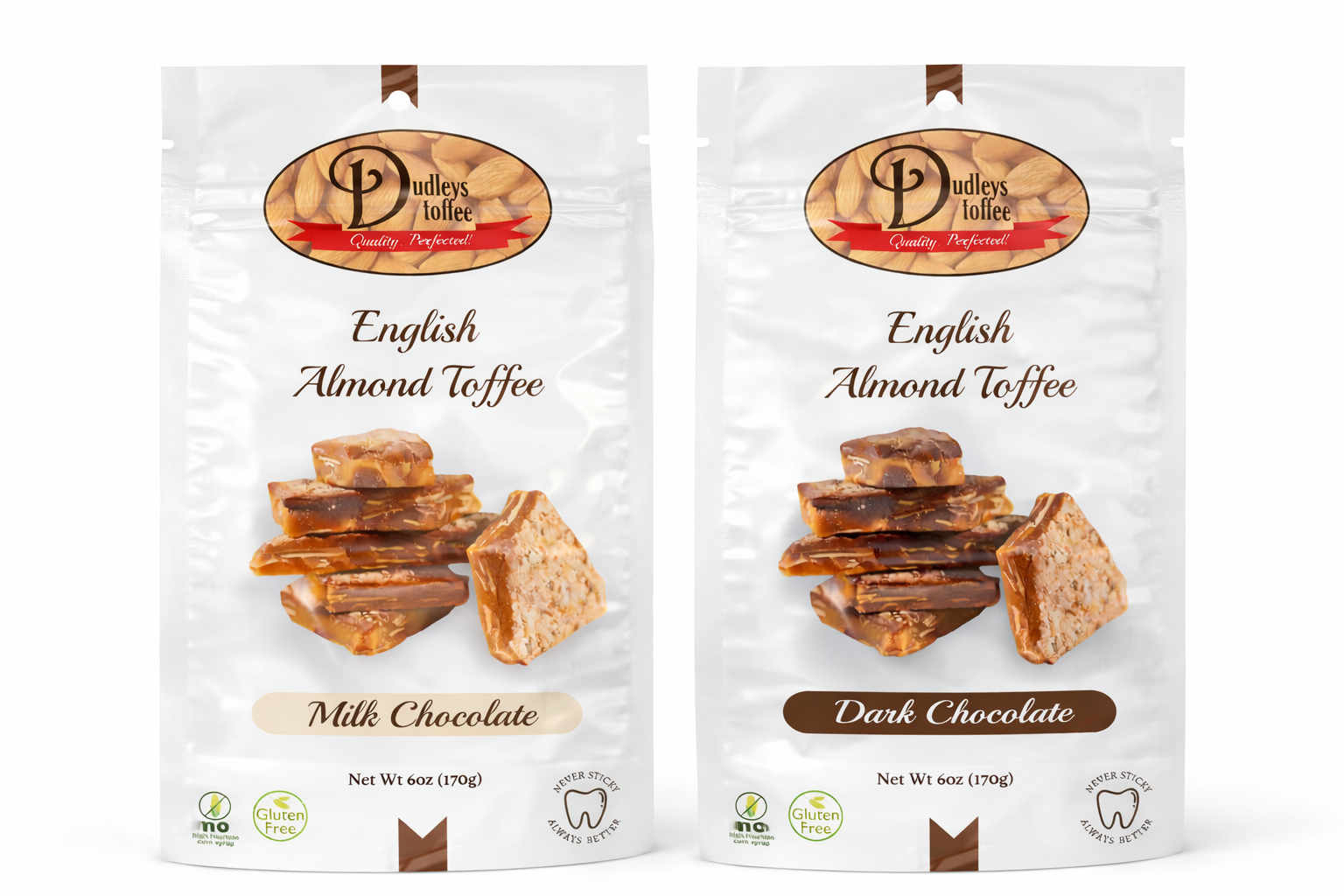
Getting started is simple. Browse the Milk Chocolate English Toffee fundraiser page or its dark chocolate counterpart to see case pricing, then plug that cost against your planned retail price in the margin worksheet from this article. Larger groups planning bulk case orders should check wholesale terms before finalizing numbers. Once your forecast looks solid, place your order and give your sellers a product people are genuinely excited to buy.
Sources
FAQ
How much will an online fundraising platform take from a large campaign?
Fees vary by platform and typically run 2% to 5% per transaction plus payment processing costs, so fees can reduce your net proceeds significantly. Always check the exact fee schedule and build it into your forecast rather than assuming a flat rate.
How many fundraising staff does it take to raise $1 million?
There’s no fixed formula since it depends heavily on donor base, campaign type, and staff experience, but larger capital campaigns commonly involve a small team of dedicated development staff rather than a single volunteer coordinator, which is one reason larger nonprofits can sustain lower expense ratios than small grassroots groups.